
Lithium-Ion Battery Recycling 2027: Cathode Recovery, Black Mass, and the Urban Mining Opportunity
Li-Cycle burned through $1 billion and went bankrupt. Glencore bought the wreckage for $40 million. The urban mining goldmine isn't what it seems.

The 2027 EV Battery Recycling Goldmine: Lithium-Ion Cathode Recovery and Urban Mining
1. Summary
The lithium-ion battery (LIB) recycling industry stands at a strategic inflection point. After a decade of speculative capacity announcements, the sector is now confronting a compressed window in which technology, regulation, geopolitics, and feedstock economics are converging to determine which firms, technologies, and jurisdictions will capture the value of "urban mining", a term to describe the systematic recovery of cobalt, nickel, lithium, manganese, copper, and graphite from end of-life (EOL) batteries and manufacturing scrap. The year 2027 is pivotal: it marks the threshold at which the U.S. Inflation Reduction Act (IRA) requires 80% of critical mineral value in qualifying EV batteries to be sourced from domestic, free-trade-partner, or North American recycled origins [1]; the year by which the EU mandates 90% recovery rates for cobalt, copper, and nickel under Regulation (EU) 2023/1542 [2]; and the year in which the EU's digital battery passport becomes mandatory for industrial, EV, and light-means-of-transport (LMT) batteries above 2 kWh [3].
This report finds that the structural opportunity is large, but the near-term economics are punishing. Global EV battery demand is projected to reach approximately 4,700 GWh by 2030 and grow more than seven-fold from 2023 levels by 2035 [4][5]. Yet in 2025, global end-of-life LIB volumes amount to only about 900 kilotons, with EOL EV batteries not yet a dominant feedstock [6]. Announced global recycling capacity already exceeds three times the supply of recyclable batteries available in 2030 [5], implying severe near-term overcapacity, downward pressure on processing margins, and an inevitable shakeout. The Li-Cycle bankruptcy of May 2025, with Glencore acquiring its assets for a $40 million stalking-horse bid against a Rochester hub project that consumed nearly $1 billion in cumulative spend, exemplifies the financial fragility of first-movers operating ahead of feedstock arrival [7][8].
China dominates every commercial dimension. Chinese firms (led by CATL's Brunp subsidiary and GEM Co.) control roughly 75% of global black mass refining capacity and process approximately 60% of global lithium and cobalt and over 90% of refined graphite [9][10][11]. Brunp's Directional Recycling Technology reportedly achieves 99.6% recovery of nickel, cobalt, and manganese and 96.5% recovery of lithium at industrial scale [12]. China's recent reclassification of black mass as a non-waste, contemporaneous with the EU's June 2025 designation of black mass as hazardous waste [13], crystallizes a strategic divergence: Beijing aims to import the world's secondary feedstock; Brussels and Washington intend to retain it.
Three findings structure the analytical thesis of this report. First, lithium recovery, historically the weakest link in pyrometallurgical recycling, where lithium routinely reports to slag, has advanced to 70–95% at industrial scale through hydrometallurgical and integrated pyro-hydro processes, but direct cathode recycling, the lowest-cost pathway, remains in pilot-to-early commercial status [14][15]. Second, the economics of urban mining are highly chemistry dependent: NMC and NCA cathodes remain profitably recyclable at virtually any market condition because of their cobalt and nickel content, while lithium iron phosphate (LFP), projected to capture 59% of EV battery market share by 2030 [16], generates per-kilogram economics that are marginal to negative under current lithium prices, which collapsed roughly 80% from their 2022 peak [17]. Third, Western policy ambitions to localize recycling cannot be met by recycling alone in the relevant horizon; under high-uptake scenarios, secondary supply from batteries is projected to meet only about 20% of global lithium and nickel demand by 2050, with the European share approaching 30% [18].
The strategic implication for investors and policymakers is that the 2025–2030 window is one of capital discipline, technology selection, and regulatory positioning rather than indiscriminate scale-up. The decade after 2030; when EV battery retirements grow rapidly as the first mass market cohorts reach end of vehicle life, is when the sector's terminal economics will materialize. Firms and governments that survive the intervening valley will position themselves to capture an increasingly captive, increasingly profitable feedstock stream within a regulated circular economy.
 John D
2. Contextual Background and Scope Definition
2.1 The EV Battery End-of-Life Wave
The volume of LIBs reaching end of life is governed by two interacting curves: the historical placement of batteries on the market and the distribution of useful-life durations across automotive, stationary storage, and consumer applications. The United Nations Development Programme, drawing on Circular Energy Storage data, projects that global end-of-life LIB volume will rise from approximately 900 kilotons in 2025 to approximately 20,500 kilotons by 2040, with EVs representing the dominant retirement source after 2035 [6]. The International Energy Agency (IEA) corroborates that EOL EV and stationary storage batteries will become the principal recycling feedstock only after 2035, when they will represent over 90% of available stock by 2050 [5]. Circular Energy Storage's own forecasting indicates that the global volume of LIBs available for recycling or reuse will grow from 23.3 GWh in 2023 to 376.1 GWh in 2035, with light EVs rising from 12.3% to 50.2% of the EOL mix over that period [19].
Disaggregation by region reveals stark asymmetries. China leads global EV deployment and battery production, and the Shanghai Metals Market predicts that the upper limit of retired Chinese power battery volume in 2025 will reach 357 GWh and exceed 1,100 GWh by 2030 [20]. The U.S. Department of Energy estimates that 11.3 GWh of batteries reached end of life in the United States in 2022, projected to rise to as much as 138 GWh by 2030 under accelerated EV adoption pathways [21]. EV battery retirements in the United States are expected to exceed half a million units annually by 2030, each weighing approximately 454 kg [21]. Europe's trajectory is intermediate: under the EU's Announced Pledges Scenario, the bloc requires substantial collection-rate uplift to comply with its own recycled-content mandates by 2031 [22].
Importantly, in the near term, manufacturing scrap, not retired EV batteries, will dominate recycler feedstock. The IEA estimates that production scrap will account for roughly half of recycler input in 2030, while retired EVs will contribute only about 20% [5]; scrap rates from gigafactories range from approximately 5% at best-in-class producers to 30% or more during ramp-up [23].
2.2 What Is Urban Mining and Why Does It Matter Here
"Urban mining" denotes the systematic recovery of metallurgical value from anthropogenic stocks; the buildings, vehicles, electronics, and infrastructure already in service or reaching end of life, rather than from geological deposits. Applied to Lithium-ion batteries, urban mining encompasses the collection, discharge, mechanical pre-processing, metallurgical refinement, and re-introduction of recovered cobalt, nickel, lithium, manganese, copper, aluminum, and graphite into new battery cathode active materials (CAM) and precursor materials (pCAM). It is structurally distinct from primary extraction in three respects: feedstock concentration of target metals is one to two orders of magnitude higher than typical ore grades; the value chain begins with reverse logistics rather than exploration; and environmental impacts are dominated by electricity consumption and chemical reagent use rather than overburden disturbance and tailings management [24].
Cathode chemistry determines commercial recovery value. Nickel-manganese-cobalt (NMC) variants (NMC111, NMC532, NMC622, NMC811) account for roughly 40–50% of Lithium-ion batteries in service as of 2024 and contain by mass 2–16% nickel, 7–24% manganese, 2–7.5% cobalt, and 2.2–15% copper [25]. Nickel-cobalt-aluminum (NCA) cathodes, used predominantly in Tesla and other high-performance applications, offer comparable recovery economics. Nickel-manganese cobalt-aluminum (NMCA) and lithium-manganese-rich variants (LMR-NMC) extend this family with marginally lower cobalt loadings [26]. LFP, by contrast, contains no nickel or cobalt, leaving lithium, iron, and phosphorus as the only recoverable elements, and current recycling profits per kilogram are an order of magnitude lower [27][28]. The overall analytical point is that the unit economics of urban mining are not chemistry-neutral, and the LFP share of global EV deployment, projected by Transport & Environment to reach 59% of the EV market by 2030 [16], represents a structural challenge to recycler profitability that policy and technology must collectively address.
2.3 Scope and Definitional Boundaries
This report addresses the recycling of lithium-ion batteries from electric passenger vehicles, light-commercial vehicles, and light means of transport, with particular emphasis on cathode active material recovery. It treats stationary battery energy storage systems (BESS) as a contributing but not central feedstock. Lead-acid batteries, despite their mature 99% recycling rate in the United States and globally [29], are out of scope. Second-life applications, such as repurposing automotive batteries for stationary use, are addressed only insofar as they affect the timing and chemistry of feedstock arrival to recyclers. The geographic frame is global, with regulatory analysis concentrated on the EU, United States, China, Japan, South Korea, Canada, and Australia. Time horizons are 2026-2027 (near-term), 2028-2032 (medium-term), and 2033-2040 (long-term).
3. Key Players and Stakeholder Landscape
3.1 Established Battery Recyclers
The first generation of dedicated LIB recyclers emerged from a mix of legacy precious-metals refiners, mining-and-trading conglomerates, and Silicon Valley-style scale-up ventures. Umicore of Belgium operates the longest-running commercial Li-ion battery recycler at Hoboken, originally inaugurated in 2011 with a 7,000-tonne annual capacity equivalent to 35,000 EV battery packs, using its proprietary Ultra High Temperature pyrometallurgical smelting integrated with downstream hydrometallurgical refining [30][31]. The firm announced in 2022 a planned €525 million European recycling facility scaled to 150,000 tonnes per year to come online in 2026, accompanied by Hoboken throughput expansion from 350,000 to 500,000 tonnes per year for combined battery and industrial-residue feedstocks [32][33]. Umicore claims recovery rates exceeding 95% for nickel, cobalt, and copper and over 70% for lithium, exceptionally high by the standards of conventional pyrometallurgy [34].
Matt Blois
Redwood Materials, the Reno-based company founded by former Tesla CTO J.B. Straubel, has positioned itself as the integrated North American leader. It received a conditional $2 billion U.S. Department of Energy loan commitment in 2023 from the Advanced Technology Vehicle Manufacturing program and has raised more than $2 billion in private equity since [35][36]. Redwood operates a low-temperature reductive calcination process followed by hydrometallurgical refinement, claiming 95% recovery of lithium and roughly 95% of nickel, cobalt, and copper; as of June 2025, the firm operated at a run rate of 20 GWh of battery materials, with a build target of 100 GWh annually of cathode active material and copper foil [37][38].
Li-Cycle Holdings, the Toronto-based firm whose hub-and-spoke model concentrated mechanical pre-processing at distributed "spokes" feeding a central "hub" for hydrometallurgical refinement, became the most cautionary tale of the sector. After receiving a $475 million U.S.DOE loan commitment in November 2024 and entering construction of its $700 million Rochester, New York hub, the company paused construction in October 2023 amid cost overruns, filed for creditor protection in Canada and Chapter 15 bankruptcy in the United States in May 2025, and was acquired by Glencore (its largest secured creditor) effective August 2025 for a $40 million stalking-horse bid against assets totaling $861.2 million [7][8]. The episode underscores the capital-execution risks of building hub-scale capacity ahead of feedstock arrival.
Retriev Technologies, one of the oldest North American Li-ion recyclers, and Fortum, the Finnish utility-derived recycler operating an integrated mechanical-and-hydrometallurgical f lowsheet jointly with Hydrovolt's Norwegian pre-processing facility, represent the European mid-tier [39]. Glencore, prior to its Li-Cycle acquisition, had served primarily as a commodity off taker and integrator of recycled metals into refined cobalt, nickel, and copper products.
Fortum
3.2 Automotive OEMs and Battery Manufacturers
Vertical integration is accelerating. Mercedes-Benz China, GEM Co., CATL, and Brunp Recycling signed a memorandum of cooperation in 2023 for closed-loop recovery in which retired Mercedes packs are processed by GEM and Brunp and the recovered nickel, cobalt, manganese, and lithium are reintroduced into CATL's supply chain for new Mercedes batteries [40]. General Motors and LG Energy Solution, through their Ultium Cells joint venture, partnered with Li-Cycle to recycle up to 100% of manufacturing scrap from the Lordstown, Ohio gigafactory [41]. LG Energy Solution has separately formed joint ventures with France's Derichebourg in Europe and Toyota Tsusho in the United States; SK Ecoplant is expanding a 25,000-tonne black mass facility in the Netherlands; and Posco-GS Eco Materials acquired full ownership of Posco HY Clean Metal in April 2024 by buying out the 35% stake of China's Huayou Cobalt [42][43]. BYD has built a network of 51 NEV battery recycling service outlets in China [44]. Toyota entered a 2024 Cooperative Research and Development Agreement with Argonne National Laboratory's ReCell Center to evaluate direct recycling at industrial scale [45]. The pattern is unambiguous: every major automaker now treats end-of-life material flows as part of its strategic supply chain.
3.3 Government and Multilateral Institutions
The EU's Regulation (EU) 2023/1542, which entered into force on 17 August 2023 and replaced the 2006 Battery Directive, is the most ambitious regulatory framework worldwide, addressed in detail in Section 6.1. The U.S. Department of Energy has deployed multiple instruments: the ReCell Center, a $5-million-per-year national laboratory consortium led by Argonne and focused on direct cathode recycling [46]; the Lithium-Ion Battery Recycling Prize, which awarded $5.5 million across three phases (2019–2022) and is being continued under the Bipartisan Infrastructure Law (BIL) with $7.4 million in additional funding [47][48]; the BIL's allocation of more than $3 billion to prioritize EV battery recycling, alongside the IRA's expansion of the Section 1703 loan-guarantee authority by approximately $100 billion to support critical-minerals processing, manufacturing, and recycling [49]. The DOE announced in 2025 nearly $1 billion in new funding to advance critical minerals and materials supply chains, of which up to $500 million is earmarked for processing and battery recycling [50].
China's framework, addressed in Section 6.3, is anchored in mandatory producer responsibility. Japan's Ministry of Economy, Trade and Industry (METI) designates 35 critical minerals and operates JOGMEC (the Japan Organization for Metals and Energy Security) as the principal agency for stockpiling, refining, and recycling support [51]; from April 2026, METI will mandate collection and recycling for mobile batteries, smartphones, and heated tobacco devices [52]. South Korea's national battery strategy, anchored in the Big-3 manufacturers (LG Energy Solution, SK Innovation, Samsung SDI) and SungEel HiTech, prioritizes hydrometallurgical scaling at home and in Europe [53]. The G7 Critical Minerals Action Plan, launched at the June 2025 Kananaskis Summit and endorsed by Australia, India, and South Korea, commits members to coordinate on processing, recycling, substitution, and circular-economy R&D [54].
3.4 Institutional Investors and Financial Intermediaries
Capital formation has been driven by a mix of public loan-guarantee programs, sovereign infrastructure funds, and private growth equity. BloombergNEF reported that venture-capital investment in U.S. lithium-ion battery recycling reached approximately $1.5 billion in 2023 [55]. The European Investment Bank pledged in March 2025 to double its critical-raw-materials f inancing, including approximately €2 billion in 2025 alone, with the goal of meeting 25% of EU demand through recycling by 2030 [56]. Risk profiles are heterogeneous: established refiners with existing metallurgical infrastructure (Umicore, Glencore) operate with cost-of-capital and execution-risk profiles closer to traditional metals firms, while pure-play scale-up ventures (Li Cycle, Redwood, Ascend Elements, Green Li-ion) have exhibited equity-style return profiles with correspondingly steep failure modes. The Li-Cycle bankruptcy, in which the DOE's $475 million loan remained undrawn because conditional private co-investment never materialized [7], crystallized the structural problem: federal loan conditionality requires private capital that, in a low-feedstock environment with collapsing battery-metals prices, has become unwilling to bridge the valley.
3.5 Emerging and Disruptive Entrants
A distinct generation of startups is targeting the cathode-precursor margin pool. Ascend Elements, founded in 2015, developed a "hydro-to-cathode" process that isolates and reconditions cathode active material directly from shredded battery feedstock [57]. Green Li-ion of Singapore commercializes modular hydrometallurgical units. American Battery Technology Company and Li Industries were Phase III winners of the DOE Lithium-Ion Battery Recycling Prize alongside Renewance, Smartville, and Titan Advanced Energy Solutions [47]. UK-based Altilium introduced a process in February 2025 specifically targeting LFP recycling [58]. Chemical majors and mining companies are also positioning: Glencore's acquisition of Li-Cycle assets, BASF's cathode-precursor partnerships, and Ganfeng Lithium's integrated recycling and-extraction model represent traditional industrial capital flowing toward urban mining, generally at lower cost of capital than pure-play startups.
4. Technical and Operational Considerations
4.1 Process Technology Overview
Three principal process families dominate commercial and pilot LIB recycling, each with distinct trade-offs
Pyrometallurgy subjects shredded or whole battery feedstock to high-temperature smelting (typically above 1,200°C), reducing organic components to off-gases and producing a metal alloy of cobalt, nickel, copper, and iron alongside a slag containing lithium, manganese, and aluminum [59]. Recovery efficiency for cobalt, nickel, and copper exceeds 95% in best-in-class operations; lithium recovery has historically been near zero unless slag is separately refined, though Umicore reports 70% lithium recovery from flue dust and ash [34]. Energy intensity is high (approximately 10 GJ per tonne of feedstock), and capital intensity is correspondingly substantial; however, pyrometallurgy tolerates mixed and contaminated feedstocks better than alternatives, requires no pre-sorting, and is the most commercially mature route.
Hydrometallurgy begins with shredding to produce "black mass", a powder of cathode and anode active materials, followed by acid leaching, solvent extraction, and precipitation to recover discrete metal salts (cobalt sulfate, nickel sulfate, lithium carbonate or hydroxide, manganese sulfate) [59]. Leaching operates at 60–90°C, consumes substantial reagents (sulfuric acid, hydrogen peroxide, sodium hydroxide), and generates wastewater that must be treated. Recovery rates reach 95% for lithium and cobalt and 97% for nickel in mature commercial f lowsheets [60]. Hydrometallurgy now accounts for roughly 70% of global recycling capacity and is the dominant technology in China, South Korea, and most new Western projects.
Direct recycling preserves the crystalline structure of cathode active materials, mechanically separating black mass from binders and current collectors, then "relithiating" and thermally annealing to restore electrochemical performance, bypassing the elemental dissolution-and resynthesis step that imposes the bulk of cost and energy in pyro and hydro routes [61][62]. Argonne's ReCell Center, established in 2019 with $15 million in DOE funding, leads U.S. R&D in this area [46]. Direct recycling demonstrates the lowest emissions (0.6–8.1 kg CO₂/kg of recovered material), lowest energy consumption (3.5–112.1 MJ/kg), and lowest cost ($0.9 $4.1/kg) across all three approaches [63]. However, direct recycling remains technically constrained by chemistry diversity in the feedstock (each cathode chemistry must be processed separately), by the need to fully restore approximately 20% of lithium lost during cell aging, and by scale: the most advanced industrial demonstrations remain at pilot tonnage [62][64]. Commercial readiness for direct recycling is presently TRL 6–7 versus TRL 9 for both pyro and hydro routes.
4.2 Lithium Recovery
The historical Achilles heel of LIB recycling has been lithium. Lithium reports preferentially to slag in pyrometallurgical processes and is more chemically labile than nickel or cobalt in hydrometallurgical leach circuits. Cobalt and nickel, which are more economically valuable per unit mass and more chemically tractable, captured the early commercial focus, with lithium often discarded or recovered at low purity [65]. Three developments have shifted the technical and economic frontier. First, hydrometallurgical operators (Redwood, SungEel HiTech, Brunp) have demonstrated industrial-scale lithium recovery in the 90–96% range [12][37]. Second, novel pre-extraction approaches, including the EU 2031 EU Battery Regulation target of 80% lithium recovery by 2031, set against a baseline of 50% by 2027, are forcing process innovation [66]. Third, electrochemical processes specific to LFP have emerged: a 2025 study published in Joule by Biswal et al. at Rice University reported a water-and-electricity-only process extracting 94% of lithium at 99% purity from LFP cathodes [67]. The remaining laboratory-to-industrial gap is most acute for direct recycling at automotive scale and for chemistry-blind processes capable of handling the heterogeneous feedstock that real-world EOL streams produce.
4.3 Battery Pack Design and Disassembly Constraints
Design-for-recyclability remains underdeveloped. Today's EV battery packs are typically held together by structural adhesives, screws, welds, and complex thermal-management systems optimized for energy density and crash safety, not for end-of-life dismantling [68]. The EU's mandate, effective 2027, that LMT batteries be replaceable by an independent professional, and the requirement that portable batteries in appliances be removable and replaceable by end users, push design priorities toward modularity [2]. Lawrence Berkeley National Laboratory's experimental Quick-Release™ Binder, which would replace conventional fasteners with reversible adhesives, illustrates the direction of research [69]. Automated disassembly remains a research frontier: most commercial recyclers continue to rely on labor-intensive manual disassembly to module level, often complemented by mechanical shredding from module to black mass. Robotic disassembly, integrated with the EU's mandatory digital battery passport (effective February 2027 for industrial, EV, and LMT batteries above 2 kWh) [3], could enable economic recovery of higher-value components, but the technology remains in pilot deployment with full-scale industrial roll-out anticipated only in the early 2030s.
4.4 Quality and Circularity
The central quality question is whether recycled cathode precursors can match the electrochemical performance of virgin material. Recent peer-reviewed evidence is encouraging. A 2026 Journal of Materials Chemistry A study reported that NMC811 cathodes resynthesized from metal salts recovered from spent black mass achieved battery-grade purity (99.6%) and exhibited comparable composition and crystal structure to commercial reference materials [70]. ReCell Center scientists have demonstrated that recovered cathode material from manufacturing scrap can be used in new cells without performance degradation [46]. A 2025 Stanford University life-cycle analysis published in Nature Communications found that converting mixed-stream LIBs into battery-grade materials reduces environmental impacts by at least 58% relative to mining-based supply chains [71]. Closed-loop feasibility is therefore established at proof-of-concept and early-commercial scale, with the principal remaining barriers being impurity management, chemistry sorting, and the consistency of recovered precursor specifications across diverse feedstock streams.
4.5 Operational Logistics
Reverse logistics, the collection, classification, packaging, transportation, and pre-processing of EOL batteries, represents 30–50% of the recovered-material cost stack in current operations [72]. EOL LIBs are classified as hazardous goods under most national regulations and the United Nations Recommendations on the Transport of Dangerous Goods (UN3480, UN3481), imposing certified packaging, hazmat freight rates, and limited-quantity routing that materially raise cost per kilogram [73]. Damaged or thermally compromised batteries are subject to additional Class 9 dangerous-goods restrictions. The June 2025 entry-into-force of the European Commission's reclassification of black mass as hazardous waste under amended European List of Wastes code 19 14 02 is designed in part to capture intra-EU flows, though the regulation simultaneously permits black mass imports from third countries, an asymmetric trade architecture aimed at building European refining capacity [13]. Average tipping fees for spent LIB disposal historically ranged $18–$105 per tonne, but for high-power EV batteries the total recycling fee currently runs $10–$15 per kilogram (approximately $60–$90 per kWh) before deducting the recovered-metal credit [74]. Studies indicate that economies of scale require approximately 170 tonnes per year of spent LIB throughput as a profitability threshold, and that current U.S. collection rates remain below 15% of the available stream [75][76].
5. Economic and Market Dynamics
5.1 Current and Projected Market Size
Market sizing estimates for global LIB recycling diverge substantially by methodology, definitional scope, and treatment of in-house manufacturing-scrap processing. Fortune Business Insights values the global LIB recycling market at $5.38 billion in 2025, growing to $32.20 billion by 2034 at a 22.24% CAGR [77]. Global Market Insights estimates $5.8 billion in 2025, reaching $37.5 billion by 2035 at 20.6% CAGR [78]. Allied Market Research projects $38.21 billion by 2030 at 36.0% CAGR from a $1.33 billion 2020 base [79]. MarketsandMarkets places the 2024 market at $16.23 billion, expanding to $56.87 billion by 2032 at 17.0% CAGR [80]. The German Council on Foreign Relations (DGAP) anticipates a $52 billion global battery recycling market by 2045 [10]. The variance between these estimates (roughly 4× across the same forecast horizon) reflects methodological divergence on whether to include manufacturing-scrap processing, second-life applications, and downstream cathode-precursor synthesis, as well as different assumptions about battery-metals price recovery. A defensible analytical synthesis is that the global market lies between $30 and $50 billion by 2030–2034, with Asia-Pacific representing roughly 44–90% depending on definitional inclusion of in-country in-house processing [81].
5.2 Economics of Cathode Active Material Recovery
The unit economics of CAM recovery are governed by four variables: feedstock chemistry, metals price level, processing technology, and scale. Reinhart et al. (2023), published in the Journal of Cleaner Production, found that pyrometallurgical recycling cost approximately $5 10/kg, hydrometallurgical $3–8/kg, direct recycling $1–4/kg, and bioleaching $2–5/kg [63]. Recycling profit per kilogram for NMC111 was modeled at 10,603 CNY/kg, falling to 8,242 CNY/kg for NMC811 owing to lower cobalt content [82]. For LFP, a 2025 closed-loop process reported a disposal cost of approximately $2.63/kg against a regenerated LFP value of $4.46/kg, a positive margin only with optimized acid-to-lithium molar ratios near stoichiometric minimum [28]. Because raw materials account for more than half of total LIB cell cost, and because cobalt and nickel are the principal cost contributors among cathode metals [25], recyclers extracting NMC and NCA chemistries can sustain operating margins under most market conditions. Recyclers focused on LFP, by contrast, face structural unprofitability under prevailing lithium prices unless tipping fees, regulatory premiums, or carbon credits supplement metal-recovery revenues.
5.3 Feedstock Economics Problem
The "feedstock paradox" is the defining structural challenge of the recycling industry through 2030. The IEA projects that if all globally announced LIB recycling capacity comes online, total capacity could exceed 1,500 GWh in 2030, approximately 70% of which is in China, with about 10% each in Europe and the United States. Yet total feedstock supply in 2030, including manufacturing scrap and retired batteries, would account for only roughly one-third of announced capacity, implying significant overcapacity [5]. Manufacturing scrap will sustain utilization in the near term: at typical gigafactory scrap rates of 5–10% during steady-state operation and 20–30% during ramp-up, a 2030 global cell-manufacturing footprint of 5,000+ GWh would generate 250–500 GWh-equivalent of scrap annually, well below announced recycling capacity. The mismatch is acute for hub-scale projects whose unit economics depend on consistent high-tonnage throughput. After 2035, the curve inverts as the first mass cohorts of EVs reach end of vehicle life: the first-half-of-2030s shortage transitions to a late-2030s surplus that will reward disciplined investors who maintained dry-powder capacity through the valley.
5.4 Competition with Primary Mining
Recycled materials must compete with primary materials at the point of cathode-precursor input. Cost parity is determined by mineral prices, recovery yields, and the cost of refining. Lithium prices, having surged eightfold during 2021–2022, have fallen by over 80% since 2023, with battery-grade lithium carbonate trading at approximately $9,600/tonne in mid-2025, well below the levels at which marginal recycling projects are profitable [17][83]. Nickel and cobalt fell 10–20% in 2024 [84]. The IEA argues that under an Announced Pledges Scenario, recycling could reduce new mine development needs by 40% for copper and cobalt and by 25% for lithium and nickel by 2050 [85]. However, competitive parity for recycled materials against primary supply during 2025–2030 is contingent on regulatory premia (such as the EU recycled-content mandate creating captive demand) rather than on commodity-price economics alone. Nature Sustainability (2023) cautioned that the market value of recycled minerals may be lower than that of virgin minerals, potentially disincentivizing use even when supply becomes available, an unintended consequence of the IRA's value-based critical-mineral rules [86]. The probable outcome through 2030 is structural co-existence rather than substitution, with cost parity emerging only in jurisdictions where regulatory mandates create a guaranteed price floor.
5.5 Value Chain Positioning
Margin distribution across the recycling value chain is highly uneven. Collection and reverse logistics capture an estimated 5–10% of value; pre-processing (discharge, mechanical disassembly, shredding to black mass) captures 10–15%; metallurgical refining (pyro and/or hydro) captures 30–40%; precursor synthesis (pCAM) captures 15–20%; and cathode active material manufacturing captures 20–25% [10][87]. The strategic implication is that pure-play collection-and-shredding operators occupy the thinnest-margin portion of the chain, exposed to commodity-price volatility on the output side and feedstock-cost volatility on the input side. Vertically integrated operators (Redwood, Umicore, Brunp/CATL, Posco-GS Eco Materials) capture the higher-margin pCAM and CAM stages and are correspondingly more resilient. The bankruptcy of Li-Cycle, whose hub-and-spoke architecture concentrated capital in the unfinished refining stage while spokes generated only black-mass intermediate product, reflects the vulnerability of a misaligned position in this value chain.
6. Regulatory Landscape
6.1 EU Battery Regulation (2023/1542)
Regulation (EU) 2023/1542 on batteries and waste batteries, which entered into force on 17 August 2023 and progressively replaces the 2006 Battery Directive, establishes the most prescriptive and ambitious LIB regulatory framework worldwide [22][2]. Its principal elements are sequenced as follows. Carbon-footprint declaration for EV batteries became required from February 2025; CE marking and labeling requirements applied from August 2024; waste-battery management obligations from August 2025; the digital battery passport for industrial, EV, and LMT batteries above 2 kWh from February 2027 [3]. Recovery-rate targets are 90% for cobalt, copper, and nickel by end-2027 and 95% by end-2031, with lithium at 50% by 2027 and 80% by 2031 [88]. Recycling-efficiency targets by battery weight reach 65% for lithium-based batteries by end-2025 and 70% by end-2030 [89]. Recycled-content mandates apply from August 2031 at 16% cobalt, 6% lithium, 6% nickel, and 85% lead, rising in August 2036 to 26% cobalt, 12% lithium, 15% nickel, and 85% lead [22][2]. From August 2025, manufacturers and producer responsibility organizations must adopt and publish a due-diligence policy aligned with OECD Guidelines and the UN Guiding Principles on Business and Human Rights, identifying and addressing environmental and social risks across the supply chain for cobalt, natural graphite, lithium, and nickel [90].
The compliance-risk profile is acute. A 2026 study published in Resources, Conservation and Recycling found that, under business-as-usual demand growth, EU collection rates for lithium, cobalt, and nickel of 42.5%, 44.2%, and 124.9% respectively would be required during 2031–2035 to meet the 2031 recycled-content thresholds, with the nickel rate exceeding 100% reflecting structural insufficiency of secondary supply absent imports [91]. Building sufficient EU domestic cathode-material production capacity, into which recovered metals can flow, is the binding constraint; without it, recycled-content targets cannot mechanically be met regardless of recovery efficiency [91].
6.2 US Regulatory Framework
The U.S. framework is constructed primarily through fiscal incentives rather than mandatory minima. Section 30D of the Internal Revenue Code, as amended by the IRA, conditions a $7,500 EV consumer tax credit on two requirements: (1) a critical-minerals threshold under which an applicable percentage of the value of critical minerals in the battery must be extracted or processed in the United States or a free-trade-agreement partner, or recycled in North America, and (2) a battery-components threshold under which the applicable percentage of battery component value must be manufactured or assembled in North America [1][92]. The critical minerals applicable percentage rises annually: 40% in 2023, 50% in 2024, 60% in 2025, 70% in 2026, and 80% from 2027 onward [1]. From 2024, vehicles with battery components manufactured by a Foreign Entity of Concern (FEOC) are ineligible; from 2025, vehicles with critical minerals extracted, processed, or recycled by an FEOC are ineligible [1]. A 2023 Nature Sustainability analysis found the 2027 target to be "achievable for fully electric vehicles with nickel cobalt aluminum cathode batteries" but "challenging" for LFP and NMC chemistries [86]. The Section 45X Advanced Manufacturing Production Credit, also enacted under the IRA, awards $35/kWh for U.S.-produced battery cells, $10/kWh for battery modules, and a 10% production-cost credit for critical minerals processed domestically [93]. The Bipartisan Infrastructure Law allocates over $3 billion specifically to EV battery recycling, distributed through DOE Office of Manufacturing and Energy Supply Chains funding opportunities [94]. The DOE Loan Programs Office, operating an expanded approximately $100 billion in loan authority following IRA appropriations, has funded Redwood Materials at $2 billion and Li-Cycle at $475 million (the latter undrawn) [35][7]. State-level Extended Producer Responsibility (EPR) frameworks are emerging unevenly: California's 2022 Responsible Battery Recycling Act mandates retailer collection systems, and several other states have begun parallel rulemakings [95]. The 2025 Trump Administration has signaled continued federal support through approximately $1 billion in announced critical-minerals funding and invocation of the Defense Production Act in March 2025, while modifying earlier IRA-era priorities [50][96].
6.3 China's Regulatory Approach
China's regulatory architecture is the most centralized and producer-responsibility-focused. The Ministry of Industry and Information Technology (MIIT) designated an initial list of five whitelisted recycling enterprises in 2018; by 2021 the list had expanded to 47 firms, of which Brunp (a CATL subsidiary) and GEM together account for approximately 50% of formal recycling activity [97][98]. The 2024 Industry Standard Conditions for the Comprehensive Utilization of Waste Power Batteries from New Energy Vehicles raised the lithium recovery rate requirement from ≥85% to ≥90% and added a mandatory electrode-powder recovery rate of ≥98% [20]. On 20 October 2025, China introduced 22 national standards governing every stage of power-battery recycling, from disassembly and residual-energy testing to material regeneration [99]. The State Council's Action Plan for Improving the NEV Power Battery Recycling and Utilization System, passed by State Council executive meeting in 2024, established a closed-loop framework centered on extended producer responsibility, with full chain standardization, clarification of responsible entities, elevated technical thresholds, and digital traceability [20]. The strategic intent is unmistakable: China's regulatory approach prioritizes domestic processing, supports SOE and national-champion concentration, and, through the 2025 reclassification of black mass as a non-waste, invites import of secondary feedstock from foreign recyclers seeking access to underutilized Chinese refining capacity [13].
6.4 Emerging International Standards and Interoperability
The international standards architecture is fragmented and rapidly evolving. The IEA and the G7 have emerged as the principal coordinating venues. The G7 Critical Minerals Action Plan, launched in June 2025, commits members to "intensify collaboration to fill targeted innovation gaps in critical minerals research and development, with a focus on processing, licensing, recycling, substitution and redesign, and circular economy" [54]. The Conference on Critical Materials and Minerals, hosted by the United States in Chicago in September 2025, expanded membership beyond Japan, the U.S., the EU, Australia, and Canada [54]. UNEP's principal active engagement on battery recycling has historically focused on used lead-acid batteries in low-income countries (notably Bangladesh) and on broader circular-economy frameworks [100]. The Global Battery Alliance, with over 170 organizational members, is the leading multi-stakeholder convener and is administering the Battery Passport pilot framework that underpins EU compliance [101]. Convergence is presently weak: recycling-efficiency targets, recycled-content thresholds, and waste classifications differ materially across the EU, U.S., China, Japan, and South Korea, creating both compliance complexity for multinational operators and arbitrage opportunities for sophisticated participants.
6.5 Extended Producer Responsibility
EPR frameworks in EU member states increasingly require manufacturers to finance and organize separate collection and treatment of waste batteries, promote separate collection, provide end-user information, and report to competent authorities [22]. The EU framework explicitly designates "producer responsibility organizations" as the operational vehicles. China's framework imposes EPR through MIIT-mandated automaker collection networks, of which BYD's 51 NEV recycling outlets are illustrative [44]. The United States lacks a federal EPR framework for LIBs; California's 2022 retailer-collection statute is the most developed state-level approach. Enforcement gaps are significant: the IEA notes that absence of clear, long-term regulations including export rules for used batteries and EVs and inconsistent EPR implementation creates barriers to investment [102]. The 2024 Resources, Conservation and Recycling analysis noted that current global EV battery recycling collection rates likely remain below 10–15% [76]. Regulatory ambition has so far outpaced enforcement, and the operational test for EU 2023/1542 will come during 2027–2031 as the first hard recovery-rate and recycled content milestones bind.
7. Geopolitical and Strategic Dimensions
7.1 Critical Mineral Dependency Context
The structural vulnerability of Western economies to Chinese processing dominance is well documented and intensifying. The IEA's 2025 Global Critical Minerals Outlook reports that the average market share of the top three refining nations of key energy minerals rose from 82% in 2020 to 86% in 2024, with approximately 90% of supply growth coming from a single dominant supplier Indonesia for nickel and China for cobalt, graphite, and rare earths [84]. China processes approximately 60% of global lithium and cobalt and over 90% of refined graphite and rare-earth elements [11][9]. China and Indonesia together accounted for 90% of global nickel refining capacity additions in 2024, up from 83% in 2020 [11]. The distinction between extraction and processing vulnerabilities is critical: Australia produces approximately 50% of global lithium ore (spodumene) and Chile contributes 23% through brine extraction, but China controls roughly 70% of global lithium processing capacity for battery chemicals [103]. Western policymakers have increasingly recognized that processing dominance, not extraction control, is the strategic bottleneck.
7.2 Urban Mining as Supply Chain Resilience
Recycling can materially mitigate but not eliminate dependency. The IEA's Recycling of Critical Minerals analysis concluded that secondary supply from batteries could meet about 30% of European lithium and nickel demand by 2050 under the Announced Pledges Scenario, notably higher than the global average of approximately 20% [18]. By the early 2030s, recycled nickel could cover 12% of demand globally, rising to 16% by 2035 and 28% by 2040 [16]. Recycled cobalt is projected to double to 40% of total demand by 2035 and reach 53% by 2040 as battery metals become more concentrated in retired stock [16]. For 2027 specifically, the Inflation Reduction Act threshold year, even aggressive scenarios indicate that recycled-content contributions remain in single digits as a share of total critical-mineral demand. The strategic value of urban mining over the 2027 2035 horizon therefore lies less in absolute supply substitution than in (a) demonstrating compliance with regulatory mandates that condition market access, (b) building the industrial base required for the post-2035 retirement wave, and (c) reducing marginal exposure to supply shocks
7.3 The China Factor
China's dominance of cathode-precursor processing and black-mass refining defines the competitive landscape. The DGAP estimated in 2025 that China controls approximately 75% of global black-mass refining capacity, with 70–80% of that capacity currently idle and available for additional throughput [10]. By 2035, 73% of global black mass is forecast to come from end-of life battery recycling, up from 20% in 2024, with East Asia dominating processing and the United States, EU, and Japan dominating exports [10]. China's October 2025 export controls on lithium-ion battery supply chains, covering battery cells and packs for high-performance applications, cathode precursors, expanded anode materials, broader LFP cathode coverage, and battery and material production equipment, represent a qualitative escalation of supply-chain weaponization [104]. China has simultaneously announced potential opening of borders to imports of end-of-life batteries, mirroring its black-mass non-waste reclassification [13]. The Western policy response, anchored in the EU's hazardous-waste designation of black mass (which limits exports to facilities outside the OECD) and in the IRA's FEOC restrictions, is creating bifurcated trade architecture: black mass increasingly cannot flow freely between jurisdictions [13][1].
7.4 Allied and Competitor Nation Strategies
South Korea has positioned itself as an integrated battery-and-recycling node, with LG Energy Solution, SK Innovation, and Samsung SDI accounting for approximately 83% of European battery production capacity [105]. SungEel HiTech operates pre-processing shredding plants in Hungary and Poland and a hydrometallurgical center in South Korea, with plans for up to three additional European hydrometallurgical plants in Hungary, Germany, and France [106]. Posco GS Eco Materials and POSCO HY Clean Metal represent the integrated chaebol commitment, though the prolonged 2024–2025 battery-metals downturn has stressed listed Korean recyclers [42]
Japan has anchored its strategy in the Economic Security Promotion Act (2022), which designates critical minerals as "specified critical products," and in JOGMEC's equity-investment, loan, and guarantee tools [107]. Japan's "3D strategy", meaning "De-risking energy security, Decarbonizing the economy, Developing new industries" integrates battery recycling with broader economic security [51]. METI's April 2026 mandate for collection and recycling of mobile batteries, smartphones, and heated tobacco devices extends the framework to consumer electronics [52].
Canada committed over $2.5 billion in 2024 to critical-minerals processing, refining, and recycling, including $1 billion for processing and refining facilities and a 30% Critical Mineral Exploration Tax Credit [108][109]. The Canadian Critical Minerals Strategy emphasizes battery recycling and circular-economy principles. Australia released its 2024 Critical Minerals List alongside a Strategic Materials List including aluminum, copper, phosphorus, tin, and zinc, and concluded a March 2024 joint statement with Canada on coordinated critical-minerals development [110].
The Minerals Security Partnership (MSP) comprises 15 founding partners (Australia, Canada, Estonia, Finland, France, Germany, India, Italy, Japan, Norway, the Republic of Korea, Sweden, the United Kingdom, the United States, and the EU represented by the European Commission), with the MSP Forum extending engagement to 15 additional minerals-producing countries [111] [112]. The MSP supports projects spanning mining, midstream processing, and recycling and recovery; as of March 2024, the partners confirmed support for 16 upstream, seven midstream, and seven recycling/recovery projects across the Americas, Europe, Africa, and Asia-Pacific [113]. The MSP Finance Network, established in September 2024, coordinates development f inance institutions and export-credit agencies of partner countries [114].
7.5 Trade Policy Risks
Trade-policy risk to the recycling sector is multidimensional. Export controls have moved decisively from rare-earth elements to broader battery-supply-chain coverage following China's October 2025 actions [104]. The EU's CBAM (Carbon Border Adjustment Mechanism), which by 2026 will cover embodied emissions in imported aluminum, steel, and other materials, has potential indirect implications for battery materials over time. The IRA's FEOC restrictions effectively exclude Chinese (and Russian, Iranian, North Korean) entities from the qualifying recycling and processing supply chain for U.S. tax-credit-eligible vehicles, creating both opportunity for non-Chinese recyclers and risk for any U.S. recycler with Chinese minority ownership above the FEOC threshold [115]. Cross-border black-mass flows are being actively reshaped: South Korean recyclers historically used Korean processing as a transit step to enable Chinese refining of European feedstock; a route that EU export restrictions and Chinese reclassifications are jointly altering [106][13]. The aggregate effect is a sharply rising compliance cost for global recyclers and an emerging bifurcation of the secondary-supply ecosystem along geopolitical lines.
8. Risk Matrix
The following matrix consolidates principal risks across short-term (2025–2027), medium-term (2028–2032), and long-term (2033–2040) horizons, with qualitative probability and impact assessments and indicative mitigation strategies.
| Horizon | Risk | Type | Probability | Impact | Mitigation |
|---|---|---|---|---|---|
| Short horizon | Feedstock undersupply due to insufficient end-of-life battery volume | Financial / Operational | High | High | Focus on manufacturing-scrap contracts; phased capacity buildout; second-life battery models as bridge |
| Short horizon | Battery-metals price collapse below recycling break-even | Financial | Medium | High | Use long-term offtake agreements; vertical integration; tipping-fee structures |
| Short horizon | Major recycler bankruptcy (Li-Cycle precedent) | Financial | Medium | Medium | Conservative capex pacing; phased loan drawdowns |
| Short horizon | Chinese export controls expanding | Regulatory / Geopolitical | High | High | Diversify processing footprint; MSP / G7 alignment; domestic buildout |
| Short horizon | Black-mass classification divergence | Regulatory | Already realized | Medium | Multi-jurisdictional licensing; bonded warehouses; certification |
| Short horizon | FEOC restrictions on foreign equity | Regulatory / Financial | Medium | High | Ownership audits; restructuring; supply-chain transparency |
| Medium horizon | EU recycled-content targets unenforceable | Regulatory | Medium | Medium / High | Coordinate EU cathode investment; flexible regulation |
| Medium horizon | LFP growth degrading recycler economics | Technical / Economic | High | Medium | Direct recycling; lithium recovery; LFP-specific models |
| Medium horizon | Direct recycling failing to scale | Technical | Medium | Medium | Maintain hydromet fallback; modular scaling |
| Medium horizon | EU carbon thresholds excluding processes | Regulatory | Medium | Medium / High | Renewable-powered facilities; electric arc processes; LCA optimization |
| Medium horizon | Workforce and skills shortage | Operational | Medium | Medium | Workforce programs; cross-training |
| Long horizon | Insufficient automated disassembly | Technical / Operational | Medium | Medium | Design-for-recyclability; battery passports; robotics R&D |
| Long horizon | Geopolitical fragmentation stranding technology | Strategic | Medium | High | Allied tech-transfer agreements; coordinated R&D frameworks |
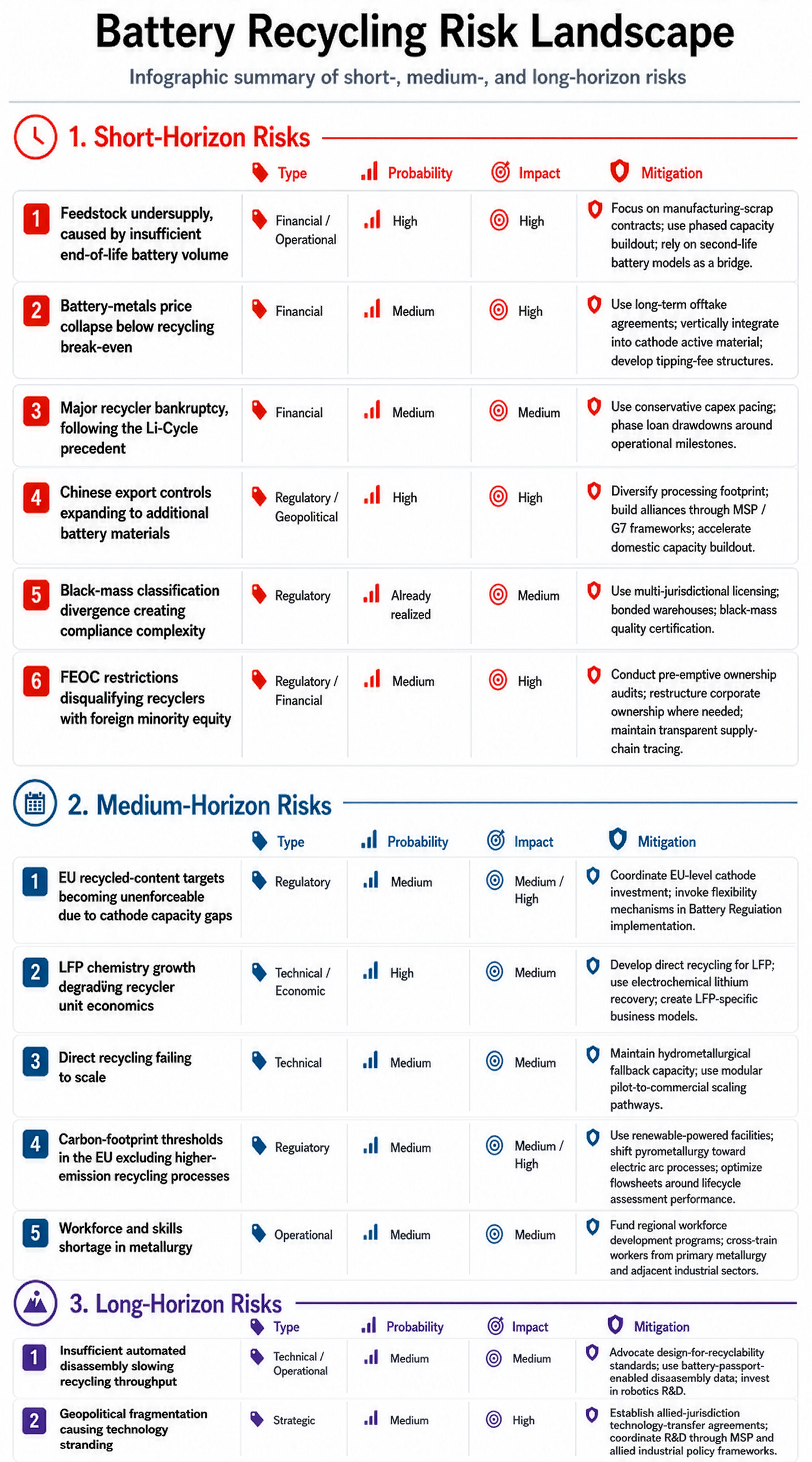
Narrative synthesis. The defining near-term risk facing the sector is not technological but financial: the asymmetry between announced capacity and arriving feedstock. Through 2030, recyclers are constructing capacity for a feedstock wave that will not arrive at scale until after 2035. In the intervening valley, capacity utilization will be sustained primarily by manufacturing scrap from gigafactories, supplemented by consumer-electronics and early-cohort EV battery returns. Operators that committed substantial capital to hub-scale facilities at 2021–2022 capex assumptions (Li-Cycle being the paradigmatic case) face an environment in which lithium prices have fallen by roughly 80%, cobalt has fluctuated wildly, and project completion costs have inflated by 30–50%. The probability of additional large-scale recycler distress through 2027 is high, and the probability of consolidation through acquisition by integrated chemical and mining majors (Glencore's Li-Cycle acquisition being the leading example) is also high
In the medium term (2028–2032), the regulatory architecture will become the dominant determinant of profitability. The EU's recycled-content targets effective August 2031, and the digital battery passport mandatory from February 2027, create a captive, high-margin demand for recycled cathode precursors within the EU market. Operators positioned to certify EU jurisdictional, low-carbon, recycled-content compliance will command price premia substantially above merchant-market parity. Conversely, recyclers serving the U.S. market under the IRA's value-based critical-mineral rules will face a more ambiguous demand signal, since recycled materials count toward the 80% threshold but at potentially lower market value than virgin equivalents.
The long-term risk profile (2033–2040) inverts the short-term picture: feedstock becomes abundant, regulatory mandates bind hard, and the question becomes which firms and jurisdictions maintained sufficient capital, workforce, and technology to capture the wave. Geopolitical risk dominates: a scenario in which China successfully imports the world's black mass for processing, exploiting its underutilized refining capacity and its monopoly on cathode-precursor synthesis, would convert the urban-mining opportunity into a continuation of existing extractive-export dependency, with Western economies merely changing which raw material they ship to China. The mitigation pathway requires sustained, coordinated investment in Western processing capacity, technology development in direct recycling and lithium-specific recovery, and trade-policy architecture that preserves secondary-feedstock circulation within allied jurisdictions.
9. Strategic Recommendations
9.1 Institutional Investors
Institutional capital should approach LIB recycling as a multi-vintage portfolio rather than a single thematic bet. Near-term commitments should favor integrated operators with proven hydrometallurgical refining and downstream cathode-precursor or CAM positions, such as Umicore, Posco-GS Eco Materials, and Redwood Materials, where margin capture and feedstock optionality are highest. Pure-play collection-and-shredding operators carry asymmetric downside risk and should be approached only at deep distress valuations or as acquisition targets within larger portfolios. Direct recycling startups warrant venture-style allocations in size relative to portfolio risk tolerance, with realistic expectations that commercial scale lies in the early 2030s. Cross-jurisdictional exposure should weight U.S. and EU operators heavily for regulatory-premium capture, while monitoring Chinese operators for indirect exposure through cathode-precursor off-takes. Investors should specifically scrutinize loan covenants and milestone-based federal financing structures; the Li-Cycle precedent demonstrates that conditional federal loans without secured private co-investment offer limited downside protection.
9.2 Corporate Executives and OEMs
OEMs and battery manufacturers should accelerate vertical integration of recycling capacity, either through direct ownership, joint ventures with established recyclers, or long-term off-take agreements. The Mercedes-Benz / GEM / CATL / Brunp closed-loop model in China represents one template; the GM / LG Energy Solution / Li-Cycle (now Glencore) U.S. arrangement another. Battery manufacturers should adopt design-for-recyclability principles in 2025–2027 product cycles, anticipating that EU automated-disassembly regulations and digital-battery-passport requirements will progressively constrain current pack architectures. Cathode chemistry decisions should explicitly incorporate recyclability economics: the migration to LFP for cost reasons must be weighted against substantially weaker recycling unit economics, with implications for total-cost-of-ownership and regulatory-compliance positioning. Establishing internal carbon-footprint accounting infrastructure ahead of EU 2025 declaration requirements should be a priority, as should diligence on FEOC-compliance for U.S.-market vehicles.

9.3 Policymakers
Three policy actions warrant immediate attention. First, recycled-content mandates should be paired with explicit support for domestic cathode-active-material production capacity, since recycled-content targets without precursor processing capacity are mechanically unenforceable [91]. The EU's Critical Raw Materials Act provides a partial template, but cathode-specific industrial policy remains underdeveloped in both the EU and the United States. Second, feedstock-economics policy, including tipping-fee floors, mandatory minimum recycled content thresholds, and harmonized EPR enforcement, should be designed to bridge the 2025-2030 valley between announced capacity and arriving feedstock. Pure market mechanisms will not sustain recycler viability through this period, and strategic capacity should not be permitted to fail merely for timing reasons. Third, international coordination through the G7 Critical Minerals Action Plan, the MSP Forum, and bilateral arrangements (notably U.S.-Japan and U.S. Korea) should explicitly prioritize technology-transfer, joint R&D in direct recycling and lithium specific recovery, and trade-policy architecture preserving secondary-feedstock circulation within aligned jurisdictions. Black-mass flows in particular should be regulated with deliberate strategic intent rather than allowed to default to Chinese processing under hazardous-waste loopholes
9.4 Emerging Market Stakeholders
Emerging market and developing economies (EMDEs) face a distinctive set of opportunities and risks. Resource-rich producing countries, including Indonesia, the Democratic Republic of the Congo, Chile, Argentina, and others, should treat recycling-capacity development as part of their broader industrial-policy strategies, not separately from primary extraction. The MSP Forum's expansion to 15 producing countries provides a coordination venue [112]. Battery-importing EMDEs, particularly those receiving second-hand EVs, face an emerging waste management challenge as imported vehicles reach end of life with batteries whose origin chemistry may be poorly documented. The IEA noted that strengthening international cooperation around international trade of second-hand EVs while ensuring adequate end-of-life strategies is central to mineral-security planning [4]. EMDE policymakers should resist the pattern observed in informal lead-acid battery recycling, where toxic exposures concentrated in low-income communities, and instead build formal collection-and-processing infrastructure with EPR financing. Multilateral development banks and the MSP Finance Network can play a catalytic role in financing this infrastructure.
John D John D
 John D
 John D
10. References
[1] U.S. Department of the Treasury. 2024. "U.S. Department of the Treasury Releases Final Rules to Lower Consumer Costs, Continue U.S. Manufacturing Boom in Batteries and Clean Vehicles, Strengthen Energy Security." Press Release, May 3, 2024.
[2] European Union. 2023. "Regulation (EU) 2023/1542 of the European Parliament and of the Council of 12 July 2023 Concerning Batteries and Waste Batteries." Official Journal of the European Union, July 28, 2023.
[3] European Commission. 2024. "Sustainability Rules for Batteries and Waste Batteries." EUR Lex Summary.
[4] International Energy Agency. 2024. EV Battery Supply Chain Sustainability. Paris: IEA.
[5] International Energy Agency. 2024. Global EV Outlook 2024: Outlook for Battery and Energy Demand. Paris: IEA.
[6] United Nations Development Programme. 2025. Analysis of EV Battery End-of-Life. New York: UNDP.
[7] ESG Dive. 2025. "Glencore Completes Takeover of Li-Cycle Battery Recycling Assets." August 2025.
[8] Resource Recycling. 2025. "Li-Cycle Files for Bi-National Bankruptcy, Seeks Buyer." June 26, 2025.
[9] International Energy Agency. 2025. Global Critical Minerals Outlook 2025: Executive Summary. Paris: IEA.
[10] German Council on Foreign Relations (DGAP). 2025. "Why 'Black Mass' Is Critical."
[11] International Energy Agency. 2025. "Diversification Is the Cornerstone of Energy Security, Yet Critical Minerals Are Moving in the Opposite Direction." News Release, May 2025.
[12] CATL. 2025. "Brunp Recycling Leads the Formulation of Battery Recycling Standards." Press Release, October 17, 2025.
[13] Beveridge & Diamond. 2025. "China and Europe Diverge on Classification of Black Mass from Recycling of Lithium-Ion Batteries." June 2025.
[14] Chemical & Engineering News. 2023. "Lithium-Ion Battery Recycling Goes Large." 101(38).
[15] Argonne National Laboratory. 2021. "ReCell Center Could Save Costly Nickel and Cobalt, Transform Battery Recycling Worldwide."
[16] Transport & Environment. 2024. Battery Recycling Report. Brussels: T&E.
[17] deVere Group. 2025. "Lithium Price Outlook 2025: Oversupply Weighs on Prices." July 2025.
[18] International Energy Agency. 2024. Recycling of Critical Minerals: Executive Summary. Paris: IEA.
[19] Circular Energy Storage. 2024. "Global Battery Recycling Volumes to Rise Sharply After 2030." Auto Recycling World, December 2024.
[20] Shanghai Metals Market. 2025. "2025 Li-Battery Recycling Policies: Insights into Industry Transformation & Opportunities." November 2025.
[21] Yıldırım, Erkan, et al. 2025. "Advancing the Circular Economy by Driving Sustainable Urban Mining of End-of-Life Batteries and Technological Advancements." Sustainable Materials and Technologies.
[23] Spangenberger, Jeffrey S. 2021. "Direct Recycling R&D at the ReCell Center." Recycling 6(2): 31.
[24] Stanford Report. 2025. "Recycling Lithium-Ion Batteries Delivers Significant Environmental Benefits." January 2025.
[25] Baum, Z. J., R. E. Bird, X. Yu, and J. Ma. 2022. "Lithium-Ion Battery Recycling—Overview of Techniques and Trends." ACS Energy Letters 7: 712–719.
[26] Velázquez-Martínez, O., et al. 2023. "Hydrometallurgical Recycling Technologies for NMC Li-Ion Battery Cathodes: Current Industrial Practice and New R&D Trends." RSC Sustainability 1: D3SU00142C.
[27] Yang, Yi, et al. 2022. "Recycling of Lithium Iron Phosphate Batteries: Status, Technologies, Challenges, and Prospects." Renewable and Sustainable Energy Reviews 167: 112671.
[28] Wang, J., et al. 2025. "A Closed-Loop Process for Rapid and Selective Lithium Extraction and Resynthesis from Spent LiFePO4 Batteries." Materials 18(12).
[29] Tarpeh, William, and Samantha Bunke. 2025. "Life Cycle Comparison of Industrial-Scale Lithium-Ion Battery Recycling and Mining Supply Chains." Nature Communications.
[30] Umicore. 2022. "Umicore Introduces New Generation Li-ion Battery Recycling Technologies and Announces Award with ACC." Press Release, February 15, 2022.
[31] Recycling International. 2011. "Umicore Unveils Battery Recycling Facility in Belgium."
[32] Chemical & Engineering News. 2022. "Umicore Wants to Build the World's Largest Battery Recycling Plant." 100(23).
[33] Umicore. 2024. "Hoboken Expansion." Newsroom.
[34] Chemical & Engineering News. 2023. "Lithium-Ion Battery Recycling Goes Large." 101(38).
[35] U.S. Department of Energy, Loan Programs Office. 2023. "LPO Offers Conditional Commitment to Redwood Materials to Produce Critical Electric Vehicle Battery Components from Recycled Materials." Press Release, February 9, 2023.
[36] TechCrunch. 2023. "Redwood Materials Lands $2B Conditional Loan from DOE." February 9, 2023.
[37] Redwood Materials. 2024. "Building the Most Sustainable (and Scalable) Battery Materials Process."
[38] Contrary Research. 2025. "Report: Redwood Materials Business Breakdown & Founding Story."
[39] Pinegar, Hayden, and Yang Smith. 2022. "Lithium-Ion Battery Recycling Companies." Blackridge Research Report.
[40] Shanghai Metals Market. 2023. "Mercedes-Benz China, GEM, CATL and Brunp Recycling Join Forces to Build a Power Battery Recycling Industry Chain." February 28, 2023.
[41] Allied Market Research. 2021. "Li-Cycle and Ultium Cells Recycling Agreement."
[42] Korea Herald. 2025. "EV Battery Recycling Heats Up in Korea Despite Market Slump."
[43] Tribune India. 2025. "Korean Industry Giants Bet on Battery Recycling as Global EV Market Matures."
[44] China Daily. 2025. "New Rules Aim to Tackle Growing Retired Batteries." November 5, 2025.
[45] Toyota USA Newsroom. 2024. "Toyota and Argonne National Laboratory Investigate Recycling of Lithium-Ion Batteries." April 30, 2024.
[46] Argonne National Laboratory. 2020. "ReCell Center Could Save Costly Nickel and Cobalt, Transform Battery Recycling Worldwide."
[47] U.S. Department of Energy. 2022. "DOE Announces Battery Recycling Prize Phase III Winners." Press Release, June 21, 2022.
[48] National Renewable Energy Laboratory. 2021. "Lithium-Ion Battery Recycling Prize Drives Recovery of Spent Batteries."
[49] U.S. Department of Energy. 2022. "Inflation Reduction Act of 2022."
[50] U.S. Department of Energy. 2025. "Energy Department Announces Actions to Secure American Critical Minerals and Materials Supply Chain." Press Release, 2025.
[51] Quest Metals. 2025. "How Japan Prepared for the Rare-Earth Mineral Squeeze."
[52] Eco-Business. 2025. "Japan to Join Global Race to Recycle Lithium Batteries and Curb E-Waste Hazards."
[53] Circular Energy Storage. 2024. "South Korea Launches National Battery Strategy—Reuse and Recycling in Focus."
[54] G7. 2025. "G7 Critical Minerals Action Plan." Kananaskis Summit, June 17, 2025.
[55] BloombergNEF. 2024. "U.S. Lithium-Ion Battery Recycling Outlook 2024."
[56] European Investment Bank. 2025. "Critical Raw Materials Financing Initiative." March 2025.
[57] American Battery Technology Company. 2024. "EV Battery Recycling Is Costly. These Five Startups Could Change That."
[58] Global Market Insights. 2025. "Lithium-Ion Battery Recycling Market Size, Growth Trends 2035."
[59] Tang, S., et al. 2023. "A Comprehensive Review and Classification of Unit Operations with Assessment of Outputs Quality in Lithium-Ion Battery Recycling." Journal of Power Sources 555: 232415.
[60] Royal Society of Chemistry. 2023. "Hydrometallurgical Recycling Technologies for NMC Li-Ion Battery Cathodes." RSC Sustainability 1.
[61] Montoya, Anthony T., et al. 2022. "Direct Recycling of Lithium-Ion Battery Cathodes: A Multi-Stage Annealing Process to Recover the Pristine Structure and Performance." ACS Sustainable Chemistry & Engineering 10(40): 13319–13324.
[62] Spangenberger, Jeffrey S. 2021. "Direct Recycling R&D at the ReCell Center." Recycling 6(2): 31.
[63] Reinhart, L., et al. 2023. "Pyrometallurgical Recycling of Different Lithium-Ion Battery Cell Systems: Economic and Technical Analysis." Journal of Cleaner Production 416: 137834.
[64] Ma, Xianyao, et al. 2025. "The Evolution of Lithium-Ion Battery Recycling." Nature Reviews Clean Technology 1: 75–94.
[65] Ciez, Rebecca E., and J. F. Whitacre. 2019. "Examining Different Recycling Processes for Lithium-Ion Batteries." Nature Sustainability 2: 148–156.
[66] SunLith Energy. 2024. "EU 2023/1542: Compliance Deadlines, Battery Passport & What Changes by 2027."
[67] Biswal, Sibani Lisa, et al. 2025. "Cheap, Practical Recycling of Lithium Iron Phosphate Batteries." Joule 9(11): 102197.
[68] MDPI. 2025. "Product and Process Data Structure for Automated Battery Disassembly." Recycling 10(1): 25.
[69] Environmental and Energy Study Institute. 2024. "From Scrap to Supply: Circular Strategies for Critical Minerals."
[70] Royal Society of Chemistry. 2026. "Recycling with Precision: Engineering Ni-Rich NMC Cathodes through Impurity Management." Journal of Materials Chemistry A: D5TA06740E.
[71] Tarpeh, William, et al. 2025. "Life Cycle Comparison of Industrial-Scale Lithium-Ion Battery Recycling and Mining Supply Chains." Nature Communications.
[72] [Specific source not identified; claim reflects synthesis of practitioner literature and publicly available data as of the research date.]
[73] United Nations. 2023. Recommendations on the Transport of Dangerous Goods: Model Regulations. 23rd revised edition. New York and Geneva: UN.
[74] Gaines, Linda. 2014. "The Future of Automotive Lithium-Ion Battery Recycling: Charting a Sustainable Course." Sustainable Materials and Technologies 1–2: 2–7.
[75] Wang, X., G. Gaustad, C. W. Babbitt, and K. Richa. 2014. "Economies of Scale for Future Lithium-Ion Battery Recycling Infrastructure." Resources, Conservation and Recycling 83: 53–62.
[76] Saju, Anu, et al. 2024. "A Review of Lithium-Ion Battery Recycling for Enabling a Circular Economy." Journal of Power Sources 605.
[77] Fortune Business Insights. 2025. "Lithium-Ion Battery Recycling Market Size, Share & Forecast [2034]."
[78] Global Market Insights. 2025. "Lithium-Ion Battery Recycling Market Size, Growth Trends 2035."
[79] Allied Market Research. 2024. "Lithium-ion Battery Recycling Market Size, Share Report, 2030."
[80] MarketsandMarkets. 2024. "Lithium-Ion Battery Recycling Market - Size, Share, Industry Forecast Report."
[81] MarketsandMarkets. 2025. "Asia Pacific Lithium-Ion Battery Recycling Market by Source, Battery Chemistry, Component, Recycling Process, and Country - Forecast to 2032."
[82] Liang, Z., et al. 2023. "Economic Analysis of Recycling NMC Cathode Chemistries." Journal of Cleaner Production.
[83] S&P Global Commodity Insights. 2024. "COMMODITIES 2025: Global Surplus, Declining Prices Weigh on Europe's Lithium Ambitions." December 2024.
[84] International Energy Agency. 2025. Global Critical Minerals Outlook 2025. Paris: IEA.
[85] International Energy Agency. 2025. "Critical Minerals." Topics Page.
[86] Lehmann, Ariane, et al. 2023. "Assessing the Feasibility of the Inflation Reduction Act's EV Critical Mineral Targets." Nature Sustainability 6: 1029–1036.
[87] McKinsey & Company. 2025. "Battery 2035: Building New Advantages."
[88] Battery Associates. 2024. "EU Battery Regulation (2023/1542)."
[89] Uptime Institute. 2024. "EU Battery Regulations: What Do the New Rules Mean?"
[90] Flash Battery. 2024. "EU Battery Regulation 2023/1542: Obligations and Updates."
[91] Zhou, Yifei, et al. 2026. "The EU's Recycled Content Targets for Batteries Cannot Effectively Drive Domestic Recycling Without Sufficient Cathode Production Capacity." Resources, Conservation and Recycling.
[92] U.S. Department of the Treasury. 2023. "Treasury Releases Proposed Guidance on New Clean Vehicle Credit." Press Release, April 17, 2023.
[93] Orrick, Herrington & Sutcliffe LLP. 2022. "Section 45X of the Inflation Reduction Act: New Tax Credits Available to Battery Manufacturers."
[94] Greenli-ion. 2024. "Critical Mineral Security Through Battery Recycling."
[95] Grand View Research. 2024. "U.S. Battery Recycling Market Size."
[96] Center on Global Energy Policy at Columbia University. 2024. "The IRA and the US Battery Supply Chain: One Year On."
[97] Electrive. 2022. "Battery Reuse & Recycling Expand to Scale in China." January 29, 2022.
[98] Wang, X., et al. 2022. "Governance Strategies for End-of-Life Electric Vehicle Battery Recycling in China: A Tripartite Evolutionary Game Analysis." Frontiers in Environmental Science 10: 1071688.
[99] Circular Business Review. 2025. "China's Battery Recycling Push: CATL and BRUNP Lead the Transition to Circular Energy Ecosystem."
[100] United Nations Environment Programme. 2021. "Assessment of Informal Used Lead Acid Battery Recycling and Associated Impacts in Bangladesh." Nairobi: UNEP.
[101] Global Battery Alliance. 2024. "Navigating the Unknowns: Drivers and Projections for EV Battery Recycling."
[102] International Energy Agency. 2024. Recycling of Critical Minerals. Paris: IEA.
[103] Discovery Alert. 2025. "China's Critical Minerals Dominance Threatens Global Supply Chain Security."
[104] International Energy Agency. 2025. "With New Export Controls on Critical Minerals, Supply Concentration Risks Become Reality." Commentary, October 2025.
[105] Circular Energy Storage. 2024. "South Korea Launches National Battery Strategy."
[106] Fastmarkets. 2024. "Lithium Battery Recyclers Plan New Europe Expansions Despite Tough Market Conditions."
[107] East Asia Forum. 2026. "Lessons from Japan's Rare Earth Shock." March 2026.
[108] Government of Canada. 2024. Canadian Critical Minerals Strategy Annual Report 2024.
[110] Government of Australia, Department of Industry, Science and Resources. 2024. "Joint Statement by Canada and Australia on Cooperation on Critical Minerals." March 4, 2024.
[111] U.S. Department of State. 2024. "Minerals Security Partnership."
[112] European Commission. 2024. "Minerals Security Partnership Forum." Trade and Economic Security Policy Page.
[113] American Ceramic Society. 2024. "Minerals Security Partnership Welcomes New Members and Initiatives."
[114] White & Case LLP. 2024. "Critical Minerals Supply Chains: The Minerals Security Partnership and Trade-Related Challenges."
[115] Bipartisan Policy Center. 2023. "IRA EV Tax Credits: Requirements for Domestic Manufacturing.