Flywheel Energy Storage for Off-Grid Homesteads: FESS vs. LFP, Self-Discharge, LCOS, and the Torus, Amber Kinetics, Energiestro Reality Check
A flywheel loses up to 5% of its charge every hour. Your solar window is six hours. Do the math and then read why the appeal persists anyway.

Are Flywheel Batteries Worth It for Off-Grid Living? What the Engineering and Economics Actually Say
1. Summary
Flywheel energy storage systems (FESS) occupy a peculiar position in the modern energy storage landscape. The technology has been the subject of sustained federal research investment since the mid-1970s, has generated multiple grid-scale commercial deployments, and possesses a set of physical attributes (high cycle life, fast response, mechanical rather than chemical degradation, indifference to ambient temperature) that on their face appear ideally suited to the durability and self-sufficiency requirements of off-grid homesteading. Despite this apparent fit, no flywheel product has achieved meaningful penetration into the residential off-grid market, and the analysis assembled in this report concludes that none is likely to do so within the next five years. The economic and engineering gap between flywheels and lithium iron phosphate (LFP) batteries at residential scale is large, persistent, and currently widening rather than narrowing.
The central technical finding is that the parasitic self-discharge characteristic of all but the most expensive flywheel architectures is fundamentally incompatible with the diurnal solar cycling pattern that defines off-grid homestead operation. Mechanical-bearing systems lose between 1% and 5% of stored energy per hour, while well-engineered active-magnetic bearing systems lose roughly 0.5% to 2% per hour [1][2][3]. Only specialized superconducting magnetic bearing prototypes have demonstrated standby losses approaching 0.1% per hour, and these systems require continuously cooled cryostats that themselves consume power and add capital cost [4]. By contrast, an LFP battery loses on the order of 1% to 3% of its charge per month under standby conditions. A homestead that charges its storage during a six-hour solar window and must hold that energy for fourteen to eighteen hours of evening, overnight, and pre-dawn use is asking the storage medium to do exactly what flywheels are worst at doing.
The economic finding is equally direct. Installed residential LFP systems in the United States in 2025 ranged from approximately $700 to $1,300 per usable kilowatt-hour, with battery pack prices at the cell level falling to roughly $108 per kilowatt-hour and stationary pack prices reaching approximately $70 per kilowatt-hour according to BloombergNEF benchmarks [5][6]. The only flywheel product publicly marketed for residential and small commercial use, the Torus Nova Spin, is offered as part of integrated home systems quoted at $35,000 to $55,000 installed, including solar generation [7][8]. On a like-for-like usable kWh basis, that pricing implies a flywheel storage component that is several multiples more expensive than incumbent LFP, and the comparison flatters the flywheel because Torus systems are themselves typically paired with LFP batteries to provide the energy duration the flywheel cannot economically supply [9][10].
The strategic finding is that flywheels remain a power technology rather than an energy technology. The grid-services niche that animated Beacon Power’s Stephentown installation, the Amber Kinetics deployments, and the more recent commercial activity from Torus and Revterra is fundamentally about delivering kilowatts of fast-response capacity for seconds to minutes, not kilowatt-hours of overnight energy. The Beacon Stephentown plant, the largest commercial flywheel deployment ever built in North America, had an effective installed cost of approximately $13,800 per kWh of stored energy at first build and approximately $10,600 per kWh at the second-generation Hazle Township plant [11]. These numbers, while distorted by the frequency-regulation use case, illustrate the structural cost problem: flywheel capital expense scales primarily with rotor mass and containment, not with electronics or chemistry, so the $/kWh denominator does not benefit from the same volume-driven cost declines that have transformed lithium-ion economics.
Three pathways to cost-competitiveness are identifiable but each carries low probability over the next decade. First, a step-change in low-cost rotor materials (the Energiestro prestressed-concrete approach is the leading candidate) could in principle bring rotor cost per kWh into a range where balance-of-system costs dominate, but the technology remains at low Technology Readiness Level (TRL 5-6) with only a handful of beta installations as of early 2025 [12][13]. Second, scale manufacturing of high-temperature superconducting bearings (Revterra’s approach) could reduce parasitic losses sufficiently to make daily cycle storage viable, though the company’s primary commercial focus is data centers and EV fast charging, not residential applications [14][15]. Third, an unexpected geopolitical disruption to the lithium-ion supply chain, combined with continued domestic flywheel manufacturing investment under industrial-policy programs, could create a market opening even at a cost premium. The probability-weighted expectation across these pathways is that flywheels remain a niche grid and commercial technology through at least the early 2030s.
The principal recommendations are differentiated by audience. Off-grid homesteaders evaluating storage in the present should select LFP battery systems for daily-cycle energy storage, with no flywheel product currently representing a rational primary investment for that role; the only defensible exception is a specialized cold-climate or extreme-cycling application in which a homesteader has direct access to retired commercial flywheel hardware, has the engineering capability to operate it safely, and treats it as a power-quality supplement rather than energy storage. Investors and entrepreneurs in the flywheel sector should focus on data center power conditioning, EV fast charging, and grid frequency services rather than the residential market, where the unit economics do not support customer acquisition costs. Policymakers and program designers should treat flywheels as a complement to chemical storage in portfolio approaches and should resist proposals to subsidize residential flywheel deployment on energy-sovereignty grounds, since the energy-density, safety-engineering, and self-discharge constraints make residential FESS a poor return on public dollars relative to other storage R&D investments.
The remainder of this report develops these conclusions in detail, with explicit treatment of the physics, the manufacturing economics, the comparative storage landscape, the regulatory environment, and the scenario-conditional pathways under which these conclusions could change.
Flywheel Energy Storage for Off-Grid Homesteading and Small-Scale Agriculture: A Technical, Economic, and Strategic Assessment
1. Summary
2. Introduction and Contextual Background
2.1 The Off-Grid Energy Storage Problem
2.2 Historical Development of Flywheel Energy Storage
2.3 Why Flywheels Have Not Penetrated the Residential Market
3. Technology Deep-Dive
3.1 Physics and Engineering Fundamentals
3.2 Rotor Materials and Manufacturing
3.3 Bearing Systems
3.4 Vacuum Enclosure and Containment
3.5 Power Electronics and Grid Interface
3.6 Self-Discharge and Energy Retention
4. Key Players, Stakeholders, and the Competitive Landscape
4.1 Established Flywheel Manufacturers 4.2 Startups and Research Ventures
4.3 Competing Storage Technologies
5. Economic and Market Dynamics
5.1 Current Cost Structure of Flywheel Systems
5.2 Levelized Cost of Storage (LCOS) Comparison
5.3 The Cycle Life Advantage and Its Economic Implications
5.4 Manufacturing Scale and Cost Reduction Pathways
5.5 Total Cost of Ownership Modeling
6. Operational Considerations for Off-Grid Deployment
6.1 Installation Requirements
6.2 Maintenance and Knowledge Burden
6.3 Noise, Vibration, and Siting Constraints
6.4 Safety Profile and Failure Modes
6.5 Cold Climate and Extreme Environment Performance
7. Regulatory Landscape
7.1 Building and Electrical Codes
7.2 Permitting and Zoning
7.3 Transportation and Handling Regulations
8. Geopolitical and Strategic Dimensions
8.1 Supply Chain and Material Sovereignty
8.2 Energy Sovereignty and Resilience
8.3 Military and Government Research Spillover
9. Future Trajectory and Scenario Analysis
9.1 Technology Development Scenarios
9.2 Market Entry Conditions
9.3 The Niche Survivability Question
10. Risk Matrix 10.1 Short-Term Risks (1-3 Years)
10.2 Medium-Term Risks (3-7 Years)
10.3 Long-Term Risks (7+ Years)
11. Strategic Recommendations
11.1 Recommendations for Off-Grid Homesteaders and Rural Self-Sufficiency Practitioners
11.2 Recommendations for Investors and Entrepreneurs
11.3 Recommendations for Policymakers and Program Designers
12. References
2. Introduction and Contextual Background
2.1 The Off-Grid Energy Storage Problem
The energy storage requirement for an off-grid residential or small-agricultural property is shaped by three structural features that distinguish it from grid-tied storage and from utility-scale storage. The first is the diurnal cycling pattern imposed by solar photovoltaic generation, which provides usable energy for approximately four to seven peak-equivalent hours per day depending on latitude and season, and zero output for the remaining seventeen to twenty hours. The second is the asymmetry between average and peak load, with critical loads (refrigeration, water pumping, well controllers, communications equipment, and in cold climates, heating-system circulators and ignition controls) drawing modest continuous power but requiring significant peak capacity for compressor starts and pump cycles. The third is the absence of grid backstop: a storage failure on a homestead means loss of essential services, and in cold-climate or remote installations can rapidly escalate to a life-safety event.
For purposes of analysis, three representative homestead profiles bound the range. A minimal off-grid cabin with LED lighting, a small refrigerator, a laptop, a well pump operated periodically, and propane for cooking and primary heat typically requires 2 to 4 kWh per day of usable storage with a peak demand of 1.5 to 2.5 kW. A moderate family homestead with full electric lighting, a standard refrigerator and chest freezer, well pump, washing machine, electronics load, and electric ignition for a non-electric heating system typically requires 8 to 15 kWh per day with peak demand of 4 to 7 kW. A productive small farm with milking equipment, refrigerated bulk storage, electric fencing, multiple well pumps, and shop power requirements typically requires 18 to 35 kWh per day with peak demand of 8 to 12 kW and occasional inrush requirements of 15 to 25 kW. These figures are consistent with practitioner reporting and represent the baseline against which any storage technology must be evaluated, though they vary substantially with climate, dwelling characteristics, and lifestyle choices and should be treated as engineering estimates rather than statistically derived norms.
The critical parameter that constrains technology choice is not aggregate capacity but the ability to hold energy through the off-sun period without unacceptable self-discharge. A storage system that loses 2% per hour appears benign over a one-hour test but loses approximately 30% over an eighteen-hour overnight hold. For a 10 kWh nominal system, that represents 3 kWh of irrecoverable loss every cycle, equivalent to approximately one full additional kWh of solar generation and one additional kWh of charging-discharging cycle wear (in the case of supplementary chemical storage). This parameter, more than any other, defines the boundary between flywheel-suitable and flywheel-unsuitable applications, and the boundary falls on the wrong side of the homestead use case for most current flywheel technology.
2.2 Historical Development of Flywheel Energy Storage
The modern history of flywheel energy storage as a candidate grid technology begins in the 1970s with NASA Glenn Research Center work on aerospace energy storage and continues through DOE-funded research programs that supported development of composite rotor materials, magnetic bearings, and high-speed motor-generator integration. The U.S. federal investment in flywheel commercialization peaked in the late 2000s and early 2010s, when DOE provided a $43 million loan guarantee to Beacon Power for the Stephentown, New York frequency-regulation plant and approximately $24 million in subsequent grant support for the Hazle Township, Pennsylvania facility [16][17]. Boeing received Sandia and DOE support for a 5 kWh / 100 kW high-temperature superconducting flywheel program in the same period [4]. Beacon Power’s October 2011 Chapter 11 filing, which occurred during a politically charged period for federal clean-energy lending, is the canonical reference event for the commercial difficulties of grid-scale flywheel deployment, though the underlying assets continued to operate and were acquired by Rockland Capital in 2012 and subsequently transferred through additional ownership transitions [18][19].
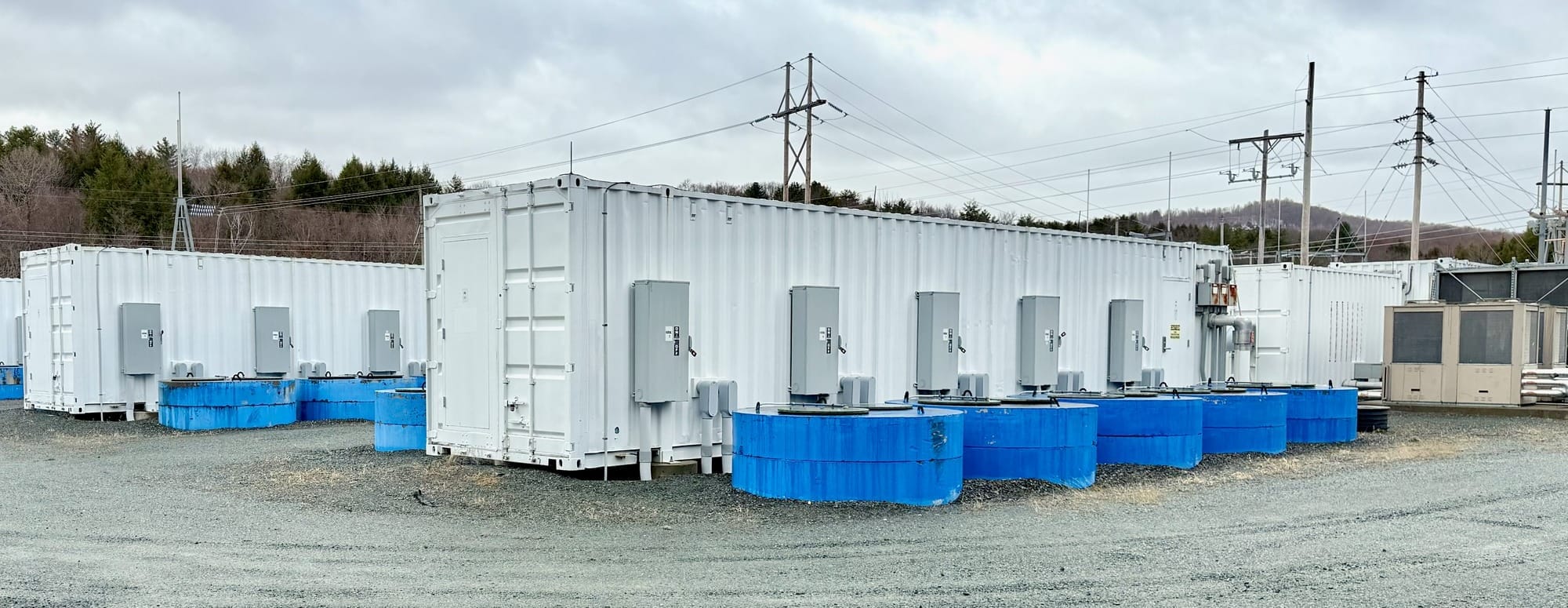
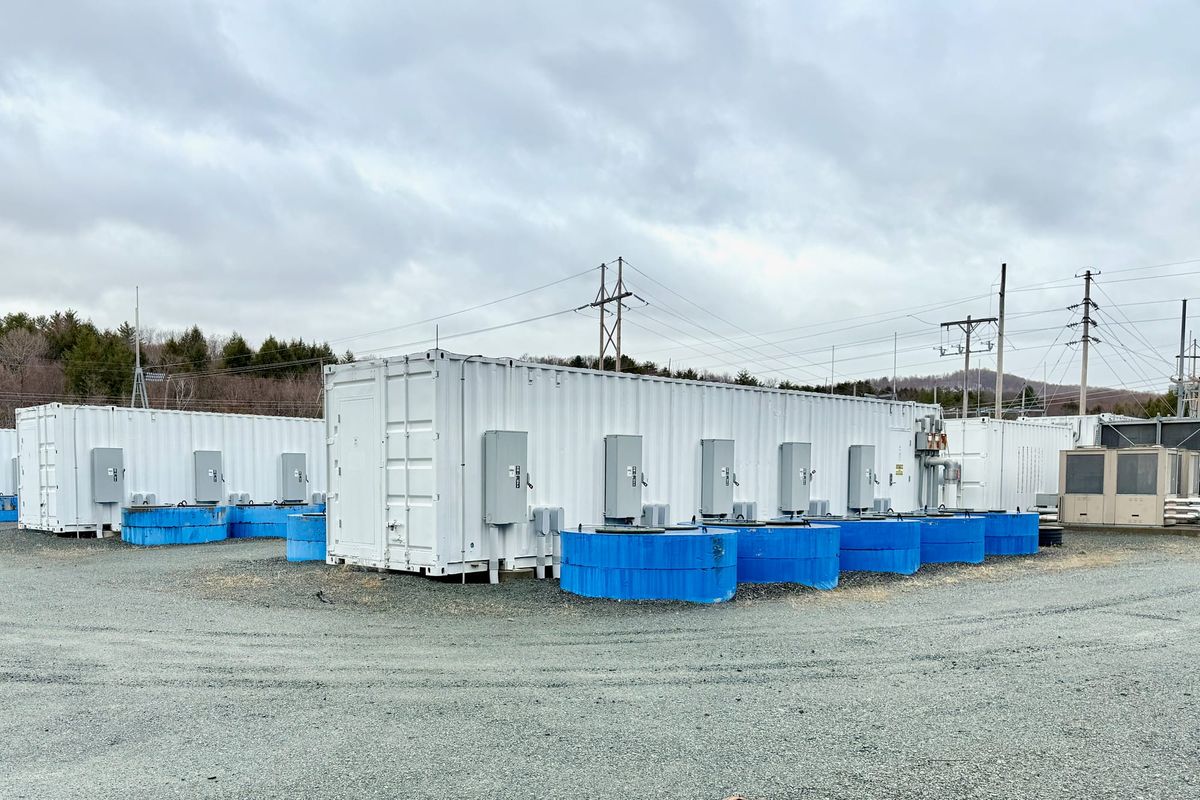
The Stephentown installation is technically and economically illustrative. The plant comprised 200 carbon-fiber composite flywheel modules, each rated at 100 kW power and 25 kWh energy, suspended on magnetic bearings, operating in vacuum chambers, and spinning at 16,000 rpm [20]. Total project cost was approximately $69 million for 20 MW of power capacity and 5 MWh of energy capacity, yielding the implied $13,800/kWh figure that recurs in critical analyses of grid-scale flywheel economics [11]. The fact that a flywheel plant of that scale could earn a positive operating margin from the New York Independent System Operator’s pay-for-performance frequency regulation tariff demonstrates that flywheels are commercially viable for power services, but the economics never extended to bulk energy storage and never approached residential price points.
A second commercial trajectory has been pursued by Amber Kinetics, founded as a DOE Energy Storage Demonstration grant recipient and operating in the long-duration steel-rotor flywheel niche. The Amber Kinetics M32 product is a single-rotor steel flywheel weighing approximately 5,000 pounds, storing approximately 32 kWh at full charge, delivering 8 kW of power over a four-hour duration, and operating at peak speeds of approximately 8,500 rpm with a hybrid magnetic and mechanical bearing arrangement [21][22]. The company has accumulated more than 2 GWh of cumulative discharge across deployments and has reported a 30-year design life with greater than 20,000 cycles [22]. Amber Kinetics units are deployed primarily in commercial and utility installations, including a notable Australian deployment via Key Energy, which markets the M32-based MPowerTank for commercial and large-residential applications with above-ground concrete safety enclosures validated through finite element analysis at the University of Technology Sydney [23].
A third lineage runs through grid-services hybrid systems and commercial inertial storage, including Stornetic (Germany), Temporal Power (Canada, now defunct in its original form), Energiestro (France, prestressed concrete rotors), Punch Flybrid (United Kingdom, mobile and grid applications), and the more recent entrants Torus (Utah) and Revterra (Texas). Of these, only Torus has marketed product specifically for residential and light-commercial deployment, and only Energiestro has explicitly targeted small-scale renewable-paired storage as its primary commercial application. The 30 MW grid-connected flywheel installation that came online in China in 2024 represents the current high-water mark of utility-scale flywheel deployment [24].
2.3 Why Flywheels Have Not Penetrated the Residential Market
The absence of flywheels from the off-grid residential market is overdetermined: there are at least six independent reasons for it, any one of which would be sufficient to block adoption, and they compound. First, energy density is unfavorable. A state-of-the-art carbon-fiber composite flywheel rotor stores approximately 100 to 130 watt-hours per kilogram of rotor mass, but commercial system energy densities (including the rotor, hub, motor-generator, vacuum chamber, and containment) are typically 5 to 25 Wh/kg, far below LFP cell-level densities of 130-160 Wh/kg and pack-level densities of 100-130 Wh/kg [25] [26]. A 10 kWh flywheel system therefore weighs more, occupies more space, and demands more siting infrastructure than an equivalent battery.
Second, self-discharge remains the structural disqualifier for daily-cycle residential applications, as developed in detail in Section 3.6.
Third, the cost decline of lithium-ion has been more rapid and more durable than any forecast made in the 2005-2015 period anticipated. BloombergNEF data show lithium-ion battery pack prices have fallen approximately 93% over the past decade, reaching $108/kWh in 2025 [5]. Flywheel system costs, dominated by precision rotor manufacturing, vacuum systems, magnetic bearings, and containment vessels, have not benefited from analogous learning rates.
Fourth, safety engineering for residential flywheels imposes a fixed cost floor. A 32 kWh steel rotor at 150 Hz (9,000 rpm) stores energy equivalent to several kilograms of TNT in mechanical form. Containment must be engineered to absorb that energy in a credible failure mode, which in practice means either a buried vault (Amber Kinetics’ approach in early Alameda testing) or a heavily engineered above-ground enclosure (the Key Energy MPowerTank approach) [22][23]. Neither solution comports with the “wall-mounted cabinet” form factor that LFP systems achieve.
Fifth, the installer ecosystem does not exist. Off-grid solar installation in North America is a mature but fragmented trade; flywheel installation is essentially a custom engineering exercise requiring specialized expertise, vibration analysis, and structural review.
Sixth, the romantic appeal of flywheels (no chemistry, no degradation, infinite cycle life, the elegance of pure mechanical storage) has consistently exceeded the engineering reality at residential scale. This pattern, in which an apparently superior technology fails to displace an apparently inferior incumbent, is well documented in the storage literature and reflects the dominance of total system cost over single-axis performance metrics.
3. Technology Deep-Dive
3.1 Physics and Engineering Fundamentals
The energy stored in a rotating mass is given by E = ½Iω², where I is the moment of inertia of the rotor about its rotational axis and ω is the angular velocity in radians per second. For a solid disc of mass m and radius r, I = ½mr²; for a thin cylindrical rim, I = mr². The energy density of a flywheel rotor is constrained not by mass directly but by tip speed: the maximum tangential velocity at the rotor periphery, which is bounded by the tensile strength of the rotor material divided by its density. For a given material, doubling the rotor radius doubles the moment of inertia for fixed mass distribution but also doubles the tip speed at fixed angular velocity, so material strength is the binding constraint.
Theoretical specific energy (Wh/kg) for an idealized rotor scales with the ratio of tensile strength to density, modified by a shape factor that depends on rotor geometry (typically 0.3 for a uniform thin rim, 0.6 for an optimized constant-stress profile). High-strength carbon fiber (T1000-class) reaches roughly 6,500 MPa tensile strength at 1.8 g/cm³ density, yielding theoretical energy densities of 400 to 1,000 Wh/kg at the rotor material level. Practical composite rotor systems achieve 100 to 130 Wh/kg of rotor mass after derating for safety factor, manufacturing variability, and the metallic hub interface. Steel rotors (yield strength 700-1,400 MPa, density 7.85 g/cm³) achieve theoretical specific energies of approximately 50 Wh/kg and practical specific energies of 5 to 30 Wh/kg [25].
The Amber Kinetics M32, which uses a solid-steel rotor and operates at approximately 8,500 rpm, illustrates the steel-rotor regime: a 5,000 lb (2,270 kg) rotor stores approximately 29 kWh at peak speed, of which approximately 25 kWh is extractable, yielding a system specific energy of roughly 11 Wh/kg of rotor mass [21]. The Beacon Power Gen-4 module, a composite rotor at 16,000 rpm, stores 25 kWh in a unit weighing more than 1,000 kg total mass, in the same general regime when measured at the system level rather than the rotor level [20].
3.2 Rotor Materials and Manufacturing
Rotor material selection determines both cost and form factor. Steel rotors offer the lowest cost per unit of stored energy when measured on the strength-per-dollar basis: Amber Kinetics’ final technical report to DOE explicitly noted that high-strength steel offers a significant practical cost advantage compared to composite materials when measured by MPa per dollar [21]. The trade-off is that steel-rotor systems must be physically larger and heavier for a given energy capacity, which compounds installation, foundation, and shipping costs.
Carbon fiber composite rotors offer higher energy density and permit higher rotational speeds, but composite rotor manufacturing requires precision filament winding, controlled tension layup, autoclave or oven curing, and balancing operations that are capital-intensive and benefit from manufacturing scale. The minimum production volume at which carbon fiber rotor fabrication becomes economical relative to steel is not publicly documented in the peer-reviewed literature, but practitioner reports from defunct flywheel programs suggest that volumes well above current annual flywheel production would be required to amortize composite manufacturing capital. There is no realistic pathway by which a homesteader or small-shop fabricator can produce a composite rotor: the failure modes at high speed are catastrophic, and the precision balancing requirement (typically grade G1.0 or better) is not achievable with non-industrial equipment.
Glass fiber composites are intermediate, offering lower tensile strength than carbon fiber but at substantially lower material cost. Energiestro’s VOSS concept uses glass fiber for prestressing a concrete rotor, with the glass fiber providing the tensile reinforcement that allows concrete (which is strong in compression but weak in tension) to sustain the centripetal stresses of high-speed rotation [12][13]. The company’s claim is that this approach can reduce concrete-rotor cost to approximately €20 per kWh of stored energy, though this represents the rotor material cost only and not the integrated system cost, and the technology remains at limited commercial deployment as of 2025.
High-strength concrete and aramid composites have been investigated in research programs but have not produced commercially successful residential-scale products. The fundamental constraint on any rotor material at residential scale is that the rotor itself is typically only 30% to 50% of system cost; reducing rotor cost to zero would not by itself bring system costs into parity with LFP batteries.
3.3 Bearing Systems
Bearing selection is the single most consequential engineering choice in flywheel design because it determines parasitic losses, maintenance interval, and capital cost in roughly equal measure. Mechanical bearings (ball or roller) offer the lowest capital cost and the highest losses; standby losses for steel-rotor mechanical-bearing systems are typically reported in the range of 1% to 5% of stored energy per hour, with the loss dominated by bearing friction and windage in any non-vacuum portion of the system [2][3]. Mechanical bearings also require periodic replacement, typically every 5 to 10 years in continuous-duty applications [25].
Active magnetic bearings (AMB) eliminate physical contact between rotor and stator, reducing friction losses substantially but introducing continuous power consumption to maintain magnetic levitation, plus the complexity of feedback control electronics, position sensors, and backup mechanical bearings to handle power loss or control fault. AMB equipped composite-rotor systems achieve standby losses of approximately 0.5% to 2% per hour [1][2]. The Beacon Power Gen-4 design and the original Amber Kinetics composite rotor concept both used active magnetic bearings; the Amber Kinetics steel-rotor commercial product uses a hybrid passive-magnetic-and-mechanical arrangement [21][22].
Passive magnetic bearings, which use permanent magnets in repulsion or attraction without active control, eliminate the parasitic control electronics but cannot achieve full levitation in all axes due to Earnshaw’s theorem; they are typically used in combination with mechanical or active stabilization. Revterra’s commercial approach pairs permanent-magnet lift with a small high-temperature superconducting stabilization element, which the company reports reduces standby losses to approximately 50 watts on a 100 kWh system, equivalent to roughly 0.05% per hour [14][15]. Boeing’s earlier 5 kWh / 100 kW HTS-bearing prototype reportedly achieved bearing losses corresponding to approximately 0.1% per hour after accounting for cryogenic overhead [4].
Superconducting magnetic bearings represent the technical limit case but require continuous cryogenic cooling (typically liquid nitrogen at 77 K) which adds capital cost (cryocooler hardware), operating cost (electrical power for the cryocooler), and an additional failure mode (loss of cryogenic capability, which results in loss of bearing function within a defined warm-up time). For residential applications, the cryocooler overhead is a significant additional system complexity that argues against superconducting bearings even where their loss performance is technically attractive.
3.4 Vacuum Enclosure and Containment
High-speed flywheels operate in partial or hard vacuum to eliminate aerodynamic drag (windage), which scales with the cube of tip speed and is the dominant loss mechanism in non-evacuated systems above approximately 10,000 rpm. The vacuum requirement is technologically straightforward (rotary vane or scroll pumps, periodic pump-down rather than continuous pumping in well-sealed systems) but adds capital cost, an additional failure mode (gradual leakage requiring periodic re-evacuation, or sudden vacuum loss which can cause catastrophic windage-induced failure of composite rotors), and a maintenance burden. The Amber Kinetics test program documented a deliberate vacuum-loss test on a steel rotor, in which an instantaneous vent of the chamber to atmosphere produced a benign deceleration with no rotor failure; the same test on a composite rotor would be expected to produce destructive failure due to sudden frictional heating of the composite [22].
Burst containment is the more consequential engineering requirement. A composite rotor failure at 50,000 rpm releases stored energy on a millisecond time scale; the resulting fragments and pressure wave must be contained by the vessel or by external structure. The Amber Kinetics program conducted controlled burst tests on M32 rotors using deliberately notched rotors and characterized fragment trajectory and energy distribution [22]. The Key Energy MPowerTank above-ground enclosure for the M32 was validated through finite element analysis at the University of Technology Sydney specifically to demonstrate containment of a worst-case rotor failure event [23]. For a residential installation, code compliant containment in North America has no defined precedent; the practical approaches in use are buried vault construction (typical for Amber Kinetics utility installations) and engineered concrete-and-steel above-ground enclosures (typical for Key Energy commercial installations). Neither is comparable in cost or footprint to a wall mounted lithium-ion enclosure. Practitioner estimates and engineering judgment suggest residential containment cost in the range of $5,000 to $20,000 per installation, though this figure is an estimate from first principles rather than a directly published benchmark
3.5 Power Electronics and Grid Interface
The motor-generator integral to a flywheel system is typically a permanent-magnet synchronous machine or a squirrel-cage induction machine, sized to the desired charge and discharge power. Operating speeds range from a few thousand rpm for steel-rotor systems to tens of thousands of rpm for composite-rotor systems, requiring high-frequency variable-frequency drives capable of operating at the corresponding electrical frequencies (potentially several hundred hertz to several kilohertz). The bidirectional power conversion system (PCS) must handle the wide voltage range associated with the speed range of a discharging flywheel: a flywheel discharged from full speed to half speed has lost three quarters of its energy, so PCS design must accommodate at least a 2:1 voltage ratio at the AC machine terminals.
Round-trip efficiency depends strongly on bearing type and speed range. Reported figures cluster as follows: high-speed composite-rotor magnetic-bearing systems achieve approximately 85% to 90% round-trip efficiency under nameplate conditions; steel-rotor mechanical-bearing systems achieve approximately 70% to 85%; systems including significant standby periods between charge and discharge cycles see effective round-trip efficiency degraded by self-discharge in proportion to standby duration [1][3][27]. For an off-grid daily-cycle application with eighteen-hour standby, even a 90% nominal round-trip system achieving 1% per hour standby loss delivers an effective round-trip efficiency of approximately 75%, comparable to or below LFP performance.
Integration with 48-volt DC bus architectures common in off-grid solar systems requires an additional DC-DC conversion stage or selection of a flywheel system explicitly designed for low-voltage DC interface. Most commercial flywheel systems are designed for 480 VAC three-phase grid interface (Amber Kinetics M32, Beacon Power Gen-4) or for medium voltage utility connection [22][20]. The Torus Nova Spin product appears to be designed for AC integration at standard service voltages, consistent with its commercial and residential market positioning [9]. There is no commercial off-the-shelf flywheel product specifically designed for direct DC bus integration with residential solar systems, which adds integration cost and complexity.
3.6 Self-Discharge and Energy Retention
Self-discharge rate is the most important single parameter for flywheel suitability in off-grid daily-cycle applications, and it is the parameter on which current technology most decisively fails to meet the homestead use case. The published and manufacturer-reported figures cluster as follows: mechanical-bearing steel-rotor systems lose approximately 1% to 5% per hour [3]; active-magnetic-bearing composite-rotor systems lose approximately 0.5% to 2% per hour [1][2]; passive-magnetic-bearing systems with HTS stabilization (Revterra, Boeing prototypes) lose approximately 0.05% to 0.1% per hour [4][14]. By contrast, lithium iron phosphate batteries lose approximately 1% to 3% per month under standby conditions, which is approximately three orders of magnitude lower than even the best flywheel architecture [5]
The implication for daily cycling is direct. For an eighteen-hour overnight hold:
• A 1% per hour flywheel retains approximately 83.5% of stored energy.
• A 2% per hour flywheel retains approximately 69.6%
• A 5% per hour flywheel retains approximately 39.7%.
• A 0.1% per hour flywheel retains approximately 98.2%
• An LFP battery retains approximately 99.9%.
Only the 0.1% per hour case is functionally competitive with battery storage for the daily cycle use case, and only the superconducting-bearing architecture currently achieves that level. The threshold self-discharge rate for a flywheel to be functionally viable for daily cycling in an off-grid home is approximately 0.2% per hour or below, which corresponds to retaining at least 96% of stored energy across an eighteen-hour standby. Current commercial steel-rotor and active-magnetic-bearing flywheel products do not achieve this threshold; only research-grade and specialized superconducting-bearing systems do, and those systems carry the cryogenic overhead and capital cost that make them noncompetitive at residential scale.
This single parameter, more than cost, energy density, or any other metric, is why flywheels are not used for overnight storage. The technology is fundamentally suited to applications in which energy is stored for seconds to minutes (frequency regulation, ride-through, momentary backup, power conditioning) rather than hours to days.
4. Key Players, Stakeholders, and the Competitive Landscape
4.1 Established Flywheel Manufacturers
Beacon Power, LLC, currently owned by RGA Investments LLC after passing through Rockland Capital ownership following its 2011 bankruptcy, operates the Stephentown and Hazle Township grid-scale frequency-regulation plants and produces 100 kW / 25 kWh Gen 4 modules using carbon-fiber composite rotors at 16,000 rpm with active magnetic bearings [18][19][20]. The company has not productized for residential or commercial-scale applications and is not a competitor in the off-grid market.
Amber Kinetics, headquartered in Union City, California, manufactures the M32 long duration steel-rotor flywheel (32 kWh, 8 kW, four-hour duration) for utility and commercial industrial applications, with deployments in California, Hawaii, Australia, and other markets totaling more than 2 GWh of cumulative discharge [21][22]. The company’s earlier proposed Gen-3 design at 12.5 kW / 50 kWh / four-hour duration with stated cycle life greater than 20,000 and calendar life greater than 30 years has been productized as the M32 platform [28]. Amber Kinetics does not market a residential product, and its M32 is sold for utility-scale and commercial-industrial deployment, typically requiring buried-vault or above-ground containment installation
Stornetic GmbH (Germany), now part of the KION Group, develops modular composite-rotor flywheel systems for grid frequency regulation and microgrid applications, with installations including a 28-flywheel Stadtwerke München installation operating at peak speeds of 45,000 rpm with 100 kWh aggregate capacity [29]. Stornetic does not target the residential market.
Temporal Power Ltd. operated a 2 MW flywheel storage installation in Minto, Ontario, Canada from 2014, using ten four-ton steel flywheels with magnetic bearings at peak speeds of 11,500 rpm, but the company in its original form is no longer a going but the company in its original form is no longer a going concern [29].
Energiestro (France), founded in 2001, develops the VOSS prestressed-concrete flywheel system with claimed cost of approximately €20 per kWh of stored energy. The technology uses filament-wound glass fiber to prestress a concrete rotor, with the system designed to be buried in a concrete canister with an above-ground access hatch. As of early 2025, Energiestro had two beta test systems installed with commercial and industrial solar customers and an additional ten planned for installation that year, with commercial production targeted for 2027 [12][13]. The company’s stated commercial intent includes residential and small-business applications, making it the most directly relevant flywheel venture for the homestead market, though TRL remains in the 5-6 range and no third-party long-term performance data are available.
Punch Flybrid (UK) develops mobile flywheel systems for industrial and grid applications, primarily focused on construction and event power markets rather than residential storage.
Torus, Inc. (Salt Lake City, Utah) manufactures the Nova Spin flywheel and the Nova Pulse hybrid flywheel-and-LFP-battery commercial energy storage platform, with more than 230 deployments reported as of 2025 supporting AI data centers, industrial customers, and commercial real estate applications [7][9][10]. The Torus Station residential offering integrates solar generation, an inverter, a flywheel storage unit (10 kWh per unit, advertised as capable of running a home), and an application interface, with quoted installed pricing of $35,000 to $55,000 for an integrated residential package [8]. The company’s flywheel device is housed in a 44-inch-diameter outdoor cabinet, emits a stated 43 dB acoustic output, and is reported to retain energy for more than two days under no-draw conditions, implying standby losses of approximately 1% per hour or somewhat less, though this figure is derived from manufacturer marketing claims and has not been independently verified in peer-reviewed literature [8]. Torus pairs flywheels with LFP batteries in its commercial Nova Pulse platform precisely because the flywheel handles instantaneous power events while the battery handles sustained energy delivery, an architectural choice that confirms the analysis in Section 3.6 [9][10].
Revterra (Houston, Texas) develops a passive-magnetic-bearing kinetic stabilizer using high-temperature superconducting elements for stabilization, with a base unit specification of 400 kW and 100 kWh oriented toward EV fast charging, AI data center power conditioning, and grid stabilization applications [14][15]. Revterra does not target residential applications, and the company explicitly characterizes its product as a stabilizer rather than long-duration energy storage.
4.2 Startups and Research Ventures
Beyond Torus and Energiestro, the residential-scale flywheel ecosystem is sparse. Qnetic raised $2.1 million through crowdfunding and a subsequent $5 million round in 2026 for longer-duration flywheel systems, though commercial deployment specifications are not publicly documented [11]. ZOOZ Power reached public markets via SPAC in 2024-2025, with minimum net proceeds of approximately $10.9 million at closing, focusing on EV charging applications [11]. ARPA-E has funded next-generation flywheel research, including a Beacon Power “flying ring” design intended to deliver four times the energy density of conventional flywheels at substantially lower cost [30].
The DIY and open-source flywheel community is functionally limited to demonstration-scale projects. Documented maker-scale flywheel projects on GitHub and personal engineering blogs typically achieve energy storage in the millijoule to joule range, sufficient for educational demonstration but several orders of magnitude below useful homestead scale [31]. The Open Source Ecology wiki documents flywheel storage as a topic of interest but does not document a working homestead-scale build [32]. Practitioner discussions on the DIY Solar Power Forum have repeatedly considered flywheel storage but have not produced a working homestead-scale deployment, with participants explicitly identifying the bearing, vacuum, and containment challenges as beyond DIY capability [33]. The energy density and safety constraints make it implausible that a homesteader could fabricate a flywheel system with useful storage capacity using nonindustrial methods; this is a fundamental difference from lead-acid or LFP battery systems, which can be assembled from cells using basic electrical skills.
4.3 Competing Storage Technologies
The relevant comparison set for an off-grid homesteader evaluating storage in 2026 is dominated by lithium iron phosphate batteries, with a small number of alternatives that may be appropriate for specific use cases.
Lithium iron phosphate (LFP) batteries: Installed residential cost in the United States in late 2025 ranged from approximately $700 to $1,300 per usable kWh for premium integrated products (Tesla Powerwall 3, Enphase, FranklinWH), with DIY and server-rack-format products from EG4, SOK, Pytes, and similar suppliers available at $200 to $400 per usable kWh on a hardware-only basis [5][6][34]. Cycle life is typically 6,000 to 10,000 cycles at 80% depth of discharge, round-trip efficiency is 90% to 95% at the cell level (lower at the system level after inverter losses), self-discharge is approximately 1% to 3% per month, and the technology is well-supported by mature inverter and charge controller ecosystems. Safety profile includes thermal-runaway risk, though LFP chemistry is substantially more thermally stable than NMC; battery-related fires remain a documented but low-probability event.
Lead-acid and AGM batteries: Installed cost approximately $150 to $300 per kWh of nameplate capacity, but typically derated to 50% depth of discharge for cycle life, yielding effective installed cost of $300 to $600 per usable kWh. Cycle life is 500 to 2,000 cycles depending on chemistry and depth of discharge. Round-trip efficiency is 75% to 85%. The technology is mature, repairable, and supported by widespread practitioner knowledge; for the most cost-sensitive minimal-cabin applications, lead-acid remains a defensible choice though it is no longer the lowest lifecycle-cost option for moderate-load homesteads.
Vanadium and zinc-bromine flow batteries: CellCube and Redflow (which entered administration in 2024) produced commercial flow battery systems sized for residential and small-commercial deployment at installed costs of approximately $800 to $1,500 per kWh with cycle life effectively unlimited at the electrolyte level (decades of operation), round-trip efficiency of 65% to 80%, and minimal self-discharge [35]. Flow batteries excel in long duration applications and high cycling rates but have been commercially unsuccessful at residential scale due to system complexity and the need for liquid electrolyte handling.
Iron-air batteries: Form Energy commercialized an iron-air long-duration storage system targeting installed costs of less than $20 per kWh at scale for 100-hour duration applications, with round-trip efficiency of approximately 40% to 50% [36][37]. The technology is being commercialized for utility-scale deployment (the Lincoln, Maine 8.5 GWh project is the largest announced) and does not have a residential-scale product. The low round-trip efficiency makes iron-air poorly suited to off-grid daily cycling where every kilowatt-hour of solar generation is precious; the technology is appropriate for grid-scale multi-day buffering against weather events, not for diurnal storage.
Hydrogen electrolysis with fuel cell reconversion: Capital costs for residential-scale hydrogen systems remain at approximately $5,000 to $15,000 per kW of fuel cell power and an additional $1,000 to $3,000 per kg of hydrogen storage, with round-trip efficiency of 30% to 45%. The technology has been deployed at homestead scale by a small number of practitioners but remains uneconomic for daily-cycle storage relative to chemical batteries.
Pumped hydro at micro-scale: Where terrain permits a 50 to 200-meter elevation differential and water rights allow, micro-pumped-hydro can achieve installed costs of $200 to $500 per kWh with round-trip efficiency of 70% to 80% and effectively unlimited cycle life. The technology is highly site-specific and not generalizable.
Compressed air energy storage at residential scale: Not commercially available as a turnkey product; round-trip efficiency without thermal recovery is below 50%, and compressed-air storage faces the same energy-density and containment-engineering challenges as flywheels with worse round-trip efficiency.
Against this comparison set, the question “why would a homesteader choose a flywheel?” has no compelling answer at current price points. LFP dominates the daily-cycle role, lead acid retains a defensible position at the minimal-cabin end of the market, and flow batteries occupy a niche for the very longest cycle-rate applications. Flywheels would need to deliver a combination of performance and price that no current product approaches.
5. Economic and Market Dynamics
5.1 Current Cost Structure of Flywheel Systems
A residential-scale flywheel system can be decomposed into seven cost components: rotor (raw material plus precision machining and balancing); bearing system (mechanical, magnetic, or hybrid); vacuum enclosure and pumping system; burst containment vessel and structural foundation; motor-generator unit; power conversion electronics; and installation, commissioning, and integration. For a hypothetical 10 kWh / 5 kW residential composite rotor flywheel built to industrial standards, the cost structure derived from first-principles engineering estimates, manufacturer disclosures for utility-scale systems, and PNNL ESGC published estimates is approximately as follows: rotor and hub $1,500 to $4,000; bearings $2,000 to $8,000 (mechanical at the low end, AMB or HTS at the high end); vacuum system and enclosure $1,500 to $3,500; containment vessel and foundation $5,000 to $20,000; motor-generator $1,500 to $4,000; power conversion and controls $2,000 to $5,000; installation and commissioning $5,000 to $15,000 [38][39]. Total installed cost would be expected to fall in the range of $18,500 to $59,500 for a 10-kWh system, equivalent to approximately $1,850 to $5,950 per kWh of usable capacity. This is consistent with the Torus Station quoted price of $35,000 to $55,000 for an integrated home system that includes solar generation in addition to storage [8], and with the broader practitioner observation that residential flywheel storage on a per-kWh basis is two to five times the cost of equivalent LFP storage. The figures above are engineering estimates and should be treated as indicative rather than authoritative.
5.2 Levelized Cost of Storage (LCOS) Comparison
The PNNL Energy Storage Grand Challenge cost and performance assessments, the most authoritative public benchmarks, do not include residential-scale flywheel LCOS estimates because no commercial residential product has reached deployment scale [38]. Published LCOS figures for utility-scale flywheel systems used in frequency regulation applications cluster in the range of $146 to $190 per MWh for steel-rotor and composite-rotor systems respectively, based on bottom-up techno-economic modeling for 20 MW / 5 MWh frequency-regulation duty cycles [39]. These figures are not directly applicable to off-grid daily-cycle homestead storage, which has very different cycle counts, durations, and discount-rate assumptions.
Constructing a defensible first-principles LCOS estimate for a residential flywheel requires assumptions on capital cost, system lifetime, operations and maintenance, depth of discharge, and cycles per year. Using assumptions of $35,000 capital cost for a 10 kWh usable-capacity system, 30-year life, $300 per year of O&M (vacuum service, bearing inspection), 365 cycles per year, 90% round-trip efficiency at nameplate but 75% effective efficiency after 18-hour standby, and 7% discount rate, the implied LCOS is approximately $0.45 to $0.65 per kWh discharged. The equivalent calculation for an LFP system at $9,000 capital cost for 10 kWh usable, 13-year battery life with one replacement at year 13, $50 per year O&M, 365 cycles per year, 90% round-trip efficiency, and 7% discount rate yields LCOS of approximately $0.18 to $0.25 per kWh discharged. The flywheel system is therefore approximately 2 to 3.5 times more expensive on a levelized basis at current price points. This calculation is an engineering estimate and is sensitive to capital cost assumptions, but the directional finding is consistent across plausible parameter ranges.
5.3 The Cycle Life Advantage and Its Economic Implications
The cycle-life argument for flywheels is frequently presented as a decisive advantage: while LFP batteries are typically rated for 6,000 to 10,000 cycles, flywheels are advertised at 20,000 to 100,000+ cycles with theoretically unlimited mechanical cycling. In an off-grid daily-cycle context, however, the cycle-life advantage delivers limited economic value. At 365 cycles per year, an LFP battery rated for 6,000 cycles operates for approximately 16.4 years of daily cycling; at 8,000 cycles, approximately 21.9 years; at 10,000 cycles, approximately 27.4 years. These figures are within or approaching the calendar-life limits of LFP batteries (typically 15 to 20 years), so the binding constraint in off-grid daily cycling is calendar life rather than cycle life.
A flywheel’s cycle-life advantage becomes economically relevant only in applications with very high cycle rates: load-following with variable wind, frequency response, EV fast-charge buffering. In these applications a battery might cycle several times per hour, exhausting its cycle life in three to five years, while a flywheel continues indefinitely. For homestead daily cycling, the advantage is largely theoretical: a homesteader who replaces an LFP battery once at year 15 to 20 captures most of the lifecycle value at one-third to one-fifth the upfront cost.
5.4 Manufacturing Scale and Cost Reduction Pathways
Flywheel cost reduction through manufacturing scale faces structural headwinds. The dominant cost components (rotor material, vacuum chamber, containment vessel, precision motor-generator, magnetic bearings) are physical assemblies whose cost scales primarily with material and machining inputs rather than with electronic device-count. Learning rates observed in lithium-ion manufacturing (approximately 19% cost reduction per doubling of cumulative production) are not directly transferrable to flywheel systems because the physical content of a flywheel does not benefit from semiconductor-scale process improvements [5]. A plausible learning rate for flywheel systems, based on analogous industrial machinery learning curves, is 8% to 12% per doubling of cumulative production.
To bring a 10 kWh residential composite-flywheel system below $500 per kWh ($5,000 total installed cost) from current prices in the $1,850 to $5,950 per kWh range would require either a fundamental redesign that eliminates a major cost component (the Energiestro concrete-rotor approach is the leading example) or cumulative production volumes orders of magnitude beyond current annual deployment. There is no demand-side mechanism in the present market that would generate such volumes in the next decade, since the cost premium itself prevents demand from materializing. This is the classic chicken-and-egg problem of capital-intensive hardware products, and it has been faced and overcome in the past (solar PV, lithium-ion) primarily through sustained policy-driven subsidy. No analogous flywheel-specific subsidy regime exists or is in prospect.
5.5 Total Cost of Ownership Modeling
A 20-year total cost of ownership model for a representative moderate homestead (15 kWh daily consumption, 6 kW peak load, solar PV primary generation) under current pricing assumes the following. For an LFP system: 20 kWh nameplate capacity at $900 per kWh installed yields $18,000 capital cost; one battery replacement at year 14 at projected cost of $10,000 (assuming continued price decline); 20 years of O&M at $50 per year totaling $1,000; 20-year TCO of approximately $29,000. For a flywheel system at 20 kWh capacity: $40,000 to $80,000 capital cost (low and high estimates); no major replacement within 20 years; 20 years of O&M at $300 per year totaling $6,000 (vacuum service, bearing inspection, motor-generator service); 20-year TCO of approximately $46,000 to $86,000. The flywheel system never achieves TCO parity with LFP at any plausible parameter combination over a 20-year horizon, because the upfront capital differential is too large to be recovered by avoided replacement cost.
The crossover point at which flywheel TCO becomes competitive would require either a flywheel capital cost below approximately $1,200 per kWh installed (a 30% to 70% reduction from current estimated levels) or a meaningful failure of the LFP cost decline trajectory that pushes battery replacement costs sharply higher. Neither condition appears probable on a five-year horizon.
6. Operational Considerations for Off-Grid Deployment
6.1 Installation Requirements
A residential flywheel installation requires a vibration-isolated foundation capable of supporting the static rotor mass plus dynamic loading from gyroscopic and unbalanced forces, structural capacity for burst containment (whether the containment is integral to the system or provided by an external vault or enclosure), and adequate setback from occupied structures. The Amber Kinetics utility installations are typically installed in buried concrete vaults; the Key Energy MPowerTank uses an above-ground engineered enclosure validated through finite element analysis [22][23]. The Torus residential product is described as installed in an outdoor cabinet “like an oversized air conditioner” with siting “at standoff distance from bedrooms/living areas” recommended by some installers [8][40]. The installation footprint for a 10 to 20 kWh residential flywheel is therefore meaningfully larger than for an equivalent wall-mounted LFP battery, and structural and zoning considerations may apply that do not apply to battery installation.
6.2 Maintenance and Knowledge Burden
Flywheel systems require periodic maintenance that has no analog in sealed LFP battery systems. Vacuum integrity must be checked and the chamber re-evacuated periodically (typical interval one to five years, depending on seal quality). Mechanical bearings, where used, require replacement every five to ten years; magnetic bearing systems require periodic inspection of backup mechanical bearings and verification of control electronics. Motor-generator service intervals vary by design but typically include bearing inspection at the same intervals as the main bearings. By contrast, sealed LFP batteries are essentially zero-maintenance over their service life, requiring only periodic verification of state of charge and balance through the battery management system.
A homesteader without specialized mechanical and electrical expertise cannot reasonably maintain a flywheel system; the precision balancing, vacuum service, and high-frequency power electronics troubleshooting are beyond the scope of basic mechanical skills. The maintenance ecosystem (specialized technicians available within reasonable travel distance of a rural property) does not currently exist for residential flywheels and is unlikely to develop without substantial deployment volume.
6.3 Noise, Vibration, and Siting Constraints
Flywheel acoustic output is typically low when properly balanced and enclosed. Manufacturer specifications report 43 dB at the unit for the Torus Nova Spin, comparable to a quiet refrigerator and well below the level that would create nuisance issues at residential setback distances [40]. Vibration is similarly low for well-designed systems but is a function of balancing precision and bearing condition; a worn or out-of-balance flywheel can generate substantial low-frequency vibration that propagates through structural connections.
The more significant siting constraint is structural and safety-related: setback distances for burst containment, soil bearing capacity for foundation, and accessibility for periodic maintenance all favor outbuilding or yard installation rather than integration with the main residence.
6.4 Safety Profile and Failure Modes
The principal failure modes for flywheel systems are: bearing failure leading to rotor contact and rapid deceleration with thermal generation; rotor crack propagation leading to fragmentation at high speed; vacuum loss in composite-rotor systems leading to windage induced thermal failure; and motor-generator or power-electronics failure leading to inability to charge or discharge but generally not to mechanical failure of the rotor.
Catastrophic burst at high speed is the worst-case failure mode. The Amber Kinetics M32 testing program documented that the M32 design can survive vacuum-loss events without catastrophic failure due to the steel rotor’s ductility, and that controlled-burst testing (with deliberately notched rotors) produced fragments contained within the engineered enclosure [22]. Composite rotor systems are more vulnerable to vacuum-loss failures and require more robust containment.
Compared with lithium-ion thermal runaway, flywheel failure is mechanically more energetic but chemically benign: there is no toxic smoke, no risk of fire propagation to adjacent structures, and no extended re-ignition risk. A buried-vault flywheel installation arguably presents lower aggregate risk to occupants of an adjacent residence than a wall-mounted lithium-ion battery, though this comparison depends critically on installation engineering quality.
The insurance treatment of residential flywheel installations is undocumented. Major U.S. homeowner’s insurance carriers have established underwriting practices for residential lithium-ion systems but no equivalent established practice for flywheels. Practitioner reporting from the Torus residential pilot suggests insurance coverage has been obtainable on a case-by-case basis, but no actuarial data exist to support standardized underwriting. This represents a meaningful but underappreciated barrier to widespread residential flywheel deployment.
6.5 Cold Climate and Extreme Environment Performance
Flywheel performance is largely temperature-indifferent within the normal operating range, since the rotor operates in a vacuum and the bearings operate at relatively constant internal temperature regardless of ambient conditions. This contrasts sharply with lithium-ion batteries, which lose 20% to 40% of usable capacity at -20°C and require either active heating, insulation, or temperature-conditioned enclosures in cold-climate applications.
The cold-climate advantage is real but qualified. First, lithium-ion temperature derating is a well-understood problem with established engineering solutions (heated battery boxes, insulated cabinets, conditioned utility rooms) that add modest cost to the LFP system. Second, flywheel motor-generators and power electronics still have temperature limits, and the cryocooler in superconducting-bearing systems represents an additional cold-weather complication rather than an advantage. Third, the cost premium of a flywheel system substantially exceeds the cost of cold-weather conditioning for an LFP system in all but the most extreme deployment environments.
The cold-climate advantage is therefore best characterized as a niche differentiator that may justify flywheel selection in specific applications (Arctic research stations, remote telecommunications sites, specific industrial applications) but does not generally tip the cost-benefit calculation for a typical cold-climate homestead.
7. Regulatory Landscape
7.1 Building and Electrical Codes
Residential energy storage systems in North America are governed by the National Electrical Code (NEC) Article 706 (Energy Storage Systems), NFPA 855 (Standard for the Installation of Stationary Energy Storage Systems), and corresponding UL listing requirements (most prominently UL 9540 for the energy storage system as a whole and UL 1973 for the cells or units). These standards have been developed primarily with chemical battery systems in mind, with explicit treatment of thermal runaway, ventilation, and fire suppression. Flywheel systems do not fit cleanly into these frameworks and are typically reviewed on a case-by case basis by the authority having jurisdiction.
There is no widely deployed UL-listed residential flywheel product as of the date of this analysis. The Amber Kinetics M32 carries certifications appropriate to its commercial industrial deployment context. The Torus Nova Spin is reported by the manufacturer as designed for commercial code compliance but does not appear to carry a UL 9540 listing specifically for residential dwelling installation [9][41]. The pathway to code compliance for a residential flywheel product would involve either pursuit of UL 9540 or equivalent certification through established testing laboratories, or jurisdiction-by-jurisdiction engineered approval, the latter being substantially more expensive on a per-installation basis.
7.2 Permitting and Zoning
Permitting for residential battery storage has matured substantially in major U.S. markets, with streamlined processes for UL-listed products and typical permit issuance within days to weeks. Permitting for flywheel installations is functionally a custom-engineering exercise: structural review for foundation and containment, specialized electrical review for high-frequency power conversion, and potentially environmental review for vibration and acoustic
effects. Zoning treatment varies; some jurisdictions treat outdoor mechanical storage as accessory equipment subject to setback rules similar to HVAC condensers, while others may classify flywheels as industrial equipment unsuitable for residential zones.
7.3 Transportation and Handling Regulations
Flywheel systems with substantial rotor mass are typically classified for transportation as industrial machinery rather than as hazardous materials, since the stored energy is mechanical and is released only when the rotor is spinning. Shipping of an uncharged flywheel system therefore avoids the elaborate hazmat treatment that lithium-ion shipments require under Department of Transportation regulations. This is a modest but real advantage in supply-chain terms, though it is offset by the higher mass and dimensional bulk of flywheel systems.
8. Geopolitical and Strategic Dimensions
8.1 Supply Chain and Material Sovereignty
The supply chain for flywheel systems differs meaningfully from that for lithium-ion. Steel rotors are produced from inputs (iron ore, coking coal, alloying elements) that have substantially diversified global supply, with the United States possessing both ore resources and substantial finishing capacity. Composite rotors depend on carbon fiber, which is concentrated in a small number of producers (Toray, Hexcel, Mitsubishi Chemical, SGL Carbon, Teijin) with significant capacity in Japan, the United States, and Europe. Carbon fiber for high-end aerospace applications has experienced periodic supply tightness during periods of high aerospace demand, and this constraint is likely to recur as commercial aviation and defense aerospace continue to expand.
Magnetic bearing systems and high-performance permanent-magnet motor-generators typically use rare-earth magnets (neodymium-iron-boron), with global supply substantially concentrated in Chinese production. The supply-chain risk for residential flywheel systems is therefore mixed: steel-rotor systems with conventional motor-generators have largely domestic supply chains; composite-rotor systems with rare-earth-based AMB and motor generator technology share with lithium-ion systems a meaningful exposure to Chinese supply chain dependencies.
By comparison, lithium-ion supply chain vulnerabilities (lithium concentrate, cobalt, nickel, graphite anode material, separator film) are well-documented and have driven substantial U.S. industrial policy response under the Inflation Reduction Act. The relative supply-chain advantage of flywheels is real but specific: steel-rotor flywheels with non-rare-earth motors offer a domestic-supply advantage; composite-rotor systems with rare-earth-based subsystems do not.
 John D
8.2 Energy Sovereignty and Resilience
The strategic appeal of flywheel storage to the homesteading and self-sufficiency communities derives from properties that align with the broader preparedness ethos: no consumable chemistry, no degradation-driven replacement cycle, no dependence on imported battery cells, and no eventual hazardous-waste disposal burden. These properties are real and represent genuine engineering merits. They do not, however, by themselves overcome the cost, self-discharge, and form-factor barriers documented in earlier sections.
The aspirational narrative around flywheel storage in the self-sufficiency community has consistently exceeded the engineering reality. The pattern resembles other technologies (Stirling engines, wood gasification, micro-hydro) that combine intuitive elegance with stubborn practical limitations. Honest engineering communication to the homesteading community should distinguish between the real merits (cycle durability, materials sustainability, temperature indifference) and the aspirational claims (fully maintenance-free operation, daily-cycle competitiveness with batteries, DIY constructibility) that current technology does not support.
8.3 Military and Government Research Spillover
Department of Defense interest in flywheel systems for forward operating bases, mobile power units, and pulsed-power applications (including the Electromagnetic Aircraft Launch System on the Gerald R. Ford-class carriers, which uses 121 MJ flywheel rotors for catapult energy) has historically driven significant R&D investment but has not produced cost reductions transferrable to the residential market. The pulsed-power use case demands fundamentally different design optimizations (very high-power density for short discharge) than the residential daily-cycle case (moderate power, long-duration energy retention).
ARPA-E’s DAYS program (Duration Addition to electricitY Storage) explicitly targeted long duration storage at 10 to 100+ hours and prioritized non-flywheel technologies (iron-air, thermal storage, novel chemistries) because flywheel architectures were correctly identified as poorly suited to multi-day storage [42]. ARPA-E has separately funded next generation flywheel rotor research, including the Beacon Power flying-ring concept, but these programs target grid-services applications rather than residential storage [30]. The probability that defense or DOE research investment over the next decade will produce a residential-scale flywheel breakthrough is low, primarily because the relevant programs are aimed at other applications.
9. Future Trajectory and Scenario Analysis
9.1 Technology Development Scenarios
Baseline (incremental) scenario: Marginal improvements in bearing technology, modest cost reduction through scale manufacturing for grid-services and commercial-industrial applications, and continued absence of a residential market entry point. Flywheels remain a niche grid frequency-regulation, data center power-conditioning, and EV fast-charge buffering technology. Residential cost remains in the $1,500 to $5,000 per kWh range, three to five times LFP. The probability assigned to this scenario over a ten-year horizon is approximately 60% to 70%, based on the historical pattern of flywheel commercialization and the absence of identifiable demand drivers for residential deployment.
Accelerated (breakthrough) scenario: A specific materials or manufacturing breakthrough drives residential-scale system costs below $500 per kWh and makes flywheels cost competitive with battery storage for daily-cycle applications. The candidate breakthroughs are: low-cost prestressed concrete rotors achieving the Energiestro target of approximately €20 per kWh at the rotor level with successful productization (probability conditional on Energiestro reaching commercial production approximately 30%); mass-produced high temperature superconducting bearings reducing standby losses to below 0.1% per hour at affordable capital cost (probability over ten years approximately 15%); a novel rotor material from lignin-derived carbon fiber or analogous low-cost composite achieving step-change cost reductions (probability over ten years below 10%). The aggregate probability of an accelerated scenario over ten years is approximately 15% to 25%, dominated by the Energiestro pathway.
Disrupted (leapfrogged) scenario: Competing technologies (sodium-ion batteries reaching $50 per kWh at scale, solid-state batteries achieving commercial maturity, iron-air capturing the long-duration niche, continued LFP cost decline) further widen the gap between flywheels and the dominant chemical storage technologies, rendering the flywheel value proposition permanently uncompetitive at residential scale. Flywheels persist only in their established niches: utility grid services, data center power quality, specific high-cycle commercial applications. The probability assigned to this scenario over a twenty-year horizon is approximately 30% to 40%.
The probability-weighted expectation is dominated by the baseline and disrupted scenarios, both of which imply that flywheels do not become a meaningful residential storage option within the next decade.
9.2 Market Entry Conditions
The specific conditions under which a flywheel product could gain meaningful market share in the off-grid homestead segment are demanding. The product would need to deliver: installed cost below approximately $800 per kWh of usable capacity (to approach LFP cost parity within a 20-year TCO horizon); standby self-discharge below 0.2% per hour (to retain functional viability for daily cycling); maintenance interval of five years or longer with service achievable by general electrical contractors rather than specialized technicians; UL 9540 or equivalent listing specific to residential dwelling installation; form factor compatible with outdoor cabinet siting at typical residential setback distances; and an established installer network in major rural-residential markets.
No current flywheel product or near-term development pipeline meets all six conditions simultaneously. The Energiestro VOSS approach is the closest candidate on cost but is not yet commercially deployed and has not demonstrated the required self-discharge performance with low-cost bearings. The Torus Nova Spin is the closest candidate on form factor and installer network but is well above the cost threshold. A realistic pathway to meeting all six conditions requires multiple independent breakthroughs and at least five to ten years of sustained development beyond current state of the art.
9.3 The Niche Survivability Question
Even without broad cost-competitiveness, flywheels may find durable niches in specific off grid applications. Three candidates merit consideration. First, extreme-cold-climate applications (Arctic, sub-Arctic, high-altitude alpine) where lithium-ion temperature derating imposes significant capacity loss or active heating cost; in these contexts the flywheel’s temperature indifference may justify a substantial cost premium, though the niche is small in aggregate market terms. Second, high-cycle-rate applications such as load-following with variable-output micro-hydro or wind, where battery cycle life is the binding constraint; flywheels may serve as a power-buffering layer paired with smaller battery banks. Third, environmentally sensitive sites where chemical battery disposal is unacceptable for regulatory or operator-philosophical reasons; for some operators in protected-lands contexts, the absence of chemistry may justify a cost premium, though this niche is also small.
A homesteader installing a flywheel in 2026 is most likely to do so for reasons that combine genuine niche fit with personal philosophical alignment, rather than for a strict cost-benefit case. This is a defensible choice for a sufficiently informed buyer but should not be misrepresented as a generally rational economic decision.
A separate consideration is the second-hand and repurposed equipment market. Decommissioned commercial flywheel systems (Beacon Gen-4 modules, Amber Kinetics M32 units) occasionally become available through asset disposition channels at substantial discounts to new pricing. The risks of operating such equipment outside its original design context include uncertain remaining bearing life, unknown vacuum chamber integrity history, lack of manufacturer support for updates and parts, and potential code-compliance issues if the original certification does not apply to residential dwelling installation. A homesteader with substantial mechanical and electrical engineering background, access to vacuum service equipment, and a willingness to accept operational risk could potentially deploy a repurposed commercial flywheel; the population of homesteaders meeting these criteria is small.
10. Risk Matrix
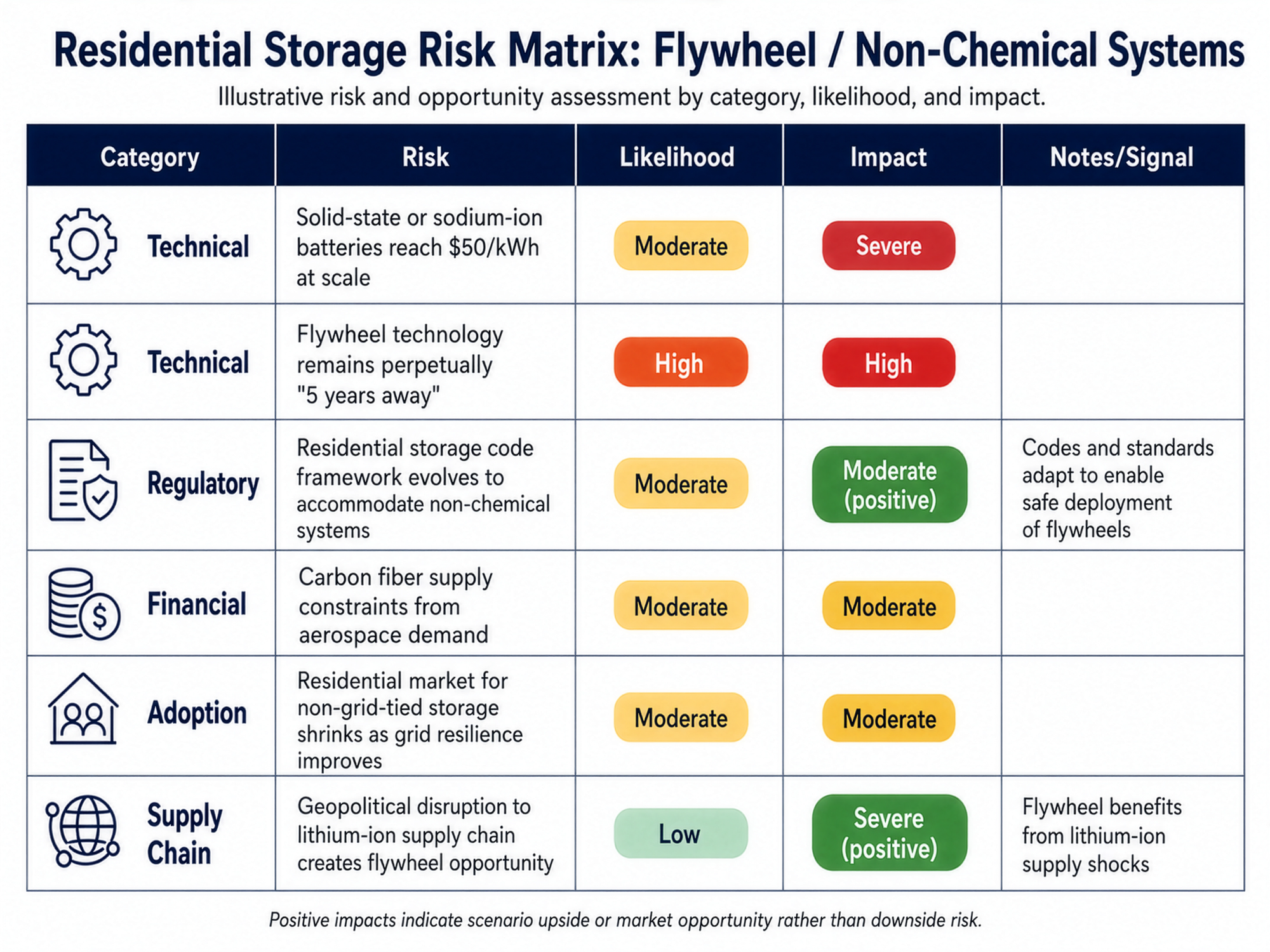
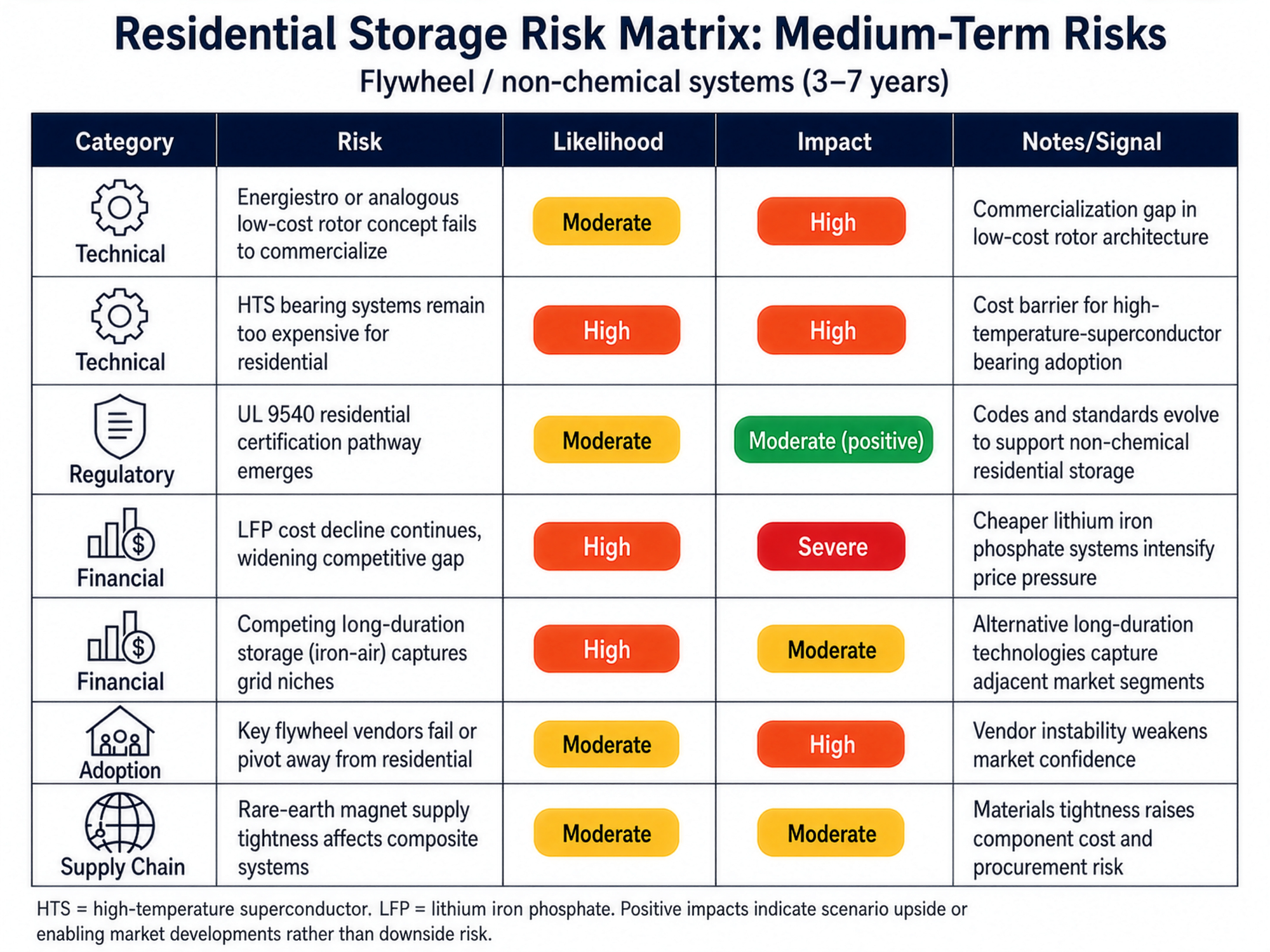
The risk landscape for flywheel storage in the off-grid residential segment is structured below across three time horizons and five risk categories. Likelihood is rated on a four-point scale (Low, Moderate, High, Very High) and impact on a four-point scale (Low, Moderate, High, Severe).
Short-term (1 to 3 years):
| Category | Risk | Likelihood | Impact |
|---|---|---|---|
| Technical | No UL 9540-listed residential product available | Very High | High |
| Technical | Self-discharge above acceptable threshold for daily cycling | Very High | Severe |
| Regulatory | Permitting requires custom engineering review | High | Moderate |
| Financial | Cost premium of 3 to 5x LFP | Very High | Severe |
| Adoption | Installer and integrator scarcity | Very High | High |
| Adoption | Insurance coverage uncertainty | High | Moderate |
| Supply Chain | Carbon fiber availability for composite systems | Moderate | Moderate |
The dominant short-term risks are economic and technical, and they are essentially binding: no residential homesteader making a 2026 storage decision can avoid the cost and self discharge problems through any choice of currently available product.
Medium-term (3 to 7 years):
| Category | Risk | Likelihood | Impact |
|---|---|---|---|
| Technical | Energiestro or analogous low-cost rotor concept fails to commercialize | Moderate | High |
| Technical | HTS bearing systems remain too expensive for residential use | High | High |
| Regulatory | UL 9540 residential certification pathway emerges | Moderate | Moderate (positive) |
| Financial | LFP cost decline continues, widening competitive gap | High | Severe |
| Financial | Competing long-duration storage (iron-air) captures grid niches | High | Moderate |
| Adoption | Key flywheel vendors fail or pivot away from residential | Moderate | High |
| Supply Chain | Rare-earth magnet supply tightness affects composite systems | Moderate | Moderate |
The medium-term risks are dominated by competitive dynamics: even if flywheel technology improves, LFP and iron-air improvements are likely to maintain or widen the competitive gap.
Long-term (7+ years):
| Category | Risk | Likelihood | Impact |
|---|---|---|---|
| Technical | Solid-state or sodium-ion batteries reach $50/kWh at scale | Moderate | Severe |
| Technical | Flywheel technology remains perpetually “5 years away” | High | High |
| Regulatory | Residential storage code framework evolves to accommodate non-chemical systems | Moderate | Moderate (positive) |
| Financial | Carbon fiber supply constraints from aerospace demand | Moderate | Moderate |
| Adoption | Residential market for non-grid-tied storage shrinks as grid resilience improves | Moderate | Moderate |
| Supply Chain | Geopolitical disruption to lithium-ion supply chain creates flywheel opportunity | Low | Severe (positive) |
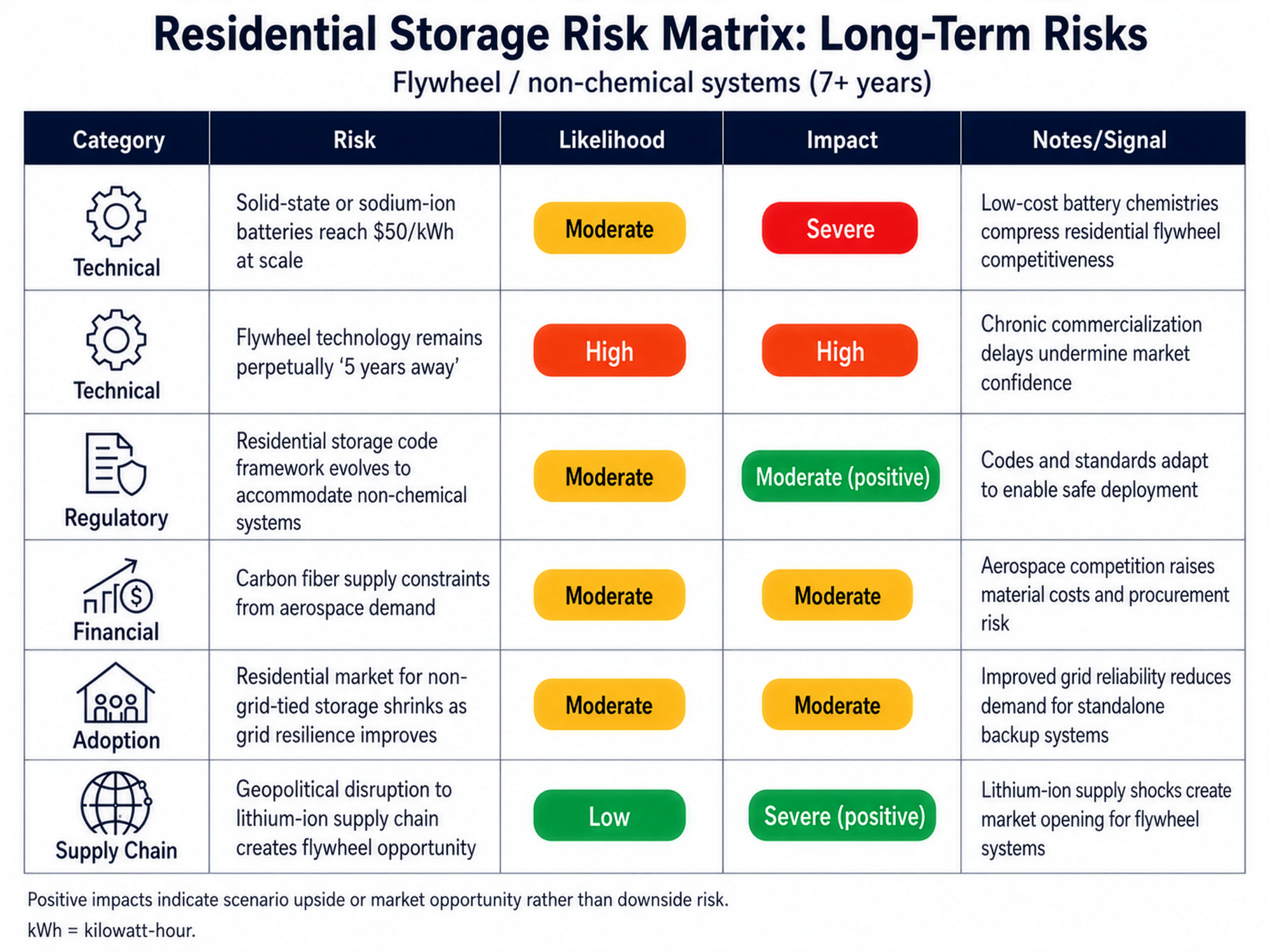
The long-term risk profile is dominated by the competitive trajectory of chemical storage technologies. The most plausible pathway to flywheel residential viability is a discontinuity in chemical storage cost trajectory, which by definition cannot be forecast with confidence. The narrative implication of the matrix is that the risk-adjusted expected return on flywheel investment for residential off-grid applications is unfavorable across all three horizons. The technology is most defensible as a complement to chemical storage in specific niches rather than as a primary daily-cycle storage technology.
11. Strategic Recommendations
11.1 Recommendations for Off-Grid Homesteaders and Rural Self-Sufficiency Practitioners
For a homesteader evaluating energy storage in 2026, the recommendation is to select LFP battery storage as the primary daily-cycle technology and to defer flywheel consideration to a future decision cycle. This recommendation applies across the moderate and productive homestead profiles defined in Section 2.1 and across most cold-climate applications where the lithium-ion temperature derating can be managed through standard cabinet conditioning.
The conditions under which the recommendation does not apply are narrow but identifiable. A homesteader with extreme cold-climate operation (sustained ambient temperatures below-30°C), substantial mechanical and electrical engineering background, access to retired commercial flywheel hardware at substantial discount to new pricing, and willingness to accept operational risk may rationally deploy a repurposed flywheel as supplementary storage. A homesteader with access to micro-hydro generation at high cycling rates may rationally pair a small flywheel with a smaller battery bank to reduce battery cycle wear. A homesteader with environmental or philosophical objections to chemical battery disposal who can absorb the cost premium may rationally select an Energiestro or comparable low cost-rotor system if and when one reaches commercial availability with adequate demonstration history. None of these exceptions applies to the typical homestead.
Homesteaders considering Torus Station or analogous integrated residential flywheel-and battery products should evaluate them as primarily LFP battery systems with a flywheel power-conditioning layer, since the flywheel in these systems provides the same role it provides in commercial Torus deployments. Whether the flywheel power-conditioning layer justifies the cost premium over an LFP-only system depends on specific load characteristics, but for typical homestead loads it does not.
11.2 Recommendations for Investors and Entrepreneurs
For investors evaluating the flywheel sector, the recommendation is to focus capital allocation on commercial and grid-services applications (data center power conditioning, EV fast-charge buffering, grid frequency regulation, microgrid stabilization) where the technology’s power-density advantage and cycle-life advantage have clear economic value. Residential flywheel ventures should be evaluated with skepticism: the unit economics, the absence of an installer ecosystem, the regulatory pathway uncertainty, and the LFP competitive trajectory combine to make the residential market economically unattractive on any plausible commercial timeline.
The most credible flywheel ventures from an investor perspective are those that either (a) position as power-conditioning and grid-services suppliers with hybrid flywheel-and-battery offerings, capturing margin in the commercial-and-industrial market while leaving residential to chemical storage; or (b) pursue a low-cost rotor breakthrough (concrete, low cost composite) with explicit cost targets that would close the gap with chemical storage and explicit milestones for demonstration, certification, and commercial deployment. Energiestro represents a defensible if speculative investment thesis on the second pathway; Revterra and Torus represent more conventional theses on the first pathway.
Entrepreneurs considering entry into the flywheel sector should design business models around commercial and grid customers from inception, with residential as a possible long term adjacency rather than a near-term target. Direct-to-consumer flywheel businesses face customer acquisition cost burdens that the unit economics cannot support at present price points.
11.3 Recommendations for Policymakers and Program Designers
For policymakers evaluating energy storage technology portfolios, the recommendation is to fund flywheel research and demonstration in their natural niches (grid services, commercial power quality, long-duration research where applicable) but to resist proposals to subsidize residential flywheel deployment as a primary policy intervention. Public dollars allocated to residential storage subsidy are more efficiently spent on chemical storage deployment, on grid resilience investment, or on long-duration storage R&D in technologies (iron-air, novel chemistries) that have demonstrated stronger pathways to cost-effective scale.
Specific policy recommendations follow from this framing. ARPA-E and DOE storage R&D programs should continue to fund flywheel materials and bearing research at the basic and applied science levels, recognizing that occasional breakthroughs in flywheel technology (HTS bearings, low-cost rotors) generate spillover value beyond the residential application. Industrial policy programs that support domestic manufacturing of flywheel components for commercial and grid applications can be justified on supply-chain-sovereignty grounds, particularly for steel-rotor systems that avoid rare-earth dependencies. Building code and certification authorities should develop a clear pathway for residential flywheel certification under UL 9540 or analogous frameworks so that the technology is not blocked by certification gaps if and when economic viability is achieved. Direct subsidy of residential flywheel installation, however, is not justified on present cost-benefit grounds and should not be incorporated into Inflation Reduction Act extensions or analogous programs.
Policymakers concerned with rural energy resilience and off-grid populations should focus on supporting LFP storage deployment, micro-grid infrastructure, and the installer workforce that serves rural-residential markets, rather than on technology-specific bets on emerging storage modalities.
John D
12. References
[1] Amiryar, M. E., & Pullen, K. R. (2017). A review of flywheel energy storage system technologies and their applications. Applied Sciences, 7(3), 286.
[2] Amiryar, M. E., & Pullen, K. R. (2020). Analysis of standby losses and charging cycles in flywheel energy storage systems. Energies, 13(17), 4441.
[3] Choudhury, S. (2021). Flywheel energy storage systems: A critical review on technologies, applications, and future prospects. International Transactions on Electrical Energy Systems, 31(9), e13024.
[4] Strasik, M., Johnson, P. E., Day, A. C., Mittleider, J., Higgins, M. D., Edwards, J., Schindler, J. R., et al. (2005). Design, fabrication, and test of a 5 kWh / 100 kW flywheel energy storage utilizing a high-temperature superconducting bearing. Sandia National Laboratories EESAT Conference Paper.
[5] BloombergNEF. (2025). Lithium-ion battery pack prices fall to $108/kWh. BloombergNEF Annual Battery Price Survey, December 2025.
[6] Cole, W., & Karmakar, A. (2025). Cost projections for utility-scale battery storage: 2025 update (NREL/TP-6A40-93281). National Renewable Energy Laboratory.
[7] Walkingshaw, N. (2025, October). Flywheel + battery storage achieves 99.9% uptime [Interview]. Battery Technology Online.
[8] KSL Television. (2024, January). Utah man creates company devoted to flywheel energy storage. KSL News.
[9] Torus, Inc. (2024, November 26). Torus unveils flywheel, battery energy storage, AI-driven cybersecurity solutions. Energy Storage News.
[10] Munro & Associates. (2025, October). How Torus' Nova Pulse energy storage solution powers a secure U.S. grid. Lean Design Reports.
[11] CleanTechnica. (2026, April 19). From Beacon to Amber, flywheels missed the grid.
[12] CompositesWorld. (2025, January). High-tension, vertical filament winding enables affordable flywheel energy storage system.
[13] Energiestro. (2025). VOSS: The solar storage flywheel. Company Technical Documentation. Essert, France.
[14] IEEE Spectrum. (2023, May). Flywheels turn superconducting to reinvigorate grid storage potential.
[15] Greentown Labs. (2024). Revterra's kinetic energy storage brings stability to the grid, AI data centers, and more. Greentown Labs Member Spotlight.
[16] U.S. Department of Energy. (2010). Loan guarantee for Beacon Power Stephentown project. DOE Loan Programs Office.
[17] U.S. Department of Energy. (2012). ARRA smart grid project funding for Beacon Power Hazle Township plant. Office of Electricity Delivery and Energy Reliability.
[18] IEEE Spectrum. (2011). Beacon Power hits a speed bump with bankruptcy filing. IEEE Spectrum.
[19] Rockland Capital. (2012, March 7). Rockland Capital completes acquisition of Beacon Power Corporation [Press release].
[20] Power Magazine. (2014, August). Beacon Power makes a comeback.
[21] Amber Kinetics, Inc. (2016). Final technical report: Flywheel energy storage demonstration (DOE Award DE-OE0000232). U.S. Department of Energy Office of Electricity.
[22] California Energy Commission. (2019). Flywheel systems for utility-scale energy storage: Final project report (CEC-500-2019-012). Sacramento, CA.
[23] Key Energy. (2024). MPowerTank technical documentation and safety validation. Key Energy Company Documentation, in collaboration with University of Technology Sydney Centre for Built Infrastructure and Research.
[24] Energy Storage News. (2024, June). China connects its first large-scale flywheel storage project to grid.
[25] Li, X., & Palazzolo, A. (2022). A review of flywheel energy storage systems: State of the art and opportunities. Journal of Energy Storage, 46, 103576.
[26] International Renewable Energy Agency. (2017). Electricity storage and renewables: Costs and markets to 2030. IRENA.
[27] U.S. Department of Energy. (2019). Energy storage technology and cost characterization report (PNNL-28866). HydroWIRES Initiative, Water Power Technologies Office.
[28] Sanders, S., & Chiao, E. (2014). Amber Kinetics flywheel: Gen-3 technical specifications [DOE Energy Storage Peer Review Poster]. U.S. Department of Energy.
[29] Stadtwerke München & Stornetic GmbH. (2018). Flywheel storage power system Munich technical documentation. Stornetic Technical Brief.
[30] Advanced Research Projects Agency-Energy. (2018). Next-generation flywheel energy storage: Beacon Power project profile. ARPA-E.
[31] Schmidt, A. (2021). Flywheel: A DIY demonstrator of flywheel energy storage [GitHub repository]. https://github.com/a-sc/Flywheel
[32] Open Source Ecology. (2022). Flywheel energy storage wiki entry. Open Source Ecology Wiki.
[33] DIY Solar Power Forum. (2021–2024). Flywheel energy storage discussion thread [Practitioner forum discussion archive].
[34] EnergySage. (2025, December). Solar battery cost: Are they actually worth it in 2026? EnergySage Marketplace Data.
[35] CSIRO. (2023). Flow battery technology assessment. Commonwealth Scientific and Industrial Research Organisation.
[36] Form Energy, Inc. (2024, October 29). Iron-air battery technology and applications overview [Presentation]. ISO New England Energy Transition Working Group.
[37] Utility Dive. (2021, July). Form Energy's $20/kWh, 100-hour iron-air battery could be a substantial breakthrough.
[38] Mongird, K., Viswanathan, V., Alam, J., Vartanian, C., Sprenkle, V., & Baxter, R. (2022). Energy storage grand challenge cost and performance assessment 2022 (PNNL-33283). Pacific Northwest National Laboratory, U.S. Department of Energy.
[39] Hassan, A., Ali, B., & Kumar, A. (2022). The development of a techno-economic model for the assessment of the cost of flywheel energy storage systems for utility-scale stationary applications. Sustainable Energy Technologies and Assessments, 47, 101382.
[40] TechBuzz News. (2023). Torus launches Torus Station. TechBuzz News.
[41] Business Wire. (2024, September 18). Torus announces commercial energy storage installation for affordable housing [Press release].
[42] Advanced Research Projects Agency-Energy. (2018). DAYS: Duration addition to electricitY storage program overview. U.S. Department of Energy.