What's the Best Off-Grid Water Heating System? Compost, Biogas, Solar, and Wind Compared
Five off-grid water heating technologies compared on cost, climate performance, labor burden, and incentive eligibility.

Off-Grid Water Heating Compared: Jean Pain Compost, Biogas, PV Heat Pump, Evacuated-Tube Solar, and Small Wind
1. Summary
Water heating represents one of the most consequential and underexamined leverage points in off-grid energy planning. According to the U.S. Energy Information Administration’s 2015 and 2020 Residential Energy Consumption Surveys, water heating accounts for approximately 16 to 24 percent of total household energy consumption, with absolute demand ranging from 12.5 million BTU per year for two-person households to 22.7 million BTU per year for four-person households. [1][2]. For rural, agricultural, institutional, and community-scale operators outside reliable grid service territories, the technology selected to meet this load shapes operating expenditures, labor obligations, capital structure, and resilience posture for two to three decades. This report evaluates five categorically distinct off-grid water heating pathways: (1) Jean Pain–style compost thermal recovery; (2) anaerobic digestion with biogas combustion; (3) photovoltaic (PV) electric water heating coupled to resistive elements or heat pump water heaters; (4) evacuated-tube solar thermal collectors; and (5) small wind turbine systems (1 to 10 kilowatts) driving electric water heating loads.
The central finding is that no single technology dominates across all evaluation criteria. Rather, the five systems occupy distinct economic, operational, and risk niches that align with different user profiles, climates, and policy environments. PV-driven heat pump water heaters demonstrate the strongest combination of capital efficiency, low maintenance burden, and supply chain maturity, with installed costs in the range of USD 5,000 to 8,500 for a typical four-person household. [3]. Evacuated-tube solar thermal systems offer superior winter performance and high collector-level efficiencies (70 to 90 percent thermal conversion in optimal operating regimes), but at higher installed cost (USD 7,000 to 10,000) and with a narrowing competitive position relative to the falling cost of PV [3][4]. Anaerobic digestion is structurally most attractive where waste streams require management regardless of energy recovery (concentrated animal feeding operations, food processing, institutional kitchens), with EPA AgSTAR data identifying 8,000 large U.S. dairy and hog operations as technically feasible candidates [5]. Compost thermal recovery occupies a defensible niche for operators with continuous biomass throughput (forestry residues, livestock bedding) but suffers from data asymmetries, regulatory non-recognition as renewable energy under most incentive frameworks, and high “invisible labor” loads. Residential-scale wind for water heating is the most marginal application: U.S. Department of Energy distributed wind data report an average small turbine capacity factor of approximately 17 percent (with a documented range of 2 to 36 percent), and capital costs for a 5 to 15 kW freestanding turbine of USD 20,000 to 80,000 typically yield unfavorable economics relative to PV unless the site features Class 3 wind resource or better [6][7][8].
For rural homesteaders pursuing maximum self-sufficiency at moderate capital investment, evidence supports a primary recommendation of PV plus heat pump water heater, with thermosiphon evacuated-tube backup in cold climates and biogas as a fallback in livestock rich settings. For institutional and commercial operators (small farms, off-grid lodges, rural clinics, schools, processing facilities), the optimal architecture is typically hybrid: evacuated-tube solar thermal as the baseload heat source with biogas or compost thermal recovery as winter and night backup where waste streams are available, and PV for electrical loads. For policymakers, the highest-leverage interventions are: (a) explicit regulatory recognition of compost thermal energy as a renewable resource for incentive eligibility, where evidence currently flags structural disadvantage [9]; (b) standardized small-scale digester safety codes that reduce permitting friction; (c) continued NREL Competitiveness Improvement Project (CIP) support for the small wind sector, which has demonstrated material LCOE reductions for the Bergey Excel 15 and similar platforms [10]; and (d) adoption-pathway funding for hybrid configurations rather than single-technology subsidies
Comparative rankings indicate that PV plus heat pump leads on capital cost, supply chain maturity, and lifecycle carbon. Evacuated-tube solar thermal leads on per-square-meter thermal yield and embodied-energy payback time (under two years in most published lifecycle assessments) [11]. Anaerobic digestion leads on dispatchability and waste valorization. Compost thermal recovery leads on energy sovereignty and circular-economy attributes but trails on quantification, code compliance, and labor economics. Small wind ranks last for almost all residential water heating contexts but retains a defensible niche in remote, high-wind, low-solar-resource locations (interior Alaska, certain Great Plains and Appalachian ridge sites, coastal Atlantic Canada and similar geographies). The principal strategic insight is that the technology choice should be made jointly with the available waste-stream, weather, labor, and capital portfolio of the site, not as a freestanding technology selection. Operators evaluating these systems should resist single-vendor framing and instead use the analytical structure presented in Sections 5 through 10 of this report.
- Summary
- Introduction and Contextual Background
2.1 Definition of Scope
2.2 Why Water Heating Matters in Off-grid Energy Planning
2.3 Technological and Adoption Context
2.4 Strategic Drivers - Technology Profiles and Operational Principles
3.1 Compost-based Thermal Recovery (Jean Pain Method and Variants)
3.1.2 Quantified Thermal Output
3.1.3 System Configuration
3.1.4 Climate and Seasonal Performance
3.15. Inputs, Lifespan, and Maintenance
3.2 Biogas Collection and Combustion
3.2.1 Operating Principle
3.2.2 Quantified Output
3.2.3 Configuration
3.2.4 Climate Performance
3.2.5 Inputs, Lifespan, and Maintenance
3.3 Photovoltaic (PV) and Solar Electric Water Heating
3.3.1 Operating Principle
3.3.2 Quantified Output and Configuration
3.3.3 Climate Performance
3.3.4 Lifespan and Maintenance
3.4 Evacuated-Tube Solar Thermal Water Heating
3.4.1 Operating Principle
3.4.2 Quantified Output
3.4.3 Configuration
3.4.4 Climate Performance
3.4.5 Lifespan and Maintenance
3.5 Residential-Scale Wind Turbine Water Heating
3.5.1 Operating Principle
3.5.2 Quantified Output
3.5.3 Configuration
3.5.4 Climate Performance
3.5.5. Lifespan and Maintenance - Key Players, Stakeholders, and Supply Chain Landscape
4.1 Compost Thermal: Niche Integrators and DIY Community
4.2 Biogas: Industrial Players, Smallholder Disruptors, and Policy Mediators
4.3 PV: Highly Commoditized Global Supply Chain
4.4. Evacuated-Tube Solar Thermal: Concentrated Manufacturing, Thinning Distribution
4.5 Small Wind: Concentrated Manufacturing, Volatile Market Structure - Economic and Market Dynamics
5.1 Capital Cost Comparison
5.2 Levelized Cost of Heat (LCOH)
5.3 Operating and Maintenance Cost Trajectories
5.4 Incentive Landscape and Market Distortions
5.5 Invisible Labor and Knowledge Barrier Economics - Technical and Operational Considerations
6.1 Reliability and Dispatchability
6.2 Integration Complexity
6.3 Hybrid and Complementary Configurations
6.4 Climate Zone Suitability Matrix - Environmental and Sustainability Analysis
7.1 Lifecycle Carbon Footprint
7.2 Circular Economy and Waste Valorization
7.3 Land Use and Ecological Footprint - Regulatory Landscape
8.1 Insurance and Liability Dimension - Geopolitical and Strategic Dimensions
- Risk Matrix
10.1 Short Term Risks (1-3 Years)
10.2 Medium-Term Risks (3-7 Years)
10.3 Long-Term Risks (7+ Years)
10.4 Cross-Cutting Risk Observations - Strategic recommendations
11.1 Rural Homesteaders and Smallholders
11.1 Institutional and Commercial Operators
11.1 Policymakers and Program Designers - References
2. Introduction and Contextual Background
2.1 Definition of Scope
For the purposes of this report, “off-grid water heating” refers to systems intended to deliver domestic-quality hot water (typically 49 to 60 °C delivery temperatures, with peak demand events between 30 and 80 gallons per day per household) at sites that are either (a) not connected to a centralized electric or natural gas utility, (b) connected but seeking to operate water heating independently of grid energy or fossil fuel inputs, or (c) connected but seeking resilience against extended utility outages. The analysis is bounded to residential single-family, smallholder-agricultural, institutional (schools, clinics, lodges), and community-scale (small district or shared-tenant) deployments. Industrial process heat above 80 °C, district heating systems above 50 dwelling-unit equivalents, and grid-tied sell back configurations are out of scope.
2.2 Why Water Heating Matters in Off-Grid Energy Planning
Water heating typically constitutes the second- or third-largest residential energy load in temperate-climate U.S. households, behind space heating and approximately co-equal with cooling [1][2]. In four-person households, EIA data place water heating at roughly 24 percent of total household energy consumption on [1]. For grid connected households, this load is largely invisible because it is dispatched by a utility commodity (natural gas or grid electricity). For off-grid households, the same load must be satisfied locally, which makes water heating a defining design constraint for the entire energy system. The temperature gradient required (cold ground or cistern water typically 5 to 18 °C raised to 49 to 60 °C delivery) implies a delta-T of 30 to 55 °C, corresponding to roughly 8.34 BTU per gallon per degree Fahrenheit, or approximately 5,000 to 9,000 BTU to heat a single 30-gallon shower draw.
2.3 Technological and Adoption Context
The five technologies examined have widely divergent maturity trajectories. Solar PV is the most rapidly maturing, with module-level embodied carbon falling from above 75 g CO2/kWh in 2010 to a current range of 20 to 34 g CO2/kWh per Etude and circular-ecology analyses, and Bloomberg New Energy Finance and IRENA reporting capital cost reductions of more than 80 percent over the same period [12][13]. Evacuated-tube solar thermal is technically mature but commercially stagnant in North America; market share has eroded as PV-coupled heat pumps have captured the residential water heating retrofit market [3]. Anaerobic digestion is mature for industrial and large-farm scale (EPA AgSTAR documents approximately 263 operational livestock-farm digesters in the United States as of recent reporting) but is only emergent at residential scale, with HomeBiogas, Puxin, and a small number of other manufacturers offering plug-and-play kits [5][14]. Distributed small wind has experienced two decades of erratic adoption, with cumulative U.S. installed capacity of 1,110 MW from over 92,000 turbines through 2023, but recent annual installations have declined as residential PV has become structurally cheaper [10][15]. Compost thermal recovery, despite a documented history dating to Jean Pain’s published work in 1972, remains predominantly a DIY or research-demonstration technology with only a handful of commercial integrators (Agrilab Technologies of Vermont being the most prominent) [16][17]
2.4 Strategic Drivers
Five interlocking drivers are accelerating interest in decentralized water heating: (1) climate adaptation and grid resilience concerns following extended outages associated with hurricanes, wildfires, ice storms, and cyber events; (2) energy sovereignty considerations for agricultural producers and Indigenous communities; (3) decarbonization mandates that are reshaping building codes (multiple U.S. jurisdictions now restrict new natural gas connections); (4) circular-economy framing of agricultural and food waste, which reframes biogas and compost thermal as waste-management assets with embedded energy recovery; and (5) the documented decline in capital costs for PV and the accompanying reframing of “off-grid” as a viable economic choice rather than a hardship. These drivers do not align uniformly across the five technologies, which is part of the reason no single technology dominates.
3. Technology Profiles and Operational Principles
3.1 Compost-Based Thermal Recovery (Jean Pain Method and Variants)
3.1.1 Operating Principle
Aerobic decomposition of lignocellulosic biomass by mesophilic and thermophilic microbial communities releases substantial heat as a byproduct of microbial respiration. Pile core temperatures of 55 to 70 °C are routinely achieved and sustained for periods of weeks to months in well-managed mounds. A heat exchanger, traditionally several hundred meters of HDPE or PEX tubing coiled within the mound, transfers this heat to a circulating water loop that can serve domestic hot water, radiant floor heating, or hydronic space heating loads. The original 1970s-era system documented by Jean Pain used a 50-tonne brushwood heap with embedded tubing that warmed well water from 10 °C to 60 °C at a rate of 4 liters per minute over a six-month cycle [16]. Modern variants developed by Compost Power, Agrilab Technologies, and academic groups at the University of New Hampshire and University of Vermont employ aerated static pile (ASP) configurations and condenser-type heat exchangers to extract heat from the moist exhaust air rather than (or in addition to) the pile interior, increasing recoverable thermal energy and reducing biological process disruption [17][18].
3.1.2 Quantified Thermal Output
Smith et al.‘s comprehensive review of compost heat recovery systems reports recovery rates averaging 1,895 kJ/hr for laboratory systems, 20,035 kJ/hr (approximately 19,000 BTU/hr or 5.6 kW thermal) for pilot-scale systems, and 204,907 kJ/hr (approximately 194,000 BTU/hr or 57 kW thermal) for commercial systems [16]. A representative 31 m³ Pain-style mound has been reported to recover approximately 10,550 kJ/hr (10,000 BTU/hr or 2.9 kW thermal) over a 12 to 18 month cycle [16]. Agrilab Technologies’ Isobar systems deployed at Diamond Hill Custom Heifers, Jasper Hill Farm, and other Vermont sites report sustained capture of approximately 1,000 BTU/hr per ton of compost continuously over an eight-week batch cycle, equating to roughly 1.4 million BTU per ton of feedstock processed [17][18]. For a single family residential application heating 60 gallons per day at 30 °C delta-T (approximately 35,000 BTU/day demand), a properly sized and managed pile of 3 to 6 m³ refreshed every 12 to 18 months can in principle meet the load.
3.1.3 System Configurations
Three configurations dominate practitioner literature: (a) the classical Pain mound, a freestanding insulated heap with embedded coiled tubing; (b) the Agrilab-style aerated static pile with vapor extraction and external heat exchanger; and (c) hybrid configurations that integrate a sealed central biogas digester within the mound, combining aerobic heat capture with anaerobic methane production [16][19]. Single-family applications typically require 15 to 25 cubic yards of feedstock (woodchips, manure, or mixed agricultural residue) and 60 to 120 m of heat exchange tubing.
3.1.4 Climate and Seasonal Performance
Pile core temperatures are largely insulated from ambient conditions during the active thermophilic phase (first 30 to 90 days) but heat extraction efficiency and biological activity decline in cold-continental climates (Köppen Dfb, Dfc) where pile surfaces freeze and aeration becomes difficult. Performance is most consistent in temperate (Cfa, Cfb) and Mediterranean (Csa, Csb) zones. In hot-arid climates (BWh, BSh), moisture management dominates as a failure mode; piles desiccate without active irrigation. Independent peer reviewed verification of year-round residential-scale performance in cold-continental climates is limited, and this data sparsity is itself a significant decision-making consideration. [16].
3.1.5 Inputs, Lifespan, and Maintenance
A single pile cycle typically lasts 12 to 18 months before microbial activity declines and the pile must be turned, harvested as finished compost, and rebuilt. Required feedstock for a residential system is on the order of 15 to 25 cubic yards of woodchip-equivalent biomass per cycle. Heat exchange tubing (HDPE/PEX) has a service life of 20 to 50 years if not damaged during pile turnover; circulation pumps require replacement at 5-to-10-year intervals. Failure modes include pile collapse, anaerobic pocket formation (which kills heat output and can create hydrogen sulfide odors), pump failure, and tubing damage during pile reconstruction.
3.2 Biogas Collection and Combustion
3.2.1 Operating Principle
Anaerobic digestion uses methanogenic archaea and acidogenic bacteria, in the absence of oxygen, to convert organic matter (manure, food waste, agricultural residue, sewage) into a mixed gas stream of approximately 60 to 70 percent methane and 30 to 40 percent carbon dioxide, with trace hydrogen sulfide and ammonia [20]. Raw biogas at 60 percent methane has a heating value of approximately 600 BTU/ft³, compared to natural gas at 1,000 BTU/ft³ [20]. The biogas can be combusted in a modified gas water heater or boiler to deliver hot water; some configurations route biogas through a small combined heat-and-power (CHP) genset and use both the electrical output and the engine waste heat.
3.2.2 Quantified Output
A residential-scale digester serving a single family with adequate organic input (on the order of 5 to 10 kg/day of mixed food and manure waste) typically produces 0.5 to 2 m³ of biogas per day, equivalent to approximately 10,000 to 40,000 BTU/day, or roughly 30 to 100 percent of the daily hot water energy demand for a small household [14][20]. Farm-scale digesters at concentrated dairy or hog operations produce orders of magnitude more; EPA AgSTAR estimates that the 8,000 large U.S. dairy and hog operations technically suitable for digesters could collectively produce more than 13 million MWh per year of energy equivalent and displace approximately 1,670 MW of fossil generation. [5].
3.2.3 Configurations
Three dominant configurations appear in the residential and small-commercial space: (a) flexible-bag tubular digesters (HomeBiogas, Puxin balloon-style), USD 1,500 to 6,000 installed, optimized for warm climates and cooking-scale gas demand; (b) fixed-dome masonry or fiberglass digesters of 1 to 10 m³ working volume, USD 5,000 to 15,000 installed, suitable for small farms; and (c) plug-flow or continuously stirred tank reactors (CSTRs) of 50 m³ and above, primarily on commercial dairies, with capital costs of USD 400 to 1,500 per wet ton of annual processing capacity. [14][21][22].
3.2.4 Climate Performance
Methanogenic activity is strongly temperature-dependent, with mesophilic optima at 35 to 40 °C and thermophilic optima at 50 to 55 °C. Below 20 °C, biogas production declines rapidly; below 10 °C it effectively halts [14][20]. In cold-continental climates, digesters require either insulation plus supplemental heating (often using a fraction of the biogas itself), siting in heated structures, or seasonal operation. EPA AgSTAR data analyzed by Iowa State University Extension confirm that covered-lagoon digesters in cold climates exhibit significant seasonal pulses with summer biogas production several times higher than winter. [22].
3.2.5 Inputs, Lifespan, and Maintenance
Required inputs are fresh organic waste at consistent composition and loading rate, plus inoculum at startup. Bag-style digesters have service lives of 10 to 15 years before bag replacement; fixed-dome and CSTR systems can operate 20 to 30 years with periodic seal, valve, and stirrer replacement. Maintenance burden includes daily feeding, weekly pH and gas-pressure monitoring, periodic desulfurization media replacement, and effluent management. Failure modes include acidification (pH crash from overloading), foaming, scum-layer formation, gas leaks, and freezing.
3.3 Photovoltaic (PV) Solar Electric Water Heating
3.3.1 Operating Principle
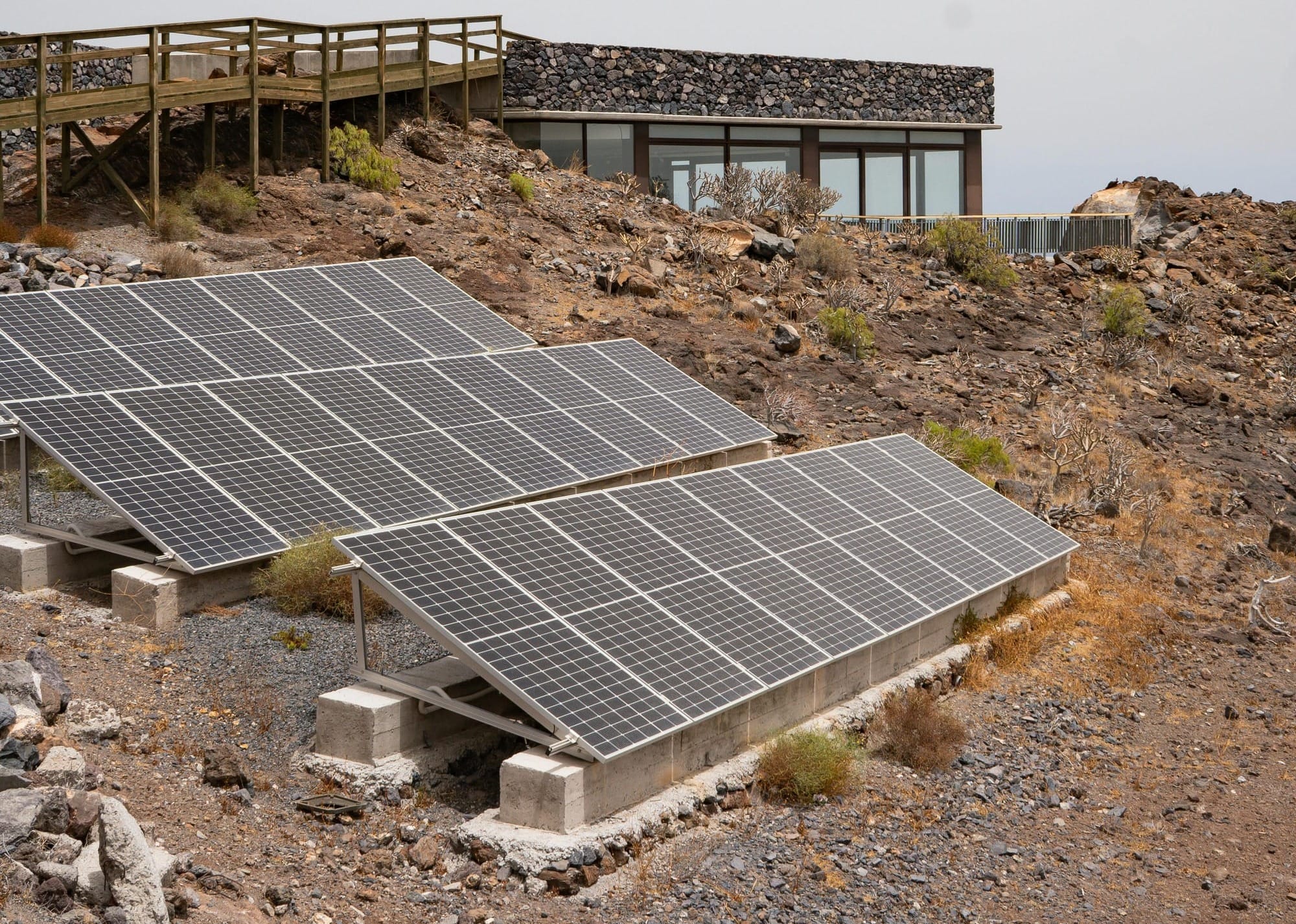
PV modules convert solar irradiance into DC electricity at module-level efficiencies of 18 to 23 percent for current-generation crystalline silicon. The electricity is delivered to a water heating load by one of three principal architectures: (a) direct DC coupling to a resistive element in a tank, with maximum power point tracking (MPPT) controllers; (b) AC coupling through an inverter to a standard resistive water heater; or (c) AC coupling through an inverter to a heat pump water heater (HPWH) with coefficient of performance (COP) typically 2.5 to 3.5 [3][4]. The third architecture is rapidly displacing solar thermal in many markets because the effective sun-to-heat efficiency of PV-plus-HPWH (approximately 18 to 22 percent PV efficiency × 2.5 to 3.5 COP, yielding 45 to 77 percent equivalent thermal conversion) approaches that of solar thermal collectors at substantially lower installed cost. [4]
3.3.2 Quantified Output and Configurations
A 1.0 to 1.5 kW PV array dedicated to water heating, paired with a 50 to 80 gallon HPWH (efficiency factor approximately 2.5, rated annual consumption approximately 1,800 kWh) is sufficient to fully offset water heating energy in a region producing at least 1,400 kWh/kW/year (most of the U.S. excluding Pacific Northwest) [3]. Capital costs are documented at USD 1,000 to 2,000 for the HPWH plus installation, and USD 3,500 to 6,000 for the marginal PV addition, totaling USD 5,000 to 8,500 before incentives [3]. Larger systems for institutional or community scale follow the same architecture with proportional sizing.
3.3.3 Climate Performance
PV performance scales linearly with cumulative annual irradiance. Northern temperate sites receive 1,100 to 1,400 kWh/kW/year; southwestern arid sites receive 1,800 to 2,200 kWh/kW/year. Cold-climate performance is enhanced by lower module operating temperatures, partially offsetting reduced winter irradiance. HPWH performance is degraded in cold ambient air (most HPWHs have minimum operating temperatures of 4 to 7 °C); this constrains the technology in unconditioned spaces in cold-continental climates and typically necessitates indoor placement.
3.3.4 Lifespan and Maintenance
PV modules carry standard 25-year linear performance warranties (typically 80 to 85 percent of nameplate at year 25) with field evidence supporting 30+ year functional life. String inverters require replacement at 10-to-15-year intervals; microinverters are warranted to 25 years. HPWHs have manufacturer-rated service lives of 10 to 15 years, with compressor and anode rod replacement as principal maintenance items. Module-level failure modes include encapsulant delamination, junction box water ingress, and hail damage.
 John D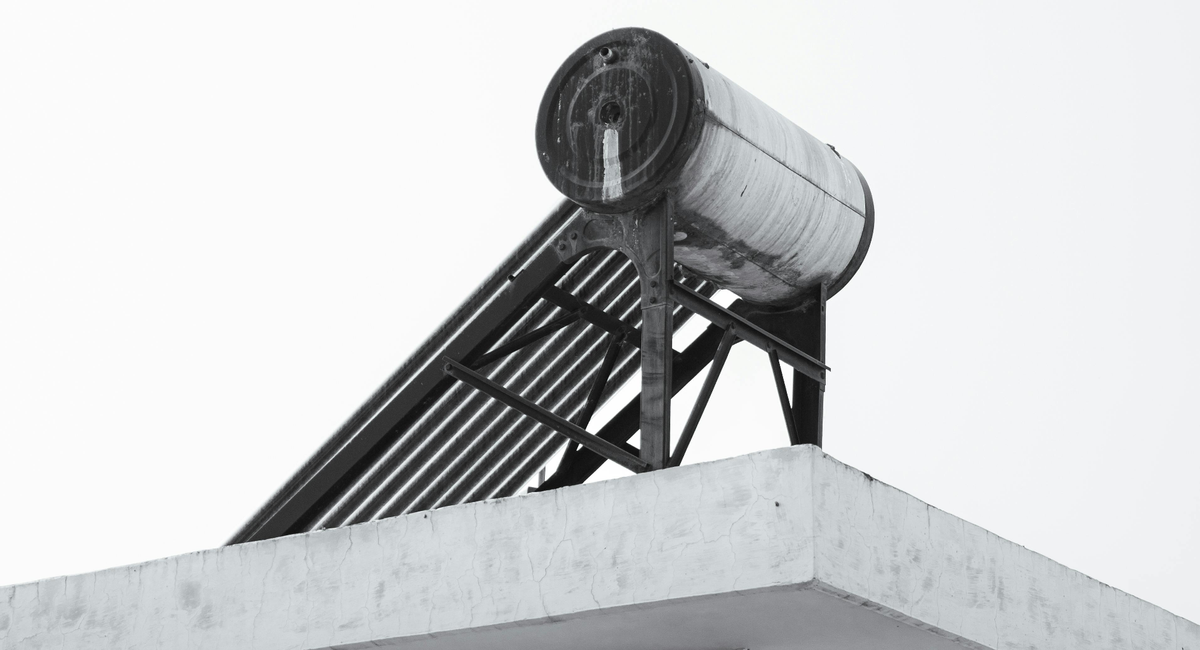
We wrote an entire article about Evacuated Tube Solar Water Heaters
3.4 Evacuated-Tube Solar Thermal Water Heating
3.4.1 Operating Principle
Evacuated-tube collectors consist of paired concentric borosilicate glass tubes with a high vacuum (typically below 5 × 10⁻³ Pa) maintained between the inner absorber tube and the outer envelope, suppressing convective and conductive heat losses [23]. A selective absorber coating (typically aluminum nitride/aluminum graded coatings) on the inner tube absorbs solar irradiance with greater than 92 percent absorptance at 80 °C operating temperature with emittance below 8 percent [23]. Heat is transferred to a water or glycol-water working fluid via direct flow, U-tube, or heat-pipe configurations and stored in an insulated tank. Circulation may be passive (thermosiphon) or active (pumped); pumped systems with closed-loop glycol are standard in freezing climates.
3.4.2 Quantified Output
Single-tube output ranges from approximately 1,400 BTU/day per tube under standard test conditions; a 30-tube collector array delivers up to approximately 58,000 BTU/day, sufficient for domestic hot water for a four to six person household in temperate climates [24]. Annual solar fraction (the share of water heating energy supplied by the system) is typically 50 to 80 percent in sunny climates with proper sizing, dropping to 30 to 50 percent in cold or cloudy regions [4]. Collector-level thermal efficiency for evacuated tubes is 70 to 90 percent under optimal conditions, materially higher than flat-plate collectors (40 to 70 percent), particularly at low ambient temperatures and high collector-to-ambient delta-T. [4][23].
3.4.3 Configurations
Standard residential systems comprise 20 to 30 evacuated tubes, 80 to 120 gallon storage tank with internal heat exchanger, glycol circulation pump, expansion tank, controller, and freeze-protection drainback or glycol loop. Installed costs for a closed-loop two-tank system designed for a four-person household are documented at USD 7,000 to 10,000 before incentives [3]. Direct-flow thermosiphon systems with integrated rooftop tank are cheaper (USD 3,000 to 6,000 installed) but limited to non-freezing climates.
3.4.4 Climate Performance
Evacuated-tube collectors retain a performance advantage over flat plate in cold and high latitude climates because of vacuum-suppressed thermal losses. They perform competently across all four climate zones examined in this report, though winter solar fractions in cold continental climates fall to 30 to 50 percent and require backup heating. [4][25].
3.4.5 Lifespan and Maintenance
Industry data indicate evacuated tube lifespans of 20 to 25 years for double-walled all-glass tubes, with single-walled tubes typically lasting 15 to 20 years [25][26]. Failure modes documented in the peer-reviewed Journal of Failure Analysis and Prevention include vacuum loss (visible via barium getter discoloration) salt-deposit blockages in hard-water regions, gasket failure leading to manifold leaks, and thermal-cycle stress at the glass-metal seal [27]. Maintenance comprises annual inspection, periodic glycol replacement (every 5 to 7 years), pump replacement (10-to-15-year intervals), and individual tube replacement at USD 30 to 50 per tube as needed. [25]
3.5 Residential-Scale Wind Turbine Water Heating
3.5.1 Operating Principle
Small wind turbines (1 to 10 kW nameplate, occasionally up to 15 kW for residential-scale applications) convert kinetic energy of moving air to mechanical rotation and then to electricity via a permanent-magnet or induction generator. The electricity is delivered to a resistive water heating element directly (with appropriate dump-load control) or, in more sophisticated configurations, to an HPWH via a battery-buffered AC bus or to the grid with net metering offset of grid electricity used by an electric water heater. [6][8]
3.5.2 Quantified Output
The U.S. Department of Energy’s Distributed Wind Market Report documents an average small-turbine capacity factor of approximately 17 percent across the U.S. installed base, with field-observed range of 2 to 36 percent depending on site wind resource [7][10]. A 5 kW turbine at 17 percent capacity factor produces approximately 7,446 kWh per year; a 10 kW turbine produces approximately 14,892 kWh; a 15 kW turbine produces approximately 22,338 kWh [7]. By contrast, residential water heating energy demand for a four-person household is approximately 4,500 to 6,500 kWh per year (assuming HPWH at COP 2.5 and 22.7 million BTU/year heating duty). Thus a properly sited 5 to 10 kW turbine can in principle meet residential water heating loads multiple times over, though wind intermittency requires either grid intertie, battery buffering, or a thermal mass tank for usable delivery.
3.5.3 Configurations
Three dominant configurations exist: (a) freestanding monopole or guyed-tower turbines of 5 to 15 kW (Bergey Excel 10/15, Eocycle EOX-S 25, Northern Power Systems NPS 100) on towers of 24 to 40 m, USD 20,000 to 80,000 installed before incentives; (b) micro-turbines (0.4 to 2.5 kW, Primus Air 30/40, Aeolos, vertical-axis variants) at USD 500 to 4,000, generally insufficient for whole-home water heating; and (c) hybrid wind-PV systems with shared inverter and battery infrastructure. [6][8][10]
3.5.4 Climate Performance
Site-specific wind resource dominates climate considerations. NOAA wind maps and NREL wind resource handbooks (which use a 7-class system) indicate that small wind is economically marginal below Class 3 (annual average wind speed below approximately 6.4 m/s at 50 m hub height) [7]. Hot-arid interior basins, hot-humid coastal-marine sites, and cold-continental ridges and coastlines tend to have favorable resource; densely vegetated temperate forest and most suburban sites have unfavorable resource regardless of regional climate.
3.5.5 Lifespan and Maintenance
Manufacturer-rated service lives are 20 to 25 years for major components HomeGuide with field-documented examples of 15 to 25 year operational lives [8]. Annual maintenance costs are documented at USD 500 to 1,000+ per year for freestanding home turbines, HomeGuide including bearing inspection, blade balancing, electrical connection servicing, and brake mechanism testing [8]. Failure modes include blade fatigue cracking, bearing failure, generator winding burnout, lightning damage, ice throw, and tower-foundation settlement.
4. Key Players, Stakeholders, and Supply Chain Landscape
4.1 Compost Thermal: Niche Integrators and DIY Community
The commercial compost thermal supply chain is small and concentrated. Agrilab Technologies LLC of Enosburg Falls, Vermont, founded in 2010 and licensed by Acrolab Ltd. (Windsor, Ontario) to use the patented Isobar heat-pipe-based system, is the principal U.S. commercial integrator [17][18]. The DIY and maker community plays a disproportionately large role: Compost Power (founded by Gaelan Brown, VTDigger author of “The Compost-Powered Water Heater,” 2014), Cornell Small Farms Program, the University of New Hampshire (Aber and Smith research group), the University of Vermont Gund Institute (Roy lab), and Appropedia provide design documentation, peer-reviewed studies, and operational data [16][17][28]. Open-source design repositories including Permies.com, Open Source Ecology, and the Appropriate Technology Collaborative host plan sets, build tutorials, and operational logs of varying engineering rigor.
4.2 Biogas: Industrial Players, Smallholder Disruptors, and Policy Mediators
The biogas supply chain bifurcates sharply by scale. At commercial-farm scale, principal U.S. integrators include DVO Inc., Biogest, RCM Digesters, and Vanguard Renewables, with policy-mediated intermediaries (renewable natural gas offtakers tied to California’s Low Carbon Fuel Standard) increasingly defining project economics [22][29]. At residential and smallholder scale, HomeBiogas (Israel), Puxin (China), Sistema.bio (Mexico/Kenya), and a long tail of regional fabricators dominate. The EPA AgSTAR program functions both as an information clearinghouse and a co-funder via USDA REAP and EPA EQUIP coordination [5][9]. International standards work and capacity-building are led by the Global Methane Initiative, World Biogas Association, and International Energy Agency Bioenergy TCP. Compared to compost thermal, the biogas supply chain has substantially better commoditized components (digester membranes, gas storage bladders, hydrogen sulfide scrubbers) and substantially better access to financing, particularly via REAP and IRA Section 45 production credits.
4.3 PV: Highly Commoditized Global Supply Chain
The PV supply chain is the most mature and globalized of the five technologies. Module manufacturing is concentrated in China (LONGi, JinkoSolar, Trina, JA Solar, Canadian Solar) with growing U.S. manufacturing capacity from First Solar, Qcells, and others incentivized by the Inflation Reduction Act. Inverter supply (Enphase, SolarEdge, SMA, Fronius) is geographically more distributed but semiconductor-dependent. HPWHs are produced by Rheem, A.O. Smith, Bradford White, Stiebel Eltron, and several Chinese manufacturers. Component-level commoditization, certification (UL 1741, IEC 61215), and broad installer availability (more than 250,000 trained installers in the U.S. and Canada per industry sources) make PV the lowest-friction system to procure, install, and service.
4.4 Evacuated-Tube Solar Thermal: Concentrated Manufacturing, Thinning Distribution
Evacuated-tube manufacturing is concentrated in China (Sunrain, Himin, Linuo Paradigma), with secondary manufacturing in Germany (Viessmann, Vaillant), Australia (Apricus, originally), and limited North American assembly. U.S. distribution has thinned over the past decade as residential demand has shifted to PV-plus-HPWH; SunMaxx, Apricus, Stiebel Eltron, and Caleffi remain among the active distributors. Industry organizations include the Solar Energy Industries Association (SEIA) thermal working group and the Solar Rating and Certification Corporation (SRCC), which administers OG-100 collector and OG-300 system certifications recognized by most state and federal incentive programs.
4.5 Small Wind: Concentrated Manufacturing, Volatile Market Structure
The small wind supply chain has experienced significant attrition. The U.S. Department of Energy’s 2024 Distributed Wind Market Report documents only six domestic and two foreign small wind manufacturers reporting U.S. sales in 2023, down from 13 in 2021 [10]. Bergey Windpower (Norman, Oklahoma), Eocycle Technologies (Quebec, Canada), Northern Power Systems (Italy/Vermont), Primus Wind Power, Xzeres Wind, Pika Energy, and Wind Turbine Industries Corp. are the leading platforms in U.S. residential and small-commercial market segments [10][30]. NREL’s Competitiveness Improvement Project (CIP) has been the principal public R&D mechanism, with documented contribution to halving the levelized cost of energy of the Bergey Excel 15 platform [31]. Rare-earth permanent-magnet generators are present in roughly 32 percent of land-based wind installations and create exposure to geopolitically concentrated supply (China controls 92 percent of global rare-earth magnet production according to U.S. Department of Energy supply-chain assessments) [32][33].
5. Economic and Market Dynamics
5.1 Capital Cost Comparison
Table 5.1 below presents itemized capital cost ranges for representative residential-scale installations meeting a four-person household water heating load of approximately 22.7 million BTU per year (equivalent to 6,650 kWh of useful thermal energy). Costs are in 2023 2025 USD and assume professional installation in moderate-cost U.S. labor markets. Where DIY pathways are common, lower-bound figures reflect owner-built systems with reasonable but not professional craftsmanship.
Table 5.1: Indicative Installed Capital Cost (Residential, Four-Person Household)
| Technology | Low Estimate (USD) | High Estimate (USD) | Notes |
|---|---|---|---|
| Compost thermal (DIY pain mound) | $1,500 | $6,000 | Assumes self-sourced biomass; includes pump, tubing, controller |
| Compost thermal (Agrilab Isobar, residential-adapted) | $15,000 | $35,000 | Commercial system pricing estimate |
| Biogas (HomeBiogas-style bag) | $1,500 | $5,000 | Author estimate based on commercial kits; not commodity-priced |
| Biogas (small farm fixed dome or CSTR) | $8,000 | $25,000 | Suitable for cooking and limited hot water; warm climates preferred |
| PV + heat pump water heater | $5,000 | $8,500 | Includes ~1.0–1.5 kW PV, HPWH, installation |
| Evacuated-tube solar thermal | $7,000 | $10,000 | Closed-loop two-tank system; sized for ~4-person household |
| Small wind (5–10 kW freestanding) | $20,000 | $80,000 | Includes tower, foundation, interconnect, and controls |
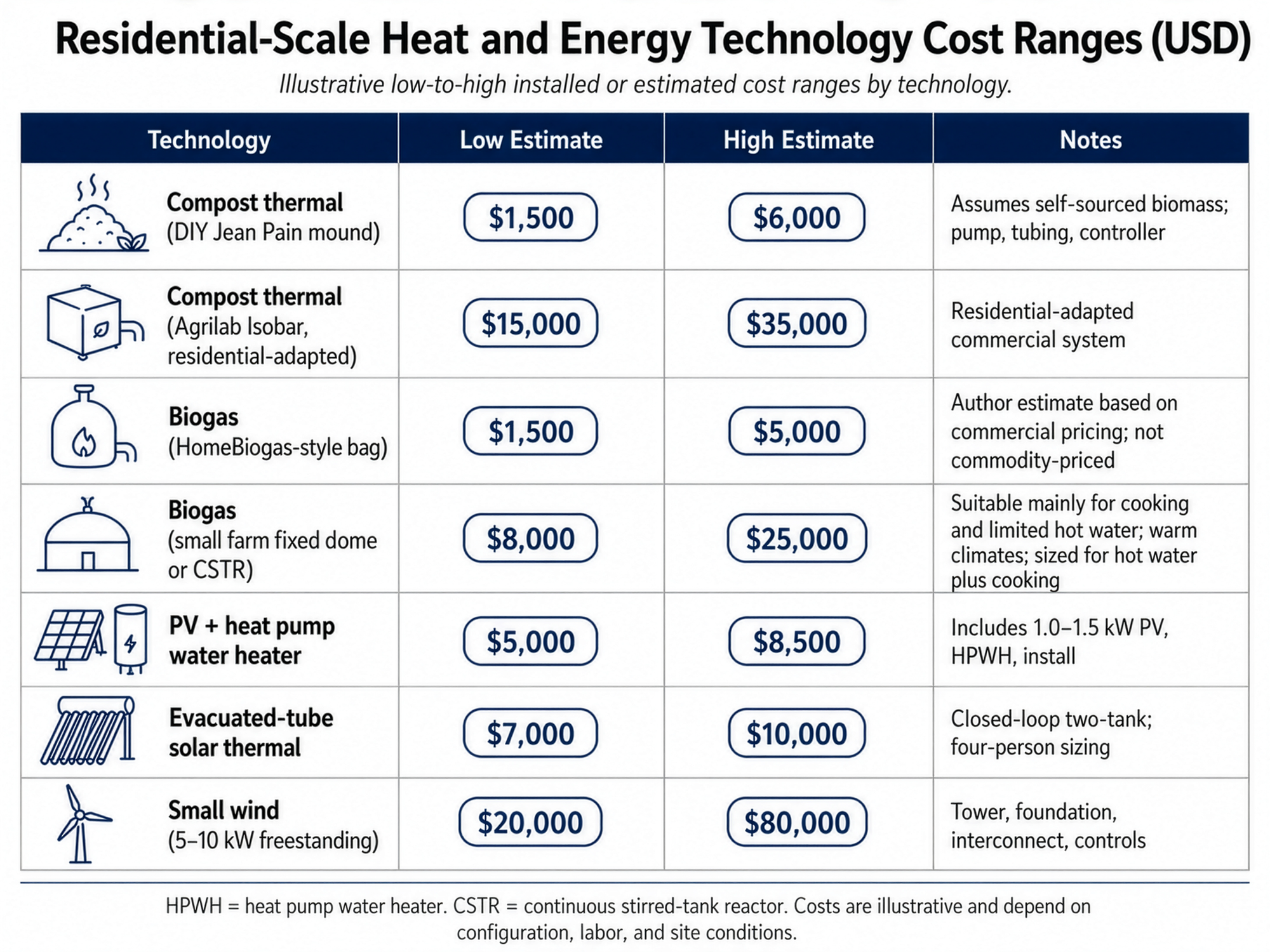
The order-of-magnitude differences between technologies are not artifacts of sizing assumptions; they reflect genuine differences in component density, labor intensity, and supply-chain maturity. The DIY compost pathway is the only sub-USD-2,000 option, but it imposes the highest non-monetary burden in labor and skill (see Section 6.2).
5.2 Levelized Cost of Heat (LCOH)
Levelized cost of heat compares technologies across their full economic life by amortizing capital, operations, and maintenance against delivered thermal energy. Reported and constructed LCOH figures, expressed in USD per kWh of useful thermal energy delivered, are summarized below. Standard discounting assumptions (5 percent real discount rate, system lives per Section 3, 2024 USD) are used unless otherwise noted.
PV + HPWH: Published LCOH from peer-reviewed comparative analyses ranges from USD 0.10 to 0.18 per kWh thermal in U.S. and Canadian conditions [4]. Lemmens et al. (2020, in Energies) and similar TRNSYS-based simulations place PV-HPWH LCOH below most solar thermal alternatives in moderate climates.
Evacuated tube solar thermal: Reported LCOH of USD 0.14 to 0.23 per kWh thermal in cold-climate Canadian/Northern U.S. conditions [4]. Iordanou et al. and Greening and Azapagic provide UK/EU comparisons in similar ranges.
Small wind (water heating end-use): LCOH derived from the NREL 2024 Annual Technology Baseline (ATB) distributed wind LCOE estimates of approximately USD 0.13 to 0.30 per kWh electrical (highly site-dependent), divided by HPWH COP of 2.5, yields a thermal LCOH of approximately USD 0.05 to 0.12 per kWh thermal at favorable sites and USD 0.15 to 0.30 per kWh thermal at marginal sites [10][32].
Biogas: Author-constructed estimate, flagged explicitly as such due to data sparsity at residential scale. Assuming USD 8,000 capital, 20-year life, 5 percent discount rate, USD 200/year O&M, and 3,000 kWh thermal per year delivered (conservative), LCOH approximates USD 0.27 per kWh thermal. At farm scale with on-site free feedstock and the digester serving multiple end uses, allocated LCOH for the water heating portion can fall to USD 0.06 to 0.10 per kWh thermal.
Compost thermal: Author-constructed estimate, flagged explicitly. Assuming USD 4,000 DIY capital, 10-year amortization (because periodic full pile rebuilds and component replacement effectively reset the system), USD 600/year for fresh feedstock if not free, USD 200/year for labor at minimal valuation, and 3,000 kWh thermal per year delivered, LCOH approximates USD 0.32 per kWh thermal. With free on-site feedstock and unvalued labor, the figure falls below USD 0.20 per kWh. With labor valued at modest agricultural wages, the figure exceeds USD 0.50 per kWh. The wide spread reflects the fundamental difficulty of LCOH comparisons for systems whose principal economic input is uncompensated household labor.
The data asymmetry between PV/solar-thermal/wind (with extensive peer-reviewed LCOH literature) and compost/biogas (with sparse and configuration-specific LCOH analysis) is itself an important finding. Decision-makers should treat compost and small-scale biogas LCOH figures as preliminary estimates with uncertainty bands of ±50 percent or greater.
5.3 Operating and Maintenance Cost Trajectories
Annual O&M costs differ by an order of magnitude across the five technologies. PV-plus HPWH requires approximately USD 50 to 200 per year (occasional inverter or HPWH compressor service). Evacuated-tube solar thermal requires USD 150 to 400 per year (glycol replacement, pump service, occasional tube replacement). Small wind requires USD 500 to 1,500 per year per [8], dominated by tower-climb labor. Residential biogas requires USD 100 to 500 per year (membrane, scrubber media, valves). Compost thermal requires USD 200 to 800 per year for materials plus an unmonetized labor burden of approximately 2 to 8 hours per week during active pile management (see Section 5.5).
Inverter and pump replacement cycles are predictable: 10 to 15 years for most string inverters, 10 to 12 years for circulation pumps under continuous duty. HPWH compressors typically last 8 to 12 years. Wind turbine bearings and brake mechanisms require service at 5-to-7-year intervals. Biogas digester membranes typically last 10 to 15 years.
5.4 Incentive Landscape and Market Distortions
The U.S. federal incentive landscape, principally the Residential Clean Energy Credit (Section 25D, 30 percent through 2032 with subsequent step-down) and the Section 48 Investment Tax Credit, treats the five technologies asymmetrically. Solar PV, solar thermal water heating, small wind (turbines under 100 kW), geothermal, and biomass/biogas are explicitly eligible. Compost thermal is not explicitly eligible; the USDA REAP definition of renewable energy under 7 CFR 4280 enumerates “wind, solar, renewable biomass, ocean, geothermal, or hydroelectric source, or hydrogen” but does not include heat from aerobic decomposition [9]. This creates a structural disadvantage in which compost thermal systems can sometimes qualify only under energy efficiency provisions (and only if they replace a defined energy load with documented savings) rather than under renewable energy provisions.
USDA REAP provides grants of 25 to 50 percent of project cost (with the higher 50 percent share available for projects in defined Energy Communities, on Tribal lands, or projects with zero direct GHG emissions) and loan guarantees up to 75 to 80 percent of project cost [9][34]. Anaerobic digestion is explicitly eligible. Solar thermal and solar PV water heating are explicitly eligible. Wind is explicitly eligible. Compost thermal is, again, not explicitly enumerated.
International frameworks differ. The UK Renewable Heat Incentive (RHI, now closed to new applicants and replaced by the Boiler Upgrade Scheme), the German Bundesförderung für effiziente Gebäude (BEG), and the EU Renewable Energy Directive (RED III) provide solar thermal and biomass support; biogas is eligible under most EU member-state schemes. None provide compost-thermal-specific support.
5.5 Invisible Labor and Knowledge Barrier Economics
A crucial dimension underemphasized in standard LCOH analysis is the labor burden of compost and biogas systems. Practitioner reports and academic case studies (Smith et al. 2017; Brown 2014; Cornell Small Farms documentation) indicate that an active residential compost thermal pile requires approximately 50 to 200 hours per year of attentive management (feedstock sourcing, layering, moisture monitoring, pile rebuilding) [16][28]. A residential biogas digester requires approximately 30 to 100 hours per year (feeding, pH monitoring, gas pressure checks, effluent management) [14][20]. PV-plus-HPWH and evacuated-tube solar thermal each require approximately 2 to 8 hours per year. Small wind requires approximately 4 to 12 hours per year for owner-side activities (visual inspection, performance monitoring); professional service is generally required for major maintenance.
Valued at modest agricultural or rural-labor wages (USD 15 to 25 per hour), the labor differential alone amounts to USD 750 to 5,000 per year between compost-thermal and PV plus-HPWH systems. This is the single most overlooked variable in many published comparative analyses of these technologies. For owner-operators who treat the labor as recreational, educational, or otherwise non-substitutable, this cost effectively does not exist; for operators with binding labor budgets, it can dominate technology choice.
6. Technical and Operational Considerations
6.1 Reliability and Dispatchability
Reliability and dispatchability differ fundamentally by whether thermal storage is intrinsic or extrinsic to the system. Compost thermal is highly storage-intrinsic: pile thermal mass and continuous biological heat generation deliver hot water on a relatively flat 24-hour profile across weeks to months, with seasonal taper toward the end of the 12 to 18 month pile cycle. Anaerobic digestion is moderately storage-intrinsic via the gas storage bladder or membrane, which buffers a few hours to two days of load. Evacuated-tube solar thermal is storage-intrinsic via the insulated water tank, which provides 24 to 48 hours of buffering from a single sunny day. PV-plus-HPWH and small wind are extrinsically buffered: the HPWH tank itself provides storage, but the energy supply from PV (diurnal) and wind (intermittent and stochastic) is not in itself dispatchable.
For off-grid sites, this distinction has direct architectural implications. PV-only and wind only water heating require either (a) larger thermal storage tanks (120 to 200 gallons rather than 60 to 80 gallons), (b) battery storage to buffer the electrical side, or (c) a backup heat source for multi-day cloudy or calm periods. Compost, biogas, and solar thermal systems can each operate with conventional 80-gallon tanks because their thermal supply is more continuous.
6.2 Integration Complexity
Integration complexity scales with the number of distinct trades, code chapters, and component interconnections. PV-plus-HPWH integrates straightforwardly: licensed electrician for the PV side, plumber for the HPWH side, and standard NEC (Article 690 for PV, Article 422 for water heaters) and IPC compliance. Evacuated-tube solar thermal requires plumbing, pressurized hydronics, often a roofing trade, glycol handling, and code compliance with the Uniform Solar Energy and Hydronics Code (USEHC) or its state equivalents.
Anaerobic digestion sits at a substantially higher complexity tier. NFPA 54 (National Fuel Gas Code), NFPA 58 (LP-Gas Code, sometimes applied by analogy), and increasingly bespoke local biogas codes apply [35]. Permitting friction is the principal practical barrier: many U.S. authorities having jurisdiction (AHJs) have no precedent for residential biogas and either default to overly conservative natural-gas-utility-pressure codes or are unable to issue a permit at all. Health departments may impose additional requirements where digesters are sited near food preparation or potable water.
Compost thermal sits in a regulatory grey zone. There is no standard code chapter for residential compost heat recovery. Health-department oversight is typically minimal at residential scale, but zoning may impose pile size and setback requirements (especially in covenant-restricted communities and dense rural-residential zoning).
Small wind integration faces tower-permitting friction (zoning height limits typical at 35 to 45 feet for accessory structures), neighbor-relations issues (visual impact, shadow flicker, noise), Federal Aviation Administration notification for towers above 200 feet (rare for residential), and electrical interconnection if grid-tied (UL 1741 inverter compliance, IEEE 1547 interconnection standards).
Qualified installer availability mirrors supply-chain maturity. PV, solar thermal, and HPWH installers are widely available in nearly all U.S. metro and most rural markets. Anaerobic digestion installers are concentrated in dairy regions (Wisconsin, New York, California, Pennsylvania, Vermont). Compost-thermal qualified integrators are limited to a handful of firms (Agrilab and a few regional permaculture-design practitioners). Small wind installers number a few hundred nationally, with significant regional concentration
6.3 Hybrid and Complementary Configurations
Several hybrid architectures have been demonstrated in practice or proposed in literature.
• Biogas backup to solar thermal: Documented at multiple Vermont and Wisconsin dairy operations and at Jasper Hill Farm’s integrated system. Solar thermal provides primary summer load; biogas provides winter and overnight backup [17][18].
• PV powering circulation pump on compost thermal loop: Documented at Compost Power demonstration sites and on multiple Permies.com and Open Source Ecology builds. The configuration eliminates parasitic grid load and enables truly off-grid operation [16].
• Wind-PV hybrid with HPWH: Documented at the Brock Environmental Center (Virginia Beach) and several Department of Energy CIP demonstration sites. Wind shoulder-season production complements summer solar peak [10].
• Compost preheat to biogas-fired water heater: Original Jean Pain configuration; replicated at small scale by various practitioners. Compost lifts inlet water to 30 to 40 °C; biogas heater finishes to 60 °C, dramatically reducing methane consumption [16].
• Solar thermal preheat to electric resistance backup: Standard architecture; near universal in installed evacuated-tube systems.
Configurations that remain theoretical or have only minimal demonstration include large scale community compost-thermal district heating (proposed but rarely implemented at meaningful scale), hybrid PV-thermal (PVT) collectors specifically tuned for water heating (commercially available but uncommon), and seasonal underground thermal storage coupled to compost or solar-thermal sources (technically feasible, capital-prohibitive at residential scale).
6.4 Climate Zone Suitability Matrix
Table 6.1: Climate Zone Suitability
| Technology | Hot-Arid (BWh/BSh) | Hot Humid (Cfa/Aw) | Temperate (Cfb/Csb) | Cold-Continental (Dfb/Dfc) |
|---|---|---|---|---|
| Compost thermal | Moisture-limited | Suitable | Optimal | Marginal (surface freeze) |
| Biogas | Suitable (heated digester optional) | Optimal | Suitable (insulation needed) | Marginal (seasonal or heated only) |
| PV + HPWH | Optimal | Suitable | Suitable | Suitable (HPWH must be in conditioned space) |
| Evacuated tube solar thermal | Optimal (overheating risk) | Suitable | Suitable | Suitable (closed-loop required) |
| Small wind | Site-dependent | Site-dependent | Site-dependent | Site-dependent |
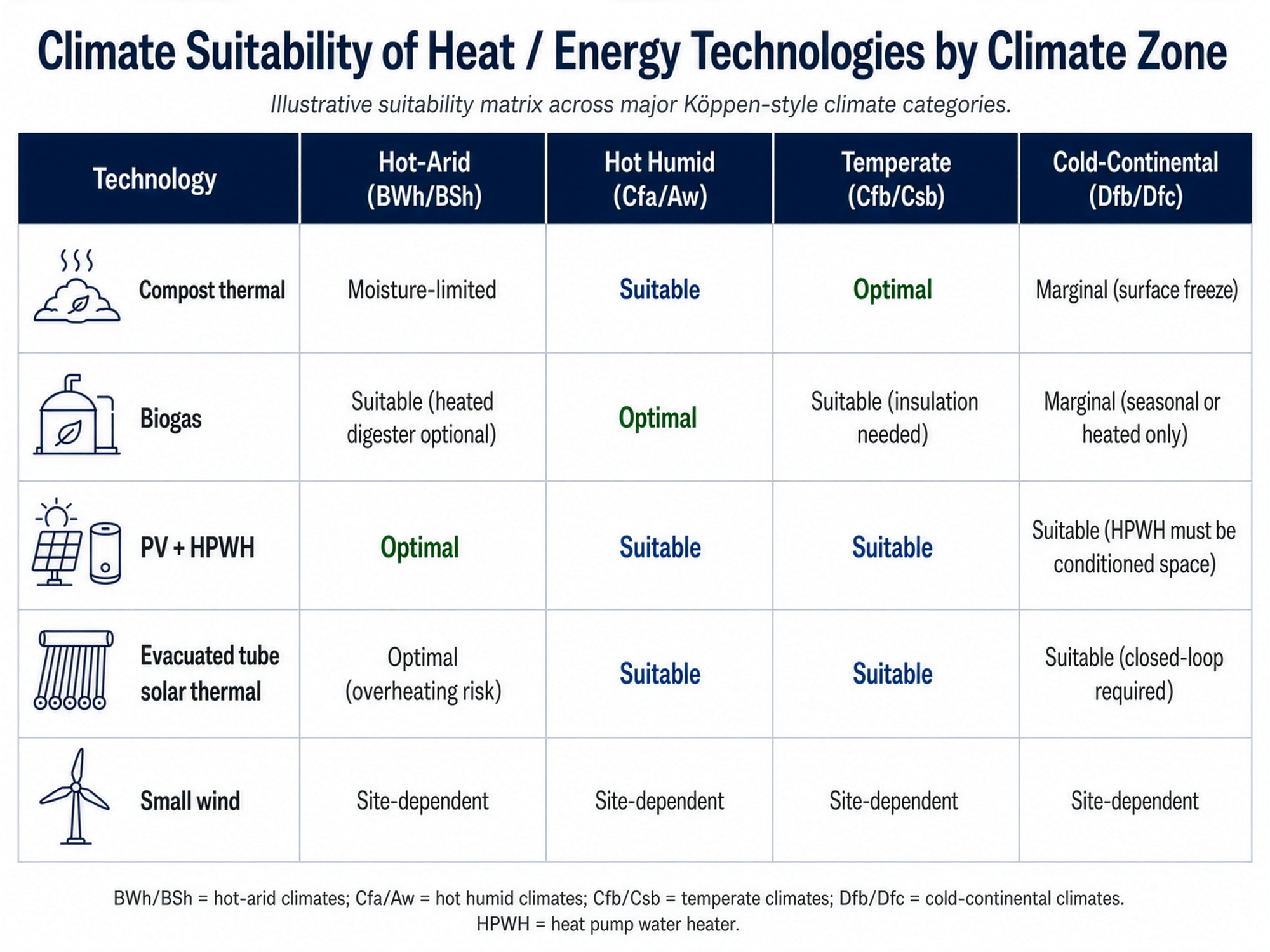
Two technologies are climatically near-universal in suitability if site conditions are met: PV plus-HPWH and evacuated-tube solar thermal. Two are strongly climate-dependent: compost thermal (constrained in cold and arid extremes) and biogas (constrained in cold). Small wind is dominated by site-specific wind resource rather than regional climate per se.
7. Environmental and Sustainability Analysis
7.1 Lifecycle Carbon Footprint
Cradle-to-grave carbon intensity per unit of thermal energy delivered varies by approximately an order of magnitude across the five technologies. Published lifecycle assessments place PV-attributed carbon at approximately 20 to 34 g CO2e per kWh of electricity delivered, which translates to roughly 8 to 14 g CO2e per kWh of thermal energy when paired with an HPWH at COP 2.5 [12]. Solar thermal collectors have embodied carbon of approximately 0.16 t CO2e per square meter of collector area, with energy payback time under two years and lifetime carbon intensity in the range of 15 to 35 g CO2e per kWh thermal [11][36]. Small wind has embodied carbon of approximately 7 to 25 g CO2e per kWh electrical depending on rare-earth content and end of-life recycling assumptions, translating to similar thermal-side intensities as PV when paired with HPWH.
Compost thermal and biogas have carbon footprints that depend critically on counterfactual feedstock fate. If feedstock would otherwise have been left to decompose anaerobically in a landfill or manure lagoon (releasing methane with global warming potential approximately 28 to 36 times that of CO2 over 100 years), then both compost thermal and biogas systems can have negative effective lifecycle carbon footprints, because they avoid larger upstream methane emissions while delivering useful energy. EPA AgSTAR estimates that an avoided methane credit of 4.81 MMTCO2e per year is associated with the existing 263 U.S. livestock-farm digesters [5]. If, conversely, the feedstock would have been aerobically composted in the absence of the heat-recovery system (no methane avoidance), the system’s own embodied carbon (HDPE tubing, pumps, heat exchangers) drives a small but positive footprint, on the order of 30 to 80 g CO2e per kWh thermal.
7.2 Circular Economy and Waste Valorization
Compost thermal and anaerobic digestion are categorically distinct from solar and wind technologies in that they produce two co-products beyond thermal energy: stabilized compost or digestate fertilizer, and waste-stream diversion. Smith et al. and Roy et al. have documented that compost-aeration-and-heat-recovery (CAHR) systems improve nitrogen retention and produce compost with measurable economic value (USD 20 to 60 per cubic yard at retail in regional markets) [16][28]. Anaerobic digestion produces digestate that, depending on feedstock and processing, can substitute for synthetic fertilizer at savings of USD 20 to 80 per ton wet weight.
Waste-stream diversion potential is substantial. EPA estimates indicate that more than 30 percent of the U.S. municipal solid waste stream by mass is organic (food, yard, paper) and that diverting this fraction via composting or anaerobic digestion reduces landfill methane emissions, leachate generation, and transportation energy [37]. For a single farm or institutional operator, on-site digestion or composting also avoids hauling costs that can range from USD 30 to 150 per ton.
7.3 Land Use and Ecological Footprint
Per-unit-thermal-output land area requirements vary widely. Evacuated-tube solar thermal requires approximately 1.5 to 3 m² of collector area per person (rooftop, near-zero land footprint). PV plus HPWH requires approximately 5 to 8 m² of module area per person. Small wind requires negligible footprint at the tower base but significant setback (typically 1.1× tower height plus blade length, or roughly 50 to 80 m radius effective land area for residential turbines). Compost thermal requires approximately 30 to 70 m² of pile-and access footprint for a residential system. Anaerobic digestion at residential scale requires approximately 2 to 10 m² depending on configuration. Visual and noise impacts differ. Wind turbines generate audible noise (35 to 55 dBA at typical residential setbacks) and shadow flicker. Compost piles generate occasional odors during turning. Biogas digesters can generate hydrogen sulfide odors if gas-clean-up is inadequate. PV and solar thermal are visually but not audibly disruptive.
8. Regulatory Landscape
The regulatory environment for off-grid water heating technologies is fragmented across federal, state, and local jurisdictions, with substantial variation that can determine project feasibility independent of underlying technology economics.
At the federal level, the Internal Revenue Code Section 25D and Section 48 incentives discussed in Section 5.4 are dispositive of capital cost burden but require IRS documentation and product-specific certification. Federal Aviation Administration regulations apply to wind turbines exceeding 200 feet. The National Electrical Code (NEC) Articles 690 (solar PV), 694 (small wind), and 705 (interconnection) define the principal electrical compliance pathway. The Uniform Plumbing Code or its state equivalents govern water-side connections.
State-level variation is significant. California’s Title 24 building energy code and the California Energy Commission appliance regulations have historically been the most aggressive in promoting solar thermal and PV-plus-HPWH adoption. New York’s NY-Sun and NYSERDA programs have funded multiple compost-thermal and biogas demonstration projects. Vermont’s Public Utility Commission and Department of Public Service have produced template biogas and compost-thermal interconnection guidance. By contrast, several southeastern and mountain-west states have minimal renewable-energy-specific code and rely primarily on default International Building Code, International Residential Code, and International Fire Code provisions.
Building code treatment varies by technology. Solar PV and solar thermal have well-defined chapters in the IRC and IBC and are routinely permitted across the U.S. Small wind is typically permitted as an “accessory structure” or through a use-specific variance, with height as the principal binding constraint; some jurisdictions (notably parts of California, Vermont, Iowa, and Texas) have created small-wind-specific permitting pathways. Anaerobic digestion is governed by NFPA 54 (Fuel Gas Code) for the gas distribution and combustion side; NFPA 58 may apply by analogy where biogas is liquefied or stored at elevated pressure. The largest practical regulatory barrier for residential biogas is uncertainty among AHJs about how to treat the digester itself, which is neither a fuel-gas appliance nor a chemical process plant in conventional code categories.
Compost thermal is the most regulatorily underspecified of the five technologies. Health departments occasionally impose vector-control or runoff requirements where piles exceed a given size or are sited near surface water. Zoning may impose accessory-structure or accessory-use limitations, particularly in covenant-restricted developments. As noted in Section 5.4, REAP and most state incentive programs do not enumerate compost thermal as renewable energy, creating an effective regulatory disadvantage that is structural rather than technical.
Fire-code implications are most acute for biogas storage. Storage pressures in residential systems are typically below 5 psig, which falls below most jurisdictional thresholds for “compressed gas” storage but above ambient. Atmospheric-pressure flexible-bag storage is generally permitted as an outdoor accessory, but indoor storage of any biogas quantity faces NFPA 1 (Fire Code) restrictions. Insurance carriers (see Section 8.1) often impose stricter limits than code.
8.1 Insurance and Liability Dimension
Insurance treatment of off-grid water heating systems is an underdiscussed dimension that materially affects total cost of ownership. PV is universally insurable under standard homeowners’ policies, often with no premium adjustment, and is increasingly treated as a property improvement that increases insured value. Evacuated-tube solar thermal is similarly insurable. HPWHs are treated as standard appliances. Small wind has historically faced underwriting reluctance among standard carriers due to tower failure risk; specialty markets (including programs run by ICAT, Travelers, and certain Lloyd’s syndicates) provide coverage at premium loads of approximately 0.2 to 0.5 percent of insured value annually.
Anaerobic digestion presents the most challenging insurance profile. The combination of stored flammable gas, biological process variability, and limited claim history makes residential biogas effectively uninsurable under most standard policies; specialty agricultural and commercial farm policies cover farm-scale digesters but typically exclude domestic-side risks. Compost thermal is generally insurable as an accessory structure but spontaneous combustion of large compost piles (documented at commercial composting facilities) has resulted in insurance carrier scrutiny of pile size and management practices. Practitioners should disclose all five technologies to their carriers prior to installation; failure to disclose can void coverage in the event of loss.
9. Geopolitical and Strategic Dimensions
The five technologies differ fundamentally in their supply-chain geography and corresponding exposure to geopolitical disruption. PV is the most geographically concentrated. Polysilicon, wafer, cell, and module manufacturing are dominated by Chinese producers (approximately 80 percent of global module production and over 95 percent of polysilicon and wafers as of recent IEA reporting) [38]. Inverter electronics depend on globally distributed semiconductor supply with significant Taiwan and South Korea concentration. The Inflation Reduction Act’s Section 45X production credits and Section 48 domestic-content adders are catalyzing U.S. domestic manufacturing, but full supply-chain reshoring is at least a decade away.
Small wind has the most acute rare-earth exposure. Permanent-magnet generators using neodymium-iron-boron (NdFeB) magnets are present in approximately 32 percent of land based and 76 percent of offshore wind installations [33]. China dominates rare-earth mining (58 percent of global production) and processing (92 percent of magnet production) [32][33]. The U.S. Department of Defense and Department of Energy have funded rare-earth supply-chain diversification initiatives (MP Materials, USA Rare Earth, Lynas in Australia/Texas, HyProMag recycling), but a resilient non-China rare-earth-magnet supply chain is not yet established at commercial scale.
Evacuated-tube solar thermal manufacturing is concentrated in China (more than 80 percent of global production) but the technology’s supply chain is materially less concentrated than PV at the component level: borosilicate glass, copper, and aluminum inputs are commoditized and available globally. Secondary manufacturing exists in Germany, Australia, Turkey, Greece, and Israel.
Biogas systems have a heterogeneous supply chain. Membranes, gas-tight fittings, and instrumentation are globally available commodities. Digester vessels at small scale are often locally fabricated from concrete, fiberglass, or HDPE. Hydrogen sulfide scrubbing media (iron sponge, activated carbon) are commodity-traded. The supply chain is more locally resilient than PV or wind.
Compost thermal has the most local supply chain of the five technologies. HDPE or PEX tubing, circulation pumps, controllers, and insulation are commodities. The principal “fuel” is on-site biomass. With access to commodity hardware and basic plumbing skills, a competent operator can build, maintain, and repair a compost thermal system entirely from locally sourced materials. This makes compost thermal the most strategically resilient of the five technologies in scenarios of acute supply-chain disruption, even though it underperforms on quantification, code recognition, and labor economics.
The strategic implication is that energy-sovereignty-focused operators (Indigenous communities, remote rural settlements, defense-installation planners, food-security focused agricultural operators) should weight supply-chain resilience explicitly in the technology selection. For most operators in benign geopolitical environments, this consideration ranks below capital cost, reliability, and labor burden; for those in higher-risk contexts, it can dominate.
10. Risk Matrix
The risk profile of each technology is presented across three time horizons and five risk categories. Likelihood and impact are rated on a qualitative low/medium/high scale, with composite ratings reflecting the product of the two. Where a quantitative matrix is reductive, narrative supplementation follows.
10.1 Short-Term Risks (1–3 Years)
PV + HPWH: Installation risk low (mature trade); performance shortfall low (predictable irradiance modeling); regulatory friction low; supply-chain delays moderate (currently easing post-2022 disruptions).
Evacuated-tube solar thermal: Installation risk moderate (declining installer pool); performance shortfall low; regulatory friction low; supply-chain delays low to moderate.
Small wind: Installation risk moderate to high (specialized trade, declining installer pool); performance shortfall high (site-specific wind resource frequently overestimated); regulatory friction moderate to high (zoning, neighbor relations); supply-chain delays moderate.
Biogas: Installation risk moderate to high (specialized integration); performance shortfall moderate (feedstock variability); regulatory friction high (AHJ uncertainty); supply-chain delays low.
Compost thermal: Installation risk high (limited integrator pool); performance shortfall moderate to high (data sparsity); regulatory friction moderate (incentive non-recognition); supply-chain delays low.
10.2 Medium-Term Risks (3–7 Years)
PV + HPWH: Component degradation low (linear PV degradation, HPWH compressor at 8 12 years); incentive expiration material concern (Section 25D 30 percent credit steps down 2033/2034); technology obsolescence low.
Evacuated-tube solar thermal: Component degradation moderate (vacuum loss in sub quality tubes, glycol fouling); feedstock irrelevant; incentive expiration material; technology obsolescence moderate (continued PV cost decline may erode competitive position).
Small wind: Component degradation moderate (bearing wear, blade fatigue); incentive expiration material; technology obsolescence moderate to high (manufacturer attrition documented in DOE distributed-wind reports) [10].
Biogas: Feedstock availability shifts moderate (livestock-population changes, food-waste diversion regulations affecting input streams); component degradation moderate; incentive expiration low (AgSTAR and REAP reasonably durable); technology obsolescence low.
Compost thermal: Feedstock availability shifts low (biomass availability typically resilient); component degradation moderate; incentive expiration not applicable (largely unincentivized); technology obsolescence low.
10.3 Long-Term Risks (7+ Years)
PV + HPWH: Climate-pattern shifts low (PV resilient to most projected climate changes; minor degradation from increased heat waves); regulatory reclassification low; market consolidation reducing component availability low (highly commoditized).
Evacuated-tube solar thermal: Climate-pattern shifts low; market consolidation reducing component availability moderate to high (declining North American distribution); structural failure modes moderate (glass fragility, freeze-cycle stress).
Small wind: Climate-pattern shifts moderate (wind-resource trends in some regions are uncertain); regulatory reclassification low; market consolidation reducing component availability high (manufacturer attrition); structural failure modes moderate (tower fatigue, blade fatigue).
Biogas: Climate-pattern shifts moderate (warmer winters favor performance); regulatory reclassification moderate (potential reclassification of methane-from-manure under future climate policy); structural failure modes moderate (digester corrosion, gas leak at long horizon)
Compost thermal: Climate-pattern shifts moderate (drought stress in some regions affecting moisture management); regulatory reclassification potentially favorable (recognition as renewable energy would unlock incentive eligibility); structural failure modes low.
10.4 Cross-Cutting Risk Observations
Three cross-cutting observations merit emphasis. First, technical risk and regulatory risk are inversely correlated for several technologies: compost thermal has low technical risk but high regulatory non-recognition risk; small wind has high technical risk but moderate regulatory risk. Second, financial risk is dominated by capital-cost variance for small wind (where actual installed costs frequently exceed initial estimates by 30 to 80 percent due to site-preparation surprises) and by labor-cost monetization for compost and biogas. Third, adoption and scaling risk is highest for technologies with thinning supply chains (small wind, evacuated-tube solar thermal) and lowest for technologies with continued cost declines and broadening installer bases (PV-plus-HPWH).
11. Strategic Recommendations
11.1 Rural Homesteaders and Smallholders
For rural homesteaders and smallholders pursuing maximum self-sufficiency at moderate capital investment (defined here as USD 5,000 to 15,000 total water heating expenditure), the dominant recommendation is a PV-plus-HPWH primary system with thermosiphon evacuated-tube solar thermal preheat in cold climates. This configuration leverages the lowest-LCOH option (PV-HPWH) while using solar thermal preheat to reduce winter HPWH duty cycles (when ambient air temperatures degrade HPWH COP). Capital deployment of approximately USD 8,000 to 12,000 yields a system with 20 to 25 year service life, sub USD-200 annual O&M, and federal Section 25D credit eligibility on both components.
Where the homestead has continuous biomass throughput (active forestry management, livestock operation generating manure, or significant on-site wood-chipping), a compost thermal system as a third stage in the heating cascade is defensible if the operator values the labor as recreational or educational. The compost system in this configuration is treated as an experimental and resilience asset rather than a primary economic optimization. The recommendation does not apply where the operator does not generate adequate on-site biomass; sourcing feedstock by purchase typically inverts the economic case.
Small wind is not generally recommended for residential water heating except at sites with documented Class 3 or higher wind resource (annual average wind speed above approximately 6.4 m/s at 50 m hub height, verifiable via NREL Wind Resource Atlas or on-site anemometry). Where this resource exists, a small wind contribution to the broader household electrical load is more defensible than dedication to water heating specifically.
Residential biogas at homestead scale is recommended only when an operator has substantial, continuous organic waste throughput (a small dairy, a small abattoir, a high-volume kitchen, or a multi-family settlement with food and human-waste coproduction).
11.2 Institutional and Commercial Operators
For institutional and commercial operators (small farms, off-grid lodges, rural clinics, small schools), the primary recommendation is a hybrid evacuated-tube solar thermal primary system with biogas or compost thermal backup, plus PV for non-thermal electrical loads. Solar thermal is recommended as primary in this segment (rather than PV HPWH) because the larger thermal demand, the larger collector area available on commercial buildings, and the better fit between solar thermal yield and commercial daytime hot water demand profiles favor direct thermal collection. Capital deployment of USD 30,000 to 100,000 is typical, with USDA REAP providing 25 to 50 percent grant offset and Section 48 ITC additional 30 percent on the remaining cost.
For dairies, hog operations, food-processing facilities, and similar operations with concentrated organic waste streams, anaerobic digestion is recommended as the principal thermal source (and frequently as electrical source via CHP), with solar thermal as a supplement. EPA AgSTAR data show 8,000 such U.S. operations are technically suitable [5]; the binding constraints are typically capital access (solved by REAP and IRA Section 45 credits) and operator expertise (solved by integrators such as DVO, RCM, and Vanguard).
For cold-climate institutional operators, solar thermal sized for shoulder-season and summer load, with biomass (cordwood boiler) or biogas backup for winter, is the most cost-effective architecture. Compost thermal at this scale (Agrilab Isobar systems) is recommended at sites with continuous large-volume biomass throughput (more than 100 tons per year of compostable material) and is generally not recommended otherwise.
11.3 Policymakers and Program Designers
For policymakers and program designers, four recommendations emerge from the body of this report.
First, explicitly recognize compost thermal energy as a renewable resource for incentive program eligibility. The current REAP definition under 7 CFR 4280 (and most state-level analogs) does not include heat from aerobic decomposition, creating a structural disadvantage for a technology that has compelling waste-valorization, energy-sovereignty, and rural-employment characteristics [9]. A modest legislative or regulatory amendment to the renewable energy definition would unlock significant adoption.
Second, fund development of standardized small-scale anaerobic digester safety codes. The principal barrier to residential and small-farm digester adoption is AHJ uncertainty about how to treat the technology under existing fuel-gas codes. NFPA, ICC, and ASABE collaboration to develop a residential-and-small-commercial biogas code chapter (analogous to the development trajectory of NFPA 855 for energy storage systems) would materially reduce permitting friction.
Third, continue and expand the NREL Competitiveness Improvement Project (CIP) for distributed wind. Documented LCOE reductions of approximately 50 percent on the Bergey Excel 15 platform demonstrate that targeted public R&D funding can materially improve small-wind economics in a market that has struggled with manufacturer attrition [31]. Expanding CIP to include water-heating-specific configurations (turbine-plus-thermal mass-tank systems without battery dependency) could unlock a structurally different value proposition.
Fourth, fund hybrid configuration demonstrations at the institutional scale. Most existing public funding programs incentivize single-technology adoption. The technical and operational evidence in this report suggests that hybrid configurations dominate single technology systems on most performance dimensions. Demonstration funding for compost thermal-plus-biogas-plus-solar-thermal-plus-PV at agricultural research stations, Tribal colleges, and rural school districts would generate empirical performance data that is currently sparse and would accelerate adoption beyond the early-adopter community.
A fifth, second-tier recommendation is to commission rigorous peer-reviewed long-term field studies of compost thermal and small-scale biogas water heating performance. The data asymmetry documented throughout this report (extensive peer-reviewed literature for PV, solar thermal, and large-scale biogas; sparse and configuration-specific literature for compost thermal and residential biogas) limits decision-grade analysis at all levels of policy and capital allocation. NIFA, NSF, and DOE EERE funding mechanisms are appropriate vehicles.
12. References
[1] U.S. Energy Information Administration. (2018). Space heating and water heating account for nearly two thirds of U.S. home energy use. Today in Energy, November 7. EIA.
[2] U.S. Energy Information Administration. (2023). Residential energy consumption survey (RECS) 2020: Consumption and expenditures data. EIA.
[3] Lane, V. (2014). Solar hot water: Which is better, PV or thermal? Renewable Energy World, April.
[4] Maaouane, M., & Kahourzade, S. (2025). A comparative analysis of solar thermal and photovoltaic systems with heat-pump integration in a new-build house under controlled conditions. Energies, 18(11), 2988.
[5] U.S. Environmental Protection Agency. (2024). AgSTAR program: Anaerobic digestion on dairy farms and market opportunities for biogas recovery systems at U.S. livestock facilities. EPA AgSTAR.
[6] Energysage. (2024). Home wind turbines: Overview, products, and costs.
[7] U.S. Department of Energy. (2018). 2018 distributed wind market report. DOE Office of Energy Efficiency and Renewable Energy.
[8] HomeGuide. (2024). How much does a wind turbine cost?
[9] U.S. Department of Agriculture, Rural Development. (2024). Rural energy for America program (REAP) renewable energy systems and energy efficiency improvements frequently asked questions. USDA RD.
[10] Pacific Northwest National Laboratory. (2024). Distributed wind market report: 2024 edition (PNNL-36057). PNNL for U.S. Department of Energy.
[11] Lamnatou, C., Mondol, J.-D., Chemisana, D., & Maurer, C. (2015). Life cycle analysis of a building-integrated solar thermal collector, based on embodied energy and embodied carbon methodologies. Energy and Buildings, 84, 378–387.
[12] Etude. (2020). The (low) embodied carbon of solar PV. Etude Sustainability Consultancy.
[13] International Renewable Energy Agency. (2024). Renewable power generation costs in 2024. IRENA.
[14] Purnomo, A., & Pertiwiningrum, A. (2014). Improved design of anaerobic digesters for household biogas production in Indonesia: One cow, one digester, and one hour of cooking per day. Energies, 7(5), 2999–3013.
[15] National Renewable Energy Laboratory. (2024). 2024 annual technology baseline: Distributed wind. NREL.
[16] Smith, M. M., Aber, J. D., & Rynk, R. (2017). Heat recovery from composting: A comprehensive review of system design, recovery rate, and utilization. Compost Science and Utilization, 25(S1), S11–S22.
[17] Brown, G. (2014). The compost-powered water heater: How to heat your greenhouse, pool, or buildings with only compost! The Countryman Press.
[18] Tucker, M. F. (2006). Extracting thermal energy from composting. BioCycle, 47(8), 38–40.
[19] Pain, J., & Pain, I. (1972). Another kind of garden: The methods of Jean Pain. Self-published.
[20] Ohio State University Extension. (2017). Manure to energy through anaerobic digestion (Ohioline AEX-653.1). OSU Extension.
[21] Klavon, K. H., Lansing, S. A., Mulbry, W., Moss, A. R., & Felton, G. (2013). Economic analysis of small-scale agricultural digesters in the United States. Biomass and Bioenergy, 54, 36–45.
[22] Iowa State University Extension and Outreach. (2025). Understanding variability in biogas production from anaerobic lagoons and mixed digesters. Iowa State University Agricultural and Biosystems Engineering.
[23] SunMaxx Solar. (2024). ThermoPower 30 tube evacuated tube solar collector technical specifications. Manufacturer specification document.
[24] Apricus Solar. (2023). Evacuated tube solar collectors: Engineering and performance documentation. Manufacturer technical documentation.
[25] Greening, B., & Azapagic, A. (2014). Domestic solar thermal water heating: A sustainable option for the UK? Renewable Energy, 63, 23–36.
[26] Northern Lights Solar Solutions (SunRain). (2024). Vacuum tube solar water heater technical documentation. Manufacturer reference.
[27] Kumbhar, S. V. (2019). Failure investigation of evacuated tube solar collector of water heater. Journal of Failure Analysis and Prevention, 19, 1202–1206.
[28] Roy, E. D., et al. (2022). Performance of a compost aeration and heat recovery system at a commercial composting facility. Journal of Ecological Engineering Design, 2(1).
[29] Bishop, C. P., & Shumway, C. R. (2009). The economics of dairy anaerobic digestion with coproduct marketing. Review of Agricultural Economics, 31(3), 394–410.
[30] Custom Market Insights. (2024). US small wind power market report 2024–2033.
[31] National Renewable Energy Laboratory. (2023). NREL selects manufacturers of small and medium-sized wind turbine technology for 2022–2023 funding [Press release]. NREL.
[32] U.S. Department of Energy. (2022). Rare earth permanent magnets: Supply chain deep dive assessment. DOE Office of Policy.
[33] Hoffs, C. (2024). Just and sustainable solutions for the mining and recycling of rare earth elements in wind turbines. Union of Concerned Scientists.
[34] Database of State Incentives for Renewables and Efficiency (DSIRE). (2024). USDA rural energy for America program (REAP) grants. NC Clean Energy Technology Center.
[35] National Fire Protection Association. (2024). NFPA 54: National fuel gas code; NFPA 58: Liquefied petroleum gas code. NFPA.
[36] Ardente, F., Beccali, G., Cellura, M., & Lo Brano, V. (2005). Life cycle assessment of a solar thermal collector: Sensitivity analysis, energy and environmental balances. Renewable Energy, 30(2), 109–130.
[37] U.S. Environmental Protection Agency. (2023). Advancing sustainable materials management: 2018 tables and figures. EPA Office of Resource Conservation and Recovery.
[38] International Energy Agency. (2023). Solar PV global supply chains. IEA.