Hugelkultur: The Science Behind Mound Growing and Why Climate Policy Should Pay Attention
Hugelkultur uses decomposing wood mounds to build soil, retain water, and cut inputs. Here's the science and the policy gap holding it back.

Buried Capital: Why Hugelkultur Deserves a Place in the Climate-Smart Agriculture Toolkit
A low-input decomposition technology, centuries old and largely unmonitored, may offer meaningful leverage at the intersection of soil health, water resilience, and circular land management.
Summary
Hugelkultur, a Central European land management practice in which woody organic debris is mounded and seeded to create a self-sustaining growing system, represents a scalable, low-cost intervention with relevance well beyond its origins in peasant farming and permaculture circles. The technique capitalizes on natural decomposition dynamics, creating mound structures that retain moisture, release nutrients gradually, and sequester carbon over multi-year cycles. Its resource profile is notable: primary inputs are often waste materials (fallen timber, prunings, agricultural residues), and once established, mounds require substantially less irrigation and external fertilization than conventional raised beds or field plots.
This analysis positions hugelkultur not as an agrarian curiosity but as a nature-based land management strategy with demonstrable applications in smallholder food production, degraded land reclamation, and urban food systems. With appropriate research investment and policy integration, the technique could contribute meaningfully to climate adaptation goals, particularly in water-stressed and low-income agricultural contexts. The central argument is straightforward: hugelkultur encodes ecological logic that industrial agriculture has largely discarded, and the cost of recovering that logic is modest relative to its potential return.
Key Takeaways
- Hugelkultur mounds mimic forest floor decomposition dynamics, creating self-regulating systems for moisture retention, nutrient cycling, and thermal buffering with minimal external inputs.
- Woody biomass within the mound structure functions as a long-term hydrological reservoir, with available evidence suggesting significant reductions in supplemental irrigation needs after the first one to two growing seasons.
- Carbon sequestration potential is meaningful but insufficiently quantified; standardized measurement protocols are a prerequisite for voluntary carbon market integration.
- Strategic applications span subsistence farming, degraded land reclamation, and urban food production, with particular relevance in arid and semi-arid contexts where input costs and water scarcity constrain conventional approaches.
- Institutional gaps, including the absence of hugelkultur from most national soil health frameworks and limited large-scale agronomic trial data, represent the primary barrier to scaled policy adoption.
Introduction: From Forest Floor to Food System
Global agricultural soils are losing productive capacity at rates that outpace natural regeneration. As documented across FAO monitoring programs, intensive tillage, monocropping, and synthetic fertilizer dependency have degraded microbial communities, reduced organic matter content, and diminished the water-holding capacity of arable land across every inhabited continent. At the same time, climate-driven water stress is intensifying, compressing growing seasons in some regions and making rainfall increasingly unpredictable in others. Conventional agronomic responses, namely irrigation expansion, input intensification, and genetic modification, address symptoms without resolving the underlying structural deficiency: soil that has been stripped of its ecological function.
Hugelkultur does not present itself as a innovative breakthrough technology. It is, more precisely, a codification of what forest ecosystems have always done. When a tree falls in a mature forest, it does not disappear; it becomes infrastructure. Over decades, it feeds fungal networks, supports invertebrate communities, retains moisture through freeze-thaw cycles, and slowly releases the mineral wealth locked in its cellular structure. Hugelkultur reconstructs this logic intentionally, compressing a slow ecological process into a managed agricultural form.
The practice has its roots in Central European subsistence farming, particularly in German-speaking regions where smallholders routinely buried woody debris beneath garden beds to improve fertility on marginal soils. Its modern reintroduction came largely through the permaculture movement, with practitioners including Sepp Holzer in Austria documenting its use at scale in high-altitude, frost-prone landscapes. From there, regenerative agriculture networks in North America, Australia, and increasingly the Global South have adapted and disseminated the technique.
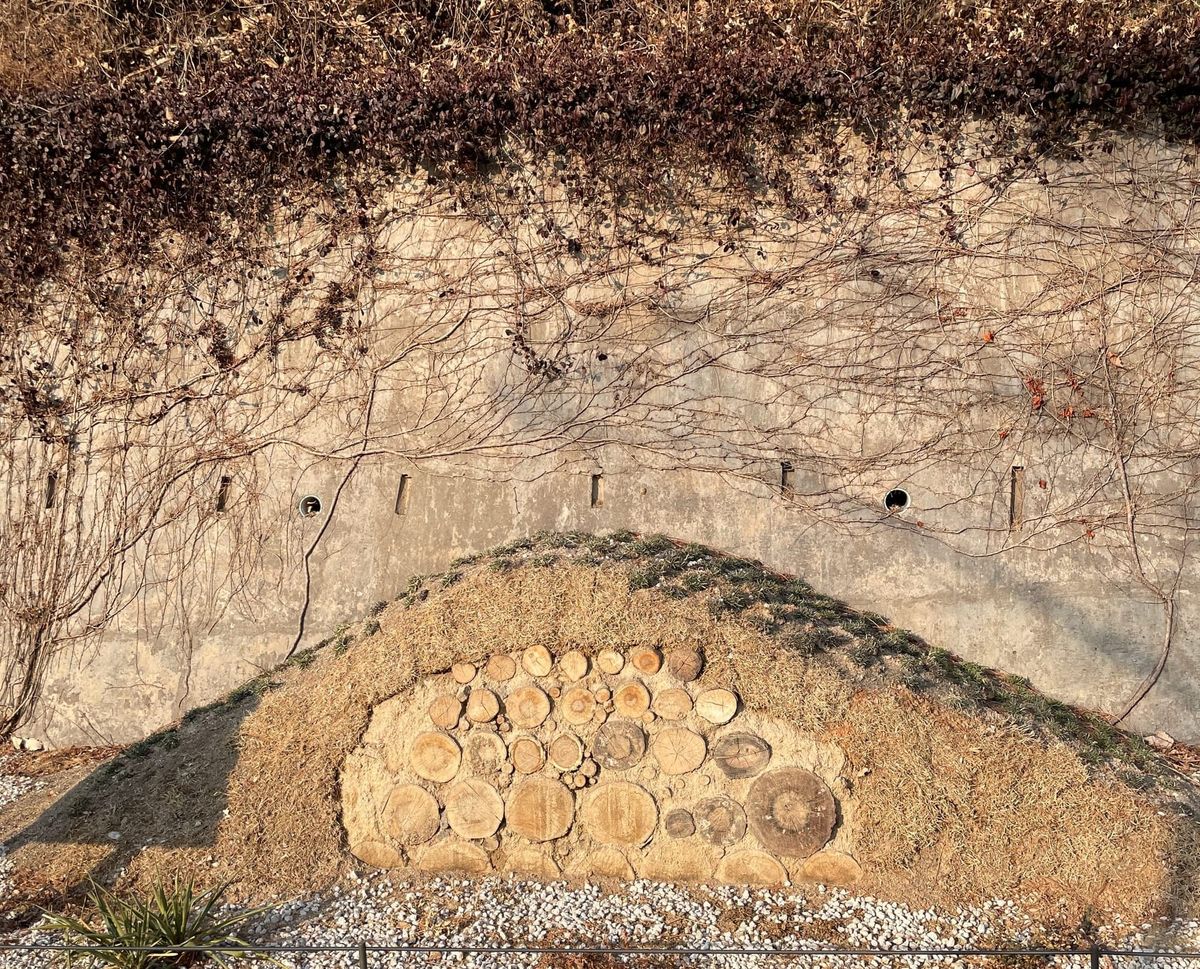
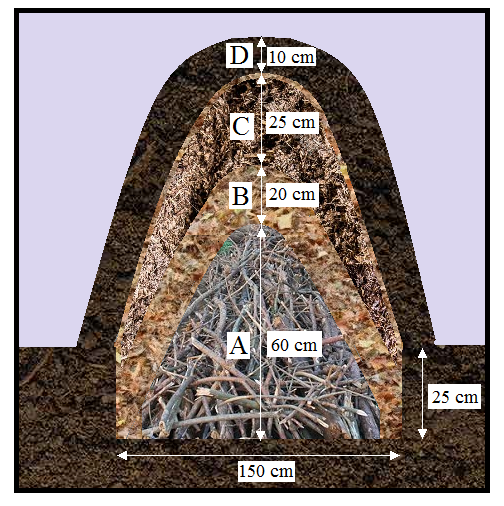
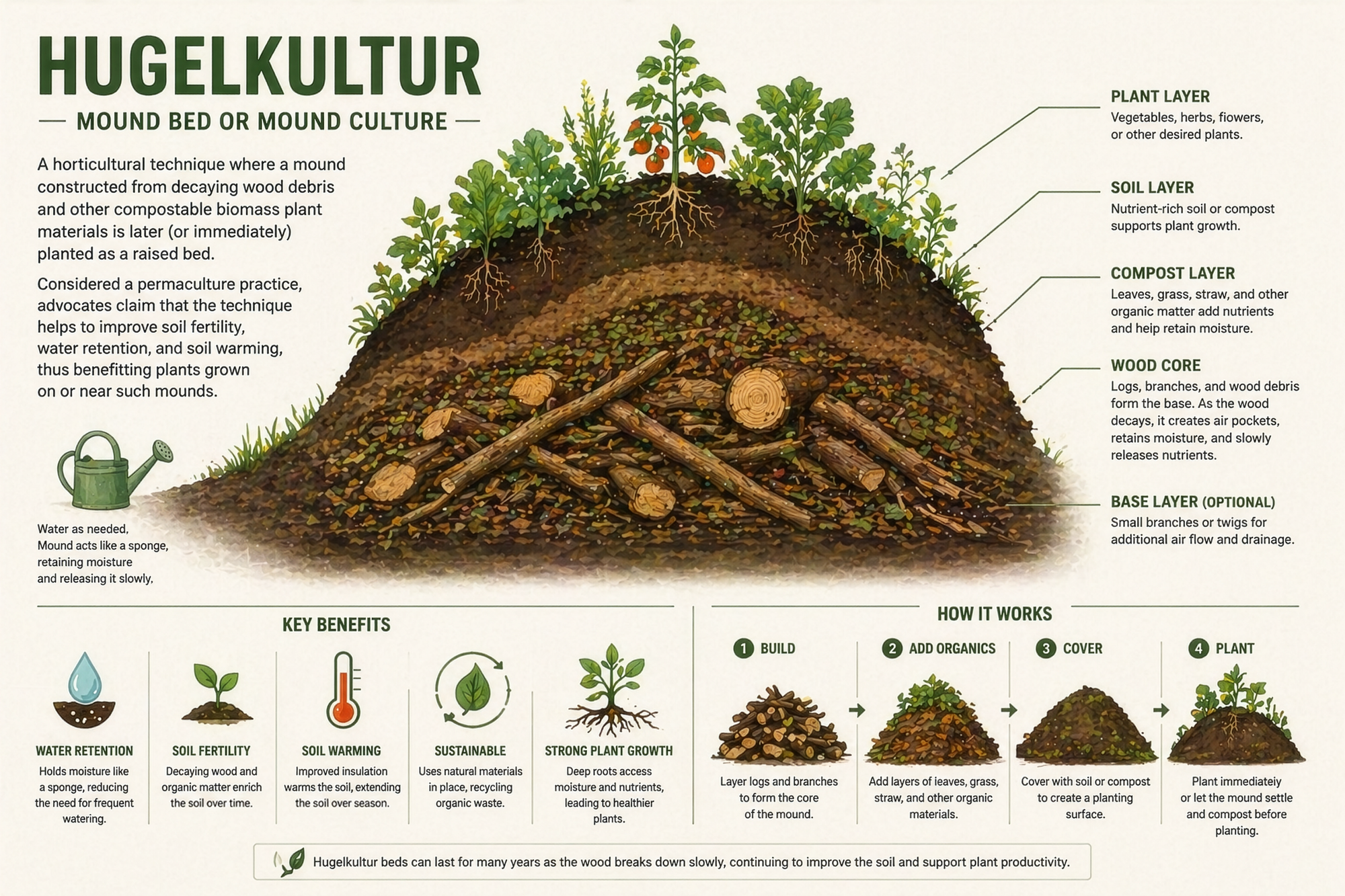
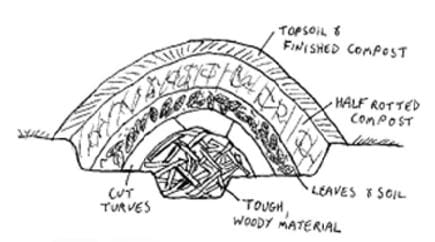
A hugelkultur mound is anatomically layered. The base consists of large, preferably partially decomposed logs (hardwoods are favored, as they decompose more slowly and hold moisture more effectively than softwoods, which also carry allelopathic risks in species such as black walnut). Above this, branches, twigs, leaves, straw, and grass clippings are packed to fill voids. A layer of inverted sod or raw compost follows, topped with finished soil and compost for immediate planting. The mound typically rises one to two meters at construction, settling progressively as decomposition proceeds.
The Science of the Mound: Mechanisms and Systems Logic
Decomposition Dynamics and Nutrient Cycling
The biological engine of a hugelkultur mound is its decomposition community. Immediately following construction, fungi colonize the woody substrate, extending hyphal networks that break down lignin and cellulose, the structural compounds resistant to most bacterial activity. This fungal phase is critical: without it, the carbon in woody material would remain largely locked, unavailable to plants. As fungal populations establish, they are followed by successive waves of bacterial communities adapted to progressively simpler organic compounds.
One well-documented challenge during the early mound phase is nitrogen immobilization. Microorganisms decomposing high-carbon woody material draw down available nitrogen from the surrounding substrate, temporarily reducing the fertility available to surface crops. Practitioners report that this effect is most pronounced in the first one to two growing seasons, particularly when fresh rather than partially decomposed wood is used as the base material. Mitigating strategies include the incorporation of nitrogen-rich materials (manure, leguminous material, food waste) within the mound layers, or the selection of nitrogen-fixing cover crops during the establishment period.
By years three through five, the decomposition dynamic shifts. Nitrogen is released as microbial populations turn over and organic compounds mineralize. Available evidence from long-term permaculture installations suggests that mound fertility peaks in this mid-cycle window, after which it gradually normalizes as the woody substrate is consumed. The full decomposition cycle for a well-constructed mound using hardwood logs is generally estimated at seven to twelve years, though empirical documentation at scale remains limited.
Moisture Retention and Hydrological Function
The hydrological properties of hugelkultur mounds are, arguably, their most strategically significant attribute. Partially decomposed wood acts as a sponge at the cellular level: the lignin matrix retains water within its structure long after the surrounding soil would have dried out. In practice, this means that a mound's interior maintains moisture availability to plant roots during dry intervals that would stress or kill crops in conventional flat-bed configurations.
Quantifying this effect precisely is complicated by variation in feedstock species, decomposition stage, climate, and mound geometry. However, practitioners working in semi-arid contexts, including documented installations in the American Southwest and sub-Saharan Africa, report substantial reductions in supplemental irrigation requirements after the first establishment season. The mechanism is intuitive: elevated mound geometry also increases the surface area available for dew and light precipitation capture, while the internal sponge releases moisture upward through capillary action during dry periods.
Thermal Regulation
Active decomposition generates heat. In the early mound phase, internal temperatures can reach levels comparable to hot composting, effectively extending the growing season at mound edges by moderating frost risk. This effect is most pronounced in the first one to two years and diminishes as the decomposition rate stabilizes. In temperate climates with defined frost seasons, this thermal buffering can represent a meaningful agronomic advantage, allowing earlier planting dates and later harvests without infrastructure investment.
Carbon Sequestration and Long-Term Soil Development
Compared to conventional composting, hugelkultur sequesters carbon more slowly and over a longer duration. Where a hot compost pile mineralizes organic matter rapidly, converting it to plant-available nutrients within weeks, a hugelkultur mound holds a significant fraction of its carbon in slow-decomposing woody material for years or decades. This slow-release profile is ecologically analogous to what soil scientists describe as stable organic matter formation, and it aligns more closely with the permanence criteria that voluntary carbon markets require.
Soil stratification within the mound evolves predictably over time. In early years, a sharp boundary exists between the woody core and the overlying topsoil layer. By mid-cycle, fungal networks bridge this boundary, and the soil profile above the mound develops elevated organic matter content, improved aggregate structure, and greater biological diversity than surrounding undisturbed soils. Available evidence from practitioner documentation suggests that post-mound soils, after the woody substrate has fully decomposed, retain elevated fertility and tilth characteristics for several years, representing a meaningful capital transfer from biological process to soil asset.
Strategic Applications: Where and Why It Scales
Smallholder and Subsistence Contexts
The cost structure of hugelkultur is its most compelling attribute for smallholder applications. Primary inputs are organic waste materials that most agricultural households already generate or can access locally: fallen timber, crop residues, prunings, leaves. The technique requires no specialized equipment, no purchased inputs after construction, and no ongoing technical supervision. In the Global South, where input costs constrain productivity on marginal land and irrigation infrastructure is absent or unreliable, the water-retention and soil-building properties of the mound offer a meaningful productivity lever.
Degraded Land Reclamation
Post-agricultural and post-industrial degraded landscapes present significant challenges for conventional restoration: low soil organic matter, poor water retention, minimal biological activity, and often a physical surface that resists revegetation. Hugelkultur's elevated mound geometry sidesteps some of these constraints by creating a growing medium independent of the underlying degraded substrate, while the decomposition process gradually inoculates surrounding soils with biological activity. In arid and semi-arid zones, the hydrological sponge effect is particularly valuable, enabling plant establishment without continuous irrigation.
Urban and Peri-Urban Food Systems
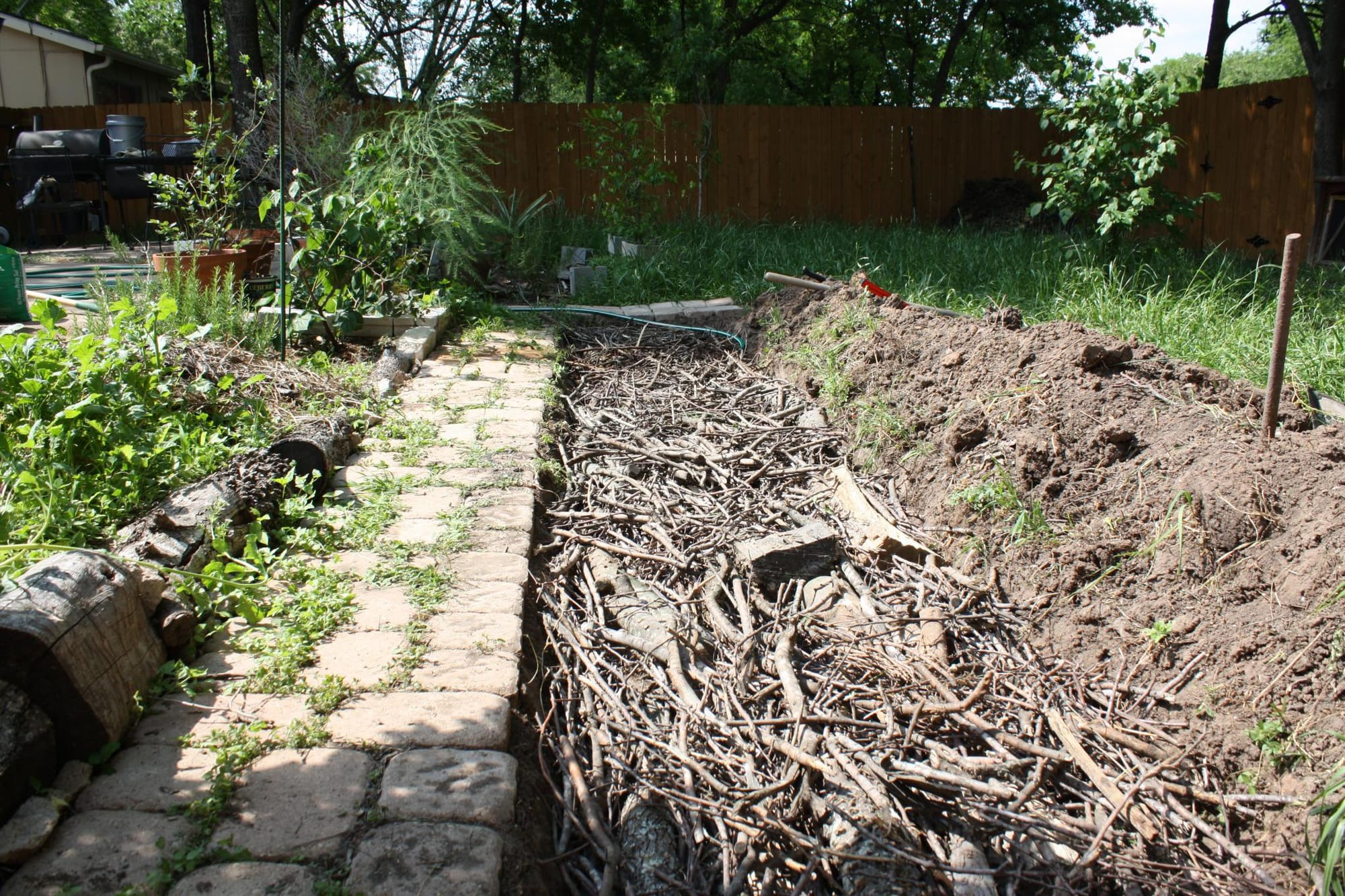
Urban community gardens and peri-urban market gardens increasingly operate under constraints of poor soil quality, limited space, and restricted access to irrigation. Hugelkultur's compatibility with raised-bed configurations, its ability to function on contaminated or compacted soils (with appropriate liner protocols), and its low-input maintenance profile make it a technically suitable option for urban food production. Several community garden networks in Northern Europe and North America have documented successful multi-year installations, though systematic yield data remains sparse.
Constraints and Honest Limitations
This analysis would be incomplete without acknowledging the practical barriers. Initial mound construction is labor-intensive, a constraint that limits adoption in contexts where labor is scarce or expensive. The nitrogen drawdown effect in early growing seasons requires management and can deter practitioners who see reduced yields in year one without understanding the multi-year fertility arc. And feedstock availability varies considerably: the technique depends on access to sufficient woody biomass, which is not universally available in densely cultivated or deforested landscapes.
 John D
Policy and Investment Implications
Positioning Within Existing Frameworks
Hugelkultur fits naturally within the nature-based solutions (NbS) paradigm that has gained significant traction in climate and biodiversity policy discourse. NbS frameworks, as articulated through IUCN standards and incorporated into national climate adaptation plans in various jurisdictions, emphasize interventions that leverage ecological processes to deliver multiple co-benefits across food security, water management, and carbon outcomes. Hugelkultur delivers on all three dimensions, though the evidence base supporting each claim varies considerably in depth.
Within FAO's climate-smart agriculture framework, the technique aligns with the triple objectives of productivity improvement, adaptation to climate variability, and mitigation through carbon sequestration and reduced synthetic input dependency. Similarly, CGIAR research programs focused on dryland farming systems and smallholder resilience represent natural institutional homes for structured agronomic trials.
Institutional Gaps
The core problem is not that hugelkultur lacks credibility; it is that it lacks institutional documentation. There are no standardized monitoring protocols for mound-level water retention, nutrient release, or carbon sequestration. There are no large-scale randomized controlled trials comparing mound-based production to conventional systems across soil types and climates. And the technique is conspicuously absent from national soil health strategies, even in countries where regenerative agriculture has otherwise gained policy attention.
This absence creates a feedback loop: without data, it cannot enter policy frameworks; without policy frameworks, it does not attract research funding; without research funding, the data gap persists.
Recommendations
Targeted investment in structured agronomic trials, coordinated through national extension services and institutions such as CGIAR, represents the highest-leverage near-term action. Trials should be designed to generate data compatible with voluntary carbon market methodology requirements, including long-term carbon accounting and additionality assessment. Practitioner knowledge networks, which hold substantial accumulated observational data, should be formally engaged as research partners rather than treated as anecdotal sources. Finally, inclusion of hugelkultur, alongside biochar, cover cropping, and agroforestry, in national soil health and climate adaptation strategies would provide the institutional legitimacy required to attract sustained research attention.
Conclusion: Rethinking the Economics of Soil
The case for hugelkultur is ultimately a case about the economics of ecological function. Industrial agriculture has treated soil as a substrate, a medium to be loaded with inputs and managed for single-season yield. The cost of that approach is now visible in degraded land, rising input dependency, and mounting vulnerability to climate variability. Hugelkultur does not solve this at scale overnight. It is a site-level technique that demands labor, patience, and a multi-year investment horizon.
What it offers in return is a self-organizing system that builds fertility rather than depleting it, retains water rather than shedding it, and sequesters carbon rather than releasing it. For policymakers designing climate adaptation programs, for researchers seeking tractable interventions with measurable co-benefits, and for land managers operating under resource constraints, the technique merits serious attention.
The insight is not new. Forests have been running this model without subsidy or supervision for millions of years. The question is whether institutional agriculture can afford to keep ignoring what the forest already knows.
John D John D
Further Reading & References
The following sources informed the analytical framing of this brief and are recommended for readers seeking deeper engagement with the evidence base.
Foundational Texts and Practitioner Literature
Holzer, S. (2011). Sepp Holzer's Permaculture: A Practical Guide to Small-Scale, Integrative Farming and Gardening. Chelsea Green Publishing.
Hemenway, T. (2009). Gaia's Garden: A Guide to Home-Scale Permaculture. Chelsea Green Publishing. (Chapter 5 addresses hugelkultur mound construction and feedstock selection in accessible depth.)
Mollison, B. (1988). Permaculture: A Designers' Manual. Tagari Publications. (The foundational permaculture text; addresses decomposition-based soil building within broader land design frameworks.)
Soil Science and Decomposition Dynamics
Brady, N. C., and Weil, R. R. (2016). The Nature and Properties of Soils (15th ed.). Pearson. (Comprehensive reference on microbial succession, nitrogen cycling, and organic matter decomposition mechanics.)
Bardgett, R. D., and van der Putten, W. H. (2014). Belowground biodiversity and ecosystem functioning. Nature, 515, 505–511. (Peer-reviewed treatment of fungal and microbial network dynamics relevant to mound decomposition phases.)
Lehmann, J., and Kleber, M. (2015). The contentious nature of soil organic matter. Nature, 528, 60–68. (Addresses stable carbon formation mechanisms and the distinction between slow and fast carbon release, directly relevant to hugelkultur's sequestration profile.)
Water Retention and Dryland Agriculture
FAO. (2011). The State of the World's Land and Water Resources for Food and Agriculture. Food and Agriculture Organization of the United Nations. Available at: fao.org
Critchley, W., Siegert, K., and Chapman, C. (1991). Water Harvesting: A Manual for the Design and Construction of Water Harvesting Schemes for Plant Production. FAO. (Addresses water retention logic in low-input agriculture; useful comparative context for hugelkultur's hydrological function.)
Rockström, J., et al. (2010). Managing water in rainfed agriculture: The need for a paradigm shift. Agricultural Water Management, 97(4), 543–550.
Regenerative Agriculture and Nature-Based Solutions Policy
IUCN. (2020). IUCN Global Standard for Nature-based Solutions (1st ed.). International Union for Conservation of Nature. Available at: iucn.org
FAO. (2021). Sustainable Food and Agriculture: Five Principles. Food and Agriculture Organization of the United Nations. Available at: fao.org
Griscom, B. W., et al. (2017). Natural climate solutions. Proceedings of the National Academy of Sciences, 114(44), 11645–11650. (Quantifies mitigation potential of nature-based land management approaches; provides useful framing for carbon sequestration claims.)
Rodale Institute. (2014). Regenerative Organic Agriculture and Climate Change: A Down-to-Earth Solution to Global Warming. Available at: rodaleinstitute.org
Carbon Markets and Soil Carbon Accounting
Paustian, K., et al. (2016). Climate-smart soils. Nature, 532, 49–57. (Authoritative treatment of soil carbon sequestration measurement challenges, permanence criteria, and policy integration.)
Verra. (2023). VM0042 Methodology for Improved Agricultural Land Management. Verified Carbon Standard. Available at: verra.org (Relevant to the question of how hugelkultur might eventually be incorporated into voluntary carbon market frameworks.)
Urban and Peri-Urban Agriculture
RUAF Foundation. (2020). Urban Agriculture: Overview and Appraisal. Resource Centres on Urban Agriculture and Food Security. Available at: ruaf.org
Goldstein, B., et al. (2016). Surveying the environmental footprint of urban food consumption. Journal of Industrial Ecology, 21(1), 151–165.
John D John D