Quantum Inertial Navigation for GNSS-Denied Environments: Can BEC and Cold-Atom Interferometry Replace GPS?
Not yet in full. Quantum clocks and gravimeters are already on submarines. A complete BEC-based IMU to replace GPS is 7 to 10 years out at minimum.

Can Quantum Navigation Replace GPS? What Bose-Einstein Condensate Inertial Sensors Actually Offer Right Now
1. Summary
Global Navigation Satellite Systems (GNSS) underpin a substantial fraction of contemporary economic activity, military operations, and critical infrastructure, yet the operational environment in which they function has deteriorated sharply since 2022. Industry data indicate that more than 430,000 GNSS jamming and spoofing incidents were recorded in 2024 alone, affecting between 700 and 1,350 flights per day, with rates of GNSS signal loss reported by IATA rising more than two hundredfold relative to 2021 [1][2][3]. The Azerbaijan Airlines Flight 8243 crash on 25 December 2024, attributed in part to jamming and spoofing in the vicinity of Grozny, illustrates that these incidents have crossed from operational nuisance to direct contributor to fatal accidents [1]. Against this backdrop, quantum inertial navigation systems based on cold-atom and Bose-Einstein condensate (BEC) interferometry have emerged as one of the most analytically credible long-term complements to GNSS, with parallel investments now visible in the United States, the United Kingdom, France, Germany, China, Australia, Japan, India, and Singapore.
This report's central thesis is that BEC-based quantum inertial navigation will not, on any plausible near-term horizon, displace GNSS as the principal source of position, navigation, and timing (PNT) for civil aviation, maritime trade, or commercial mobility. Rather, BEC and broader cold-atom interferometry are on a credible trajectory to occupy three specialised roles within a layered, defence led PNT architecture: (1) strategic-grade inertial measurement on platforms where GNSS denial is operationally certain (ballistic missile submarines, long-endurance autonomous underwater vehicles, certain classes of strategic bomber and high-altitude long-endurance unmanned aerial vehicle); (2) absolute gravimetry and magnetic-anomaly navigation as map-matching aids that bound INS drift in GNSS-denied flight (the architecture pursued by Q-CTRL's Ironstone Opal, Atomionics' Gravio, and Exail's GIRAFE); and (3) precision timing through chip-scale and rack-mount optical clocks deployed on submarines, satellites, and ground reference stations to provide GNSS-denied synchronisation [4] [5][6][7][8].
The principal findings are as follows. First, the underlying physics is mature: BECs were first realised in 1995 by Cornell, Wieman, and Ketterle, and atom interferometry with thermal cold atoms now routinely achieves laboratory-scale gyroscope bias stabilities below 10⁻⁵ deg/hr and acceleration sensitivities below 10⁻¹⁰ g, two to four orders of magnitude beyond the best ring laser gyroscopes (RLGs) and fibre-optic gyroscopes (FOGs) available from Honeywell and Northrop Grumman [9][10] [11][12]. Second, the engineering gap between laboratory performance and a deployable navigation grade Intertial Measurement Unit (IMU) remains substantial; published reviews emphasise unresolved challenges in vibration isolation, magnetic shielding, vacuum integrity, dynamic range, and dead-time between measurements [11][13]. Third, BEC-specific advantages over thermal cold-atom systems lie chiefly in long interrogation times, narrow momentum spreads (delta-kick collimation has produced effective temperatures of 340 picokelvin), and on-chip miniaturisation, but these advantages come at the cost of reduced atom flux, longer cycle times, and added complexity [13][14]. Fourth, navigation-grade prototypes have already flown: the UK's Infleqtion-led trial at MoD Boscombe Down in May 2024 placed a Tiqker optical clock and an ultracold-atom system aboard a QinetiQ RJ100 demonstrator; ONERA's GIRAFE absolute quantum gravimeter has flown over Iceland and on French naval vessels; and Q-CTRL's Ironstone Opal magnetometric system has demonstrated up to 46-fold and, in headline single-axis trials, 111-fold improvements over a strategic-grade INS in flight [4][7][8][15][16].
Principal uncertainties are: the rate at which laboratory-scale BEC interferometers can be ruggedized to operate under platform vibration and dynamics; the credibility of vendor-disclosed performance figures absent independent benchmarking against ITAR-controlled strategic-grade RLGs (Honeywell GG1320 and Northrop Grumman LN-100/LN-251 class); and the durability of cross-Atlantic export control alignment that allows allied co-development under AUKUS Pillar 2 and the September 2024 BIS plurilateral framework. Available evidence regarding Chinese capabilities, particularly the cold atom space gyroscope on the Tiangong space station and reported PLA Navy interest in quantum inertial navigation for submarines, suggests genuine peer-level competition, though specific performance claims could not be independently verified [17][18].
The recommendations elaborated in Section 9 emphasize: for defense policymakers, sustained funding of platform-integration programmes such as DARPA's RoQS (initiated February 2025) and NRL/ONR cold-atom efforts, alongside disciplined coordination through AUKUS Pillar 2 and NATO's Quantum Technologies Strategy [19][20][21][22]; for institutional investors, a barbell construction across upstream specialty photonics (M Squared Lasers, AOSense components, Exail), dual-use sensor pure-plays (Infleqtion, Q-CTRL, Atomionics), and integrators with platform access (Northrop Grumman, Lockheed Martin, BAE Systems, Honeywell, Thales, Safran Federal Systems) [4][5][8] [20]; and for research leaders, a focus on hybridization between BEC and classical sensors, magnetic and gravitational map-matching, and standardised benchmarking against established INS performance metrics [11][16][23].
Bose-Einstein Condensate Quantum Inertial Navigation: Viability, Trajectory, and Strategic Implications for GNSS Independent Positioning, Navigation, and Timing
1. Summary
2. Contextual Background and Scientific Foundations
- 2.1 The Physics of Bose-Einstein Condensation and Atom Interferometry
- 2.2 Distinction Between BEC and Thermal Cold-Atom Interferometry
- 2.3 Comparative Performance Against Classical Inertial Sensors
- 2.4 The GNSS Vulnerability Landscape Motivating Alternative PNT
3. Technology Landscape and Key Players
- 3.1 National Laboratories and Government Programmes
- 3.2 Defence Primes and Integrators
- 3.3 Pure-Play Quantum Sensing Companies
- 3.4 Academic Centres and Funding Bodies
4. Technical and Operational Considerations
- 4.1 Size, Weight, Power, and Cost Constraints
- 4.2 Sensitivity, Bias Stability, and Engineering Challenges
- 4.3 Platform Integration
- 4.4 Timing Applications
5. Economic and Market Dynamics
- 5.1 Addressable Market and Quantitative Estimates
- 5.2 Public and Private Investment Flows
- 5.3 Supply Chain and Cost Trajectories
6. Regulatory Landscape
- 6.1 Export Controls
- 6.2 Spectrum, Laser Safety, and Aviation Certification
- 6.3 Investment Screening
7. Geopolitical and Strategic Dimensions
- 7.1 Strategic Competition
- 7.2 Alliance Structures
- 7.3 Nuclear Deterrence, Submarine Warfare, and Contested Environments
8. Risk Analysis
9. Strategic Recommendations
- 9.1 Defence and National Security Policymakers
- 9.2 Institutional Investors and Corporate Strategists
- 9.3 Research Leaders and Programme Managers
- 9.4 Commercial Aerospace and Autonomous Systems Integrators
10. Conclusion
11. References
2. Contextual Background and Scientific Foundations
2.1 The Physics of Bose-Einstein Condensation and Atom Interferometry
Bose-Einstein condensation was predicted in 1924-1925 in correspondence between Satyendra Nath Bose and Albert Einstein, who extended Bose's photon statistics to massive particles and predicted that below a critical temperature a macroscopic occupation of the lowest quantum state would emerge in a non-interacting Bose gas [24][25]. The first experimental realization in a dilute alkali vapor did not occur until 5 June 1995, when Eric Cornell, Carl Wieman, and colleagues at JILA in Boulder produced a condensate of approximately 2,000 ⁸⁷Rb atoms cooled to 170 nanokelvin, followed within weeks by Wolfgang Ketterle's group at MIT using ²³Na, with both groups eventually sharing the 2001 Nobel Prize in Physics for the achievement [24][25][26]. The intervening seven decades saw the development of the experimental technologies on which condensation depends, principally laser cooling and trapping (recognised by the 1997 Nobel Prize), magneto-optical traps, and evaporative cooling. The fundamental quantum-mechanical property exploited for navigation is that BECs constitute coherent matter waves analogous to laser light, with momentum spreads orders of magnitude narrower than thermal clouds [13][14][24].
Atom interferometry exploits the wave nature of matter directly. In a typical Mach-Zehnder light pulse atom interferometer, laser-cooled atoms are subjected to a sequence of three counter propagating laser pulses that drive stimulated two-photon Raman transitions between hyperfine ground states; the first pulse acts as a beam splitter, the second as a mirror, and the third recombines the wave packets, producing an output interference signal whose phase encodes any acceleration or rotation experienced along the trajectory [10][11]. For a Mach-Zehnder gravimeter, the accumulated phase difference scales as Δφ = k_eff · g · T², where T is the interrogation time between pulses; a Sagnac-type rotation interferometer scales with the enclosed area. The quadratic scaling with T is critical: doubling interrogation time quadruples sensitivity, and BECs with very low momentum spread enable dramatically longer T than thermal clouds before atoms escape the laser beams [10][13] [14].
2.2 Distinction Between BEC and Thermal Cold-Atom Interferometry
The distinction between BEC-based and thermal cold-atom interferometry is operationally consequential. Thermal cold-atom interferometers, typified by ONERA's GIRAFE, Exail's Absolute Quantum Gravimeter (AQG), and most laboratory-scale gravimeters, use atomic clouds at microkelvin temperatures with thermal momentum spreads of order tens of cm/s; they enjoy high flux (10⁶ to 10⁹ atoms per cycle), short cycle times, and well-understood error budgets [10][11][27]. BEC-based interferometers reduce momentum spread by three to four orders of magnitude (effective 1D temperatures of 340 picokelvin have been demonstrated using delta-kick collimation), enabling much longer interrogation times in compact apparatus and the use of large-momentum-transfer beam-splitter sequences such as twin-lattice double Bragg diffraction with Bloch oscillations [13][14]. The cost is reduced atom number (typically 10³ to 10⁵ per cycle), longer preparation times, and higher complexity. A 2025 review in Applied Physics Reviews concluded that BEC interferometers are particularly promising for atom-chip-based, on-platform inertial navigation where compactness is valued over raw flux, while thermal sources retain advantages for stationary precision gravimetry [13]. Trapped, guided BEC interferometers in ring or double-well geometries offer further miniaturisation and have demonstrated coherence times approaching one second [28][29].
2.3 Comparative Performance Against Classical Inertial Sensors
The relevant classical performance benchmarks are those of strategic-grade and navigation-grade inertial sensors. Honeywell's GG1320 ring laser gyroscope, of which more than 500,000 units have been produced and which is in widespread use across commercial and military aviation, is specified at bias stability ≤0.0035 deg/hr (equivalent to roughly one nautical mile of position drift per hour of unaided flight) [30][31]. Honeywell's interferometric fibre-optic gyroscopes (IFOGs), targeting strategic-grade applications, achieve bias instability between 0.0001 and 0.001 deg/hr with angle random walk between 5×10⁻⁵ and 5×10⁻⁴ deg/√hr [32]. Tactical-grade IMUs such as the Honeywell HG1700 specify gyro bias in-run stability of approximately 1 deg/hr and ARW of 0.125 deg/√hr [33]. Northrop Grumman's LN-100 family is widely deployed on platforms including the F-22, T-45, and MH-60 helicopters. The state of the art for laboratory-scale cold-atom Sagnac gyroscopes, exemplified by the Stanford-AOSense lineage, has reported bias stability below 70 micro-deg/hr, scale factor stability below 5 ppm, and angle random walk of approximately 3 micro-deg/√hr (Durfee, Shaham, Kasevich 2006), constituting a roughly 300-fold improvement over the best classical strategic-grade gyroscopes [11][34]. Continuous interleaved cold-atom gyroscopes at LNE-SYRTE have demonstrated 1 nrad/s rotation stability [11][35]. These comparisons, however, refer to laboratory devices on vibration-isolated platforms; the published gap between such devices and a deployable, ruggedised IMU remains the principal engineering bottleneck [11][13].
2.4 The GNSS Vulnerability Landscape Motivating Alternative PNT
The strategic motivation for BEC-based PNT is grounded in measurable deterioration of GNSS reliability. The 2018 Blackett Review for the UK Government Office for Science, "Satellite-derived Time and Position: A Study of Critical Dependencies," catalogued the embedded reliance of UK critical national infrastructure on GNSS and recommended a structured policy response that ultimately produced the UK National PNT Office and a £14 million National Timing Centre programme at NPL [36][37]. The OpsGroup September 2024 report and IATA-EASA workshop conclusions document a rise from approximately 300 spoofed flights per day in early 2024 to 1,500 per day by August 2024, with 41,000 spoofing events recorded in a single month from mid-July to mid-August 2024 [1][3]. Maritime interference has likewise scaled: in April 2024, Lloyd's List documented 117 vessels simultaneously displaced to Beirut Airport coordinates and 227 vessels affected across the Eastern Mediterranean; in June 2025, Windward AI reported nearly 3,000 vessels disrupted in the Persian Gulf and Strait of Hormuz over a brief window [38]. Latvia's Electronic Communications Office recorded 820 cases of satellite interference in 2024 versus 26 in 2022, and Lithuania reported a twenty-twofold year-on-year increase in June 2025 [39][40]. The pattern is widely attributed to Russian electronic warfare deployments around Kaliningrad, the Baltic Sea, and the Black Sea, combined with regional dynamics in the Eastern Mediterranean, the Strait of Hormuz, and the India-Pakistan border [38][39][40][41]. The US response includes the 2020 Executive Order 13905 on responsible use of PNT, the DHS Resilient PNT Conformance Framework transitioned to IEEE P1952, and DARPA's portfolio of alternative PNT programmes [3][42][43].
3. Technology Landscape and Key Players
3.1 National Laboratories and Government Programmes
DARPA has been the dominant single funder of cold-atom inertial sensing for navigation over the past two decades. The agency's earlier Adaptable Navigation Systems programme included the Precision Inertial Navigation Systems (PINS) effort, which developed a cold-atom IMU targeting drift rates around five metres per hour with subsystem demonstrations through fiscal year 2017, and the All Source Positioning and Navigation (ASPN) effort focused on sensor fusion architectures [44][45]. The Chip-Scale Atomic Clock (CSAC) programme (2001-2009) produced the first commercial miniaturized atomic frequency reference, and the Quantum-Assisted Sensing and Readout (QuASAR) programme (2010-2018) developed clocks with approximately tenfold improvement over previous records [46]. DARPA's current navigation-relevant flagship is the Robust Quantum Sensors (RoQS) programme, launched in February 2025 under the Microsystems Technology Office; Phase 1 awards were announced through 2025 to Q-CTRL (AU$38M / US$24.4M, with Lockheed Martin as subcontractor), Safran Federal Systems, and other performers, with an explicit objective of helicopter class platform integration and identification of Programs of Record on which quantum sensors can transition [4][20][47]. The Defense Innovation Unit demonstrated an atomic gyroscope in space in 2024 and has stated a follow-on objective of a fully integrated atomic IMU [48].
The US Naval Research Laboratory's Quantum Optics Section is independently developing atom interferometric inertial sensors under the NRL Base Program and the Office of Naval Research, with publicly disclosed work focused on managing the trade-off between sensitivity and dynamic range [49]. NIST contributes through optical clock development, including iodine-based and ytterbium lattice clocks. AFRL has demonstrated portable Optical Rubidium Atomic Frequency Standards (ORAFS) at sea aboard HMNZS Aotearoa in joint trials with the University of Adelaide and Vector Atomic [6][50].
In Europe, the LNE-SYRTE laboratory at the Paris Observatory anchors French capability, with its continuous and interleaved cold-atom gyroscope work and partnerships with ONERA producing the GIRAFE marine and airborne gravimeters [11][15][27][35]. ONERA's atomic sensor unit operates GIRAFE for the French Ministry of Defence's hydrographic and oceanographic service (SHOM) and has flown the instrument on multiple campaigns in Iceland and France [15][27]. Germany's PTB and the Humboldt University and Hannover Institut für Quantenoptik consortium have developed BEC based atom-chip systems including the QUANTUS drop-tower experiments and the BECCAL apparatus on the ISS [13][51]. The UK National Physical Laboratory partners with the British Geological Survey and universities through the National Quantum Technologies Programme [52][53].
3.2 Defence Primes and Integrators
Northrop Grumman and Honeywell remain the strategic incumbents in inertial reference units for both commercial aviation (Honeywell ADIRS on Airbus A320/A330/A340/A380 and Boeing 737/757/777; Northrop Grumman LTN-101 Flagship) and military platforms (LN-100 family on F-22, T-45, C-130, MH-60) [31][33]. Lockheed Martin is integrated as a subcontractor on Q-CTRL's RoQS award for high-performance military vehicles [4]. BAE Systems and QinetiQ partnered with Infleqtion on the May 2024 Boscombe Down quantum-navigation flight trial, in which a Tiqker optical atomic clock and an ultracold-atom system flew aboard QinetiQ's RJ100 Airborne Technology Demonstrator [54]. Thales (through its France-based aerospace and naval businesses) and Leonardo are active in Quantum Flagship sensing consortia. Safran, through Safran Federal Systems, was selected for DARPA RoQS in October 2025 for development including helicopter-platform tests [20]. Exail (the merged entity from iXblue's earlier acquisition of Muquans) commercializes both the Absolute Quantum Gravimeter (AQG) and Differential Quantum Gravimeter (DQG) and supplies subsystems to French defense projects with ONERA [27][55].
3.3 Pure-Play Quantum Sensing Companies
AOSense, founded in 2004 as a Stanford spin-out by Brenton Young and Mark Kasevich, has been awarded prime contracts from DARPA, the Air Force, Navy, NASA, and DTRA since 2006 and has demonstrated cold-atom IMUs supporting drift rates around 5 metres per hour, gravimeters, gravity gradiometers, and compact rubidium microwave atomic clocks (production target Allan deviation 2×10⁻¹² at 1 second) [44][56]. Infleqtion, formerly ColdQuanta, headquartered in Boulder with offices in the UK and Australia, announced in 2025 the world's first deployment of an optical atomic clock (Tiqker) on an underwater autonomous vehicle (Royal Navy XV Excalibur) and is pursuing a Quantum-Enhanced Inertial Navigation System (Q-INS) and a planned space flight of a quantum gravity sensor with NASA. The company has filed for a public listing via merger with Churchill Capital Corp X [5][57][58][59]. Exail (formerly iXblue, originally Muquans) commercialises the AQG-A01, AQG-A02, AQG-B01, and AQG-B10 with sensitivity of 500 nm·s⁻²·Hz⁻¹/² at quiet sites and 10 nm/s² precision after 1-hour integration as evaluated by the German Federal Agency for Cartography and Geodesy [55].
M Squared Lasers, headquartered in Glasgow, supplies SolsTiS Ti:sapphire lasers reportedly used in more than 90% of cold-matter quantum computing efforts and has demonstrated UK-first quantum gravimeters and accelerometers [60]. Vector Atomic, based in Pleasanton, California, demonstrated a portable iodine-based optical clock at sea aboard HMNZS Aotearoa with a 26 kg footprint and reported time stability around 300 trillionths of a second per day; the company has delivered an atomic gyroscope to the DIU for space testing [6][50]. Q-CTRL, headquartered in Sydney, integrates AI-based software ruggedisation with quantum magnetometers for its Ironstone Opal product and has reported bounded positioning errors significantly lower than strategic-grade INS in airborne, ground, and maritime trials [4][8][16]. Atomionics in Singapore has commercialised the Gravio quantum gravimeter for resource exploration with mining and oil-and-gas customers in Australia and Arizona, having raised seed funding led by Wavemaker Partners with participation from Cap Vista (Singapore Defence) and SGInnovate [61]. Q.ANT in Stuttgart, a TRUMPF spin-off, develops atomic gyroscopes within its Native Sensing division alongside photonic computing and magnetic sensors, having raised €142 million in a Series A through November 2025 [62].
3.4 Academic Centres and Funding Bodies
The Stanford Center for Position, Navigation and Time, anchored by the Kasevich Group, has produced the seminal demonstrations underlying the field: light-pulse atom interferometry (Kasevich and Chu, 1991), area-reversible Sagnac gyroscope (Durfee, Shaham, Kasevich, 2006), and the 10 metre atom fountain MAGIS-100 with sensitivity to 6.7×10⁻¹² g per shot [11][34][63]. MIT (Ketterle), Imperial College London, the University of Birmingham (which leads the UK Quantum Technology Hub for Sensors and Timing and its successor QuSIT, launched December 2024 with £106 million in EPSRC and NIHR funding across nine universities, BGS, and NPL), Humboldt University (BECCAL, QUANTUS), the University of Hannover (Leibniz Universität, Institut für Quantenoptik), and the Australian National University constitute the principal academic poles [13][51][52][53][64]. Funding architectures include the US National Quantum Initiative (extended via the FY2024 budget submission), the EU Quantum Flagship (with iqClock and its successor AQuRA addressing transportable optical clocks), the UK National Quantum Technologies Programme (which has now committed approximately £1 billion across phases since 2014), and China's National Laboratory for Quantum Information Sciences in Hefei plus PLA-affiliated programmes at NUDT and Shanghai Jiao Tong University [22][53][65][66].
4. Technical and Operational Considerations
4.1 Size, Weight, Power, and Cost Constraints
A central technical challenge is bridging the gap between laboratory-scale BEC apparatus (typically a 1-2 m³ optical-table footprint with associated laser racks consuming hundreds of watts) and the SWaP-C envelopes of operational platforms. Tactical-grade IMUs such as the HG1700 occupy roughly 5 litres at 4.5 kg and 8 W [33]; an aircraft-grade ring laser gyroscope IRU is comparable. The Cooperative University of Colorado/Infleqtion accelerometer demonstrated a sensor volume reduction "greater than a factor of 10,000" relative to laboratory predecessors using software configured machine learning, although operational equivalence to a strategic-grade INS has not been independently established [5]. Q-CTRL has emphasised the role of software ruggedisation and AI based denoising in offsetting the requirement for traditional vibration isolation and magnetic shielding, and its Ironstone Opal magnetometric system has flown without conventional shielding [16]. NASA's Cold Atom Lab and the BECCAL platform demonstrate that on-orbit microgravity allows interrogation times exceeding 10 seconds and effective temperatures below 1 picokelvin, but these benefits are unavailable on terrestrial platforms [51][67].
4.2 Sensitivity, Bias Stability, and Engineering Challenges
Published reviews including Geiger, Landragin, Merlet, and Pereira Dos Santos (2020) and the European Commission Joint Research Centre 2020 assessment provide the most rigorous comparative tabulation [10][11]. Laboratory cold-atom Sagnac gyroscopes have demonstrated bias stabilities below 70 micro-deg/hr, scale factor stabilities below 5 ppm, and ARW of 3 micro-deg/√hr; cold-atom accelerometers have reached short-term sensitivities of 8.8×10⁻⁶ m/s²/√Hz [11]. Engineering challenges fall in four principal categories. First, vibration isolation: the high sensitivity of cold-atom interferometers to vibration has historically required active or passive isolation platforms unsuitable for moving vehicles; sensor hybridisation schemes pioneered at LNE-SYRTE pre-compensate Raman-laser phase using classical accelerometer feedback, allowing operation in dynamic environments [11][27]. Second, magnetic shielding: residual fields produce systematic phase shifts that require multi-layer mu-metal shielding or active compensation. Third, laser stability: each interferometer requires multiple frequency-stabilised lasers (typically at 780 nm for ⁸⁷Rb) with linewidths in the kHz range, supplied by Ti:sapphire systems (M Squared SolsTiS), DFB diodes, or fibre-amplified architectures (Exail Intelligent Laser System at 1560 nm with frequency doubling). Fourth, ultra-high-vacuum systems: interrogation regions at 10⁻¹¹ mbar require either continuously pumped systems with finite lifetime or sealed passive-pumped cells with limited operating duration. Atom chips and grating magneto-optical traps reduce SWaP at the cost of atom flux [13][14][68].
4.3 Platform Integration
Aircraft integration has progressed from gravimetry surveys (ONERA GIRAFE in Iceland 2017, France 2019) to dedicated navigation-system demonstrators (Infleqtion-BAE Systems-QinetiQ at Boscombe Down May 2024; Q-CTRL flight trials reaching up to 19,000 feet) [15][16][27][54]. Submarine integration is currently most advanced for clock applications: Infleqtion's Tiqker optical atomic clock was deployed on the Royal Navy's XV Excalibur uncrewed submarine in October 2025, the first such deployment globally, and Vector Atomic's iodine clock has been validated on HMNZS Aotearoa [6][57][58]. Australia's QuantX Labs and the University of Adelaide demonstrated four quantum clocks in Washington, DC over a six-week 2025 trial under the AUKUS Quantum Arrangement (AQuA, established at the AUKUS launch in 2021, with positioning, navigation and timing as initial focus through 2025) with A$2.7 million in Australian government funding [69][70]. Ground vehicles, autonomous underwater vehicles, and missile platforms remain at earlier integration stages. Sensor fusion architectures combining quantum inertial sensors with classical IMUs, vision-based SLAM, terrain-referenced navigation (TRN), magnetic anomaly navigation (MagNav), and celestial navigation are the principal architectural pattern; DARPA's earlier ASPN programme established the algorithmic framework [44][16][45].
4.4 Timing Applications
Optical and microwave atomic clocks for GNSS-denied synchronisation constitute the most operationally mature subsegment of quantum PNT. Vector Atomic's iodine clock at 26 kg occupies a footprint compatible with shipboard installation; Infleqtion's Tiqker has demonstrated submarine deployment; AOSense supplies rack-mount rubidium clocks. The NPL National Timing Centre R&D programme, the EU AQuRA project (successor to iqClock), and the NIST and PTB optical lattice clock programmes all target field-deployable optical references that could support GNSS-independent infrastructure synchronisation [37][66][68].
5. Economic and Market Dynamics
Market sizing for quantum sensing is contested and analytically heterogeneous. McKinsey's 2025 Quantum Technology Monitor (released April 2025) projects a global quantum sensing market of $7-10 billion by 2035, up from a 2024 base of approximately $0.7 billion as estimated in earlier editions, within a total quantum technology market of up to $97 billion by 2035 and $198 billion by 2040 [71]. The 2024 edition had projected quantum sensing at $0.5-2.7 billion by 2035 within a smaller total, illustrating substantial year-on-year revision and methodological uncertainty [72]. IDTechEx forecasts the quantum sensor market at approximately US$1.9-2.2 billion by 2045-2046 with CAGR around 11%, materially below McKinsey's high case [73][74]. Precedence Research projects $1.34 billion by 2034 at 25.7% CAGR [75]. These ranges should be interpreted as indicative rather than authoritative; underlying uncertainty about technology readiness, regulatory pathways, and competing classical sensor improvements makes precise sizing speculative. The 2026 McKinsey report notes that 2025 quantum start-up investment reached $12.6 billion, of which roughly 90% flowed to quantum computing and 10% to sensing and communication combined [71].
5.2 Public and Private Investment Flows
ECIPE's 2024 benchmarking estimates cumulative quantum public investment at approximately $15 billion in China, over $10 billion in the EU (with Germany contributing approximately 60% of EU public investment), and an estimated $4 billion to over $15 billion in the US depending on accounting conventions [76]. Private sector cumulative funding reached approximately $15 billion by 2024, with the US capturing 44%, the UK-Canada-Australia bloc approximately 20%, and China 17% [76]. Notable individual rounds include Q.ANT's €142 million Series A (July and November 2025), Q CTRL's accumulated DARPA contracts of AU$38 million, Infleqtion's announced SPAC merger with Churchill Capital Corp X, and Atomionics' staged funding from Wavemaker Partners, SGInnovate, and Cap Vista [4][57][61][62]. Delta.g, the University of Birmingham gravity-gradiometry spin-out, raised £4.6 million in a 2025 seed round led by Serendipity Capital with NSSIF participation [77].
5.3 Supply Chain and Cost Trajectories
Critical components include narrow-linewidth lasers (M Squared SolsTiS, Vexlum, Toptica, AOSense fibre lasers, DFB diodes from Glasgow/Kelvin Nanotechnology), ultra-high-vacuum systems (specialty rubidium and strontium dispensers, ion pumps, glass cells), atomic source materials (⁸⁷Rb, ⁸⁵Rb, ⁸⁷Sr, ¹⁷¹Yb), magnetic shielding (mu-metal), and frequency combs (Menlo Systems, AOSense). The September 2024 BIS interim final rule and harmonised European, UK, Japanese, and Canadian controls (the so-called Wassenaar-Minus-One coalition) restrict the export of cryogenic systems, certain specialty lasers, and dual-use components, with implications for global supply chain configuration [78][79][80][81]. Cost trajectories for absolute quantum gravimeters have moved from research-only systems in the early 2010s to commercial unit prices in the seven-figure range as of 2025 (Exail AQG); reaching commercial viability outside defence and high-end geophysics requires a further order of magnitude reduction in unit cost and footprint, plausible only with photonic integrated-circuit laser systems and atom-chip miniaturisation, both areas of active research [13][68].
6. Regulatory Landscape
6.1 Export Controls
The September 6, 2024 BIS interim final rule introduced 18 new Export Control Classification Numbers and revised nine existing ECCNs, establishing worldwide controls on certain quantum computing systems, cryocooling, additive manufacturing, and related software, with a limited license exception (IEC) for partner jurisdictions implementing equivalent controls [78][79][80]. The rule also expanded CFIUS critical-technology jurisdiction to capture investments in US businesses dealing in newly controlled quantum items [80]. The UK adopted PL9013, PL9014 (quantum computing technologies), and PL9015 in April 2024 [81]. The EU's Delegated Regulation updated its dual-use list across Categories 1-9 to incorporate Wassenaar 2024 Plenary outcomes, including new controls on quantum technology components [82]. Russian objections at the Wassenaar Plenary since 2022 have prevented multilateral consensus on quantum controls, motivating the plurilateral "Wassenaar Minus-One" approach [81][82]. Inertial-sensor controls under Wassenaar Category 7 (Navigation and Avionics) and Category 6 (Sensors and Lasers) capture certain quantum gravimeters and gyroscopes when their performance exceeds threshold specifications [83]. ITAR Category XII covers most US origin strategic-grade IMUs (Honeywell HG1700 and equivalents) and would extend to comparable quantum systems intended for guided weapons [33].
6.2 Spectrum, Laser Safety, and Aviation Certification
Aviation certification for quantum navigation systems will follow the existing FAA AC 20-138 / TSO C-145/C-146 GNSS framework as a complement rather than replacement; EASA's Safety Information Bulletin 2022-02R3 (revised July 2024) and the IATA-EASA action plan published in June 2025 emphasize layered architectures including INS, VOR/DME, and emerging quantum approaches [3] [84]. Maritime certification through IMO is at an earlier stage; the IMO, ICAO, and ITU joint statement of March 2025 addressed GNSS interference but did not yet establish certification pathways for quantum navigation aids [40]. Laser safety considerations under IEC 60825 affect open aperture configurations.
6.3 Investment Screening
CFIUS's 2024 Annual Report records 206 covered transaction notices, of which 55% proceeded to second-stage investigation, with 9% resolved through formal mitigation versus 21-23% in 2022-2023 [85][86]. Investments by PRC-connected entities accounted for 28% of critical-technology reviews despite being only 12% of total filings; quantum sensing is identified as a focus sector [87]. The Treasury final rule on outbound investment screening took effect 2 January 2025 and prohibits or requires notification of US-person investments in PRC quantum information technologies [88]. The UK National Security and Investment Act and EU FDI screening regulations have been actively applied to quantum transactions, with Germany, France, Italy, Austria, Belgium, Denmark, and the Netherlands expanding national FDI laws [80].
7. Geopolitical and Strategic Dimensions
7.1 Strategic Competition
The principal axis of strategic competition lies between the United States and China, with secondary involvement of Russia, the EU, the UK, and emerging quantum powers. China's investments in quantum precision measurement include the deployment of a cold-atom microwave clock and a cold atom gyroscope on the Tiangong space station in 2024-2025, with reported long-term rotation measurement resolution of 17 micro-radians per second; Beijing's hydrogen maser clocks aboard BeiDou satellites are reported to achieve approximately one femtosecond per day uncertainty [17][18]. The PLA's National University of Defense Technology has openly described "new generation inertial navigation" research using quantum effects, and Chinese researchers have demonstrated drone mounted coherent population trapping atomic magnetometers framed in part for submarine detection [17][18]. Verification of Chinese performance claims remains limited, and US government estimates cited in open sources suggest cold atom interferometers may reach operational conditions around 2029, with submarine deployment likely 5-10 years further out [18].
7.2 Alliance Structures
AUKUS Pillar 2 includes a dedicated Quantum Technologies working group operating under the AUKUS Quantum Arrangement (AQuA), with positioning, navigation and timing identified as the immediate focus from 2022 with experimentation through early 2025 [69][70]. The November 2025 Australian Defence announcement reported the successful Washington trial of four QuantX Labs/University of Adelaide clocks, building on the October 2025 Royal Navy Tiqker submarine trial [57][70]. NATO's Quantum Technologies Strategy was approved by Foreign Ministers in November 2023 and publicly summarised on 17 January 2024, framing PNT, sensing and imaging, and quantum-resistant cryptography as priorities; six of the first 44 DIANA cohort companies are quantum-focused [22][89]. The EU Quantum Flagship's iqClock and AQuRA projects target transportable optical clocks; a 13 EU member state letter of June 2025 to the Commission requested measures to counter GPS interference and accelerate alternative PNT [40][66].
7.3 Nuclear Deterrence, Submarine Warfare, and Contested Environments
The most strategically destabilising potential of BEC-based PNT is on the offensive side: a navigation grade cold-atom IMU on a ballistic missile submarine could substantially extend covert patrol durations by reducing the need for periodic GNSS or celestial fixes that compromise emissions control. Conversely, quantum magnetometers raise the prospect of submarine detection at greater range, threatening the survivability of sea-based deterrence [18][80]. In the Indo-Pacific, GNSS denied navigation is operationally relevant to Taiwan-strait contingencies and South China Sea operations; in the Arctic, where GNSS geometry is already weak and Russian electronic warfare assets are active, quantum-augmented PNT is of particular interest to littoral and submarine operators. Dual-use tensions arise from the civil application of gravimeters and magnetometers in resource extraction (Atomionics, Bridgeport Energy, Rio Tinto), which produces commercial datasets potentially exploitable for military purposes.

8. Risk Analysis
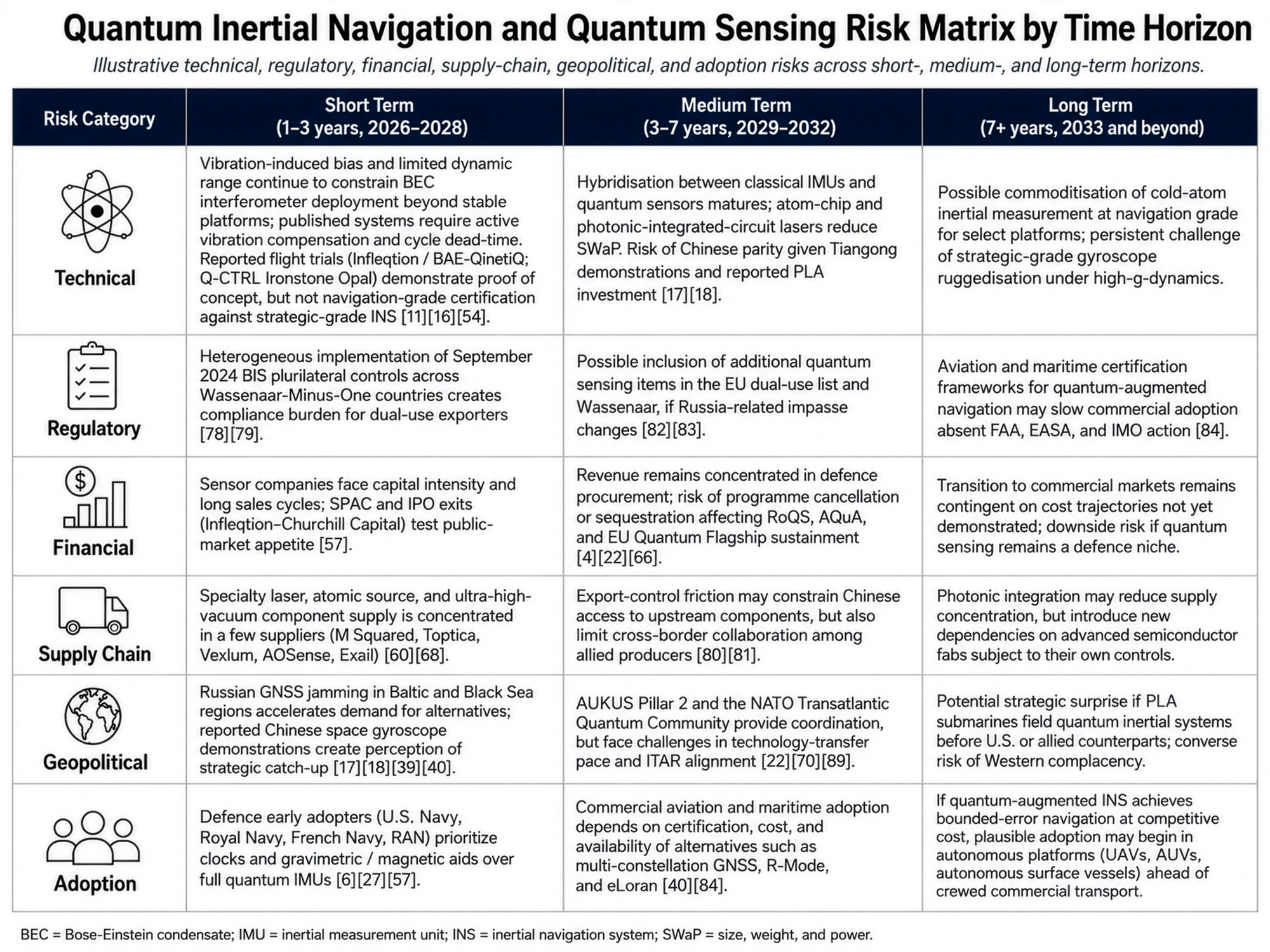
The following structured risk matrix organises principal risks across three time horizons.
| Risk Category | Short Term (1–3 years, 2026–2028) | Medium Term (3–7 years, 2029–2032) | Long Term (7+ years, 2033 and beyond) |
|---|---|---|---|
| Technical | Vibration-induced bias and limited dynamic range continue to constrain BEC interferometer deployment beyond stable platforms. Published systems require active vibration compensation and face cycle dead-time. Flight trials demonstrate proof of concept but not navigation-grade certification against strategic-grade INS [11][16][54]. | Hybridization between classical IMUs and quantum sensors matures; atom-chip and photonic-integrated laser systems reduce SWaP. Risk of Chinese parity grows given Tiangong demonstrations and reported PLA investment [17][18]. | Possible commoditization of cold-atom inertial measurement at navigation grade for select platforms; strategic-grade gyroscope ruggedization under high-g dynamics remains a persistent challenge. |
| Regulatory | Heterogeneous implementation of September 2024 BIS plurilateral controls across Wassenaar-minus-one countries creates compliance burden for dual-use exporters [78][79]. | Possible inclusion of additional quantum sensing items in the EU dual-use list and Wassenaar arrangements if Russia-related impasse changes [82][83]. | Aviation and maritime certification frameworks for quantum-augmented navigation may slow commercial adoption absent FAA, EASA, and IMO action [84]. |
| Financial | Sensor companies face capital intensity and long sales cycles; SPAC and IPO exits test public-market appetite [57]. | Revenue remains concentrated in defense procurement; program cancellation or sequestration could affect RoQS, AQuA, and EU Quantum Flagship sustainment [4][22][66]. | Transition to commercial markets depends on cost trajectories not yet demonstrated; downside risk remains if quantum sensing stays a defense niche. |
| Supply Chain | Specialty laser, atomic source, and ultra-high-vacuum component supply remains concentrated among few suppliers, including M Squared, Toptica, Vexlum, AOSense, and Exail [60][68]. | Export-control friction may constrain Chinese access to upstream components but also limit cross-border collaboration among allied producers [80][81]. | Photonic integration may reduce supply concentration but introduces new dependencies on advanced semiconductor fabs subject to their own controls. |
| Geopolitical | Russian GNSS jamming in Baltic and Black Sea regions accelerates demand for alternatives; Chinese space gyroscope demonstrations create perception of strategic catch-up [17][18][39][40]. | AUKUS Pillar 2 and NATO Transatlantic Quantum Community provide coordination but face challenges in technology-transfer pace and ITAR alignment [22][70][89]. | Potential strategic surprise if PLA submarines field quantum inertial systems before U.S. or allied counterparts; converse risk of Western complacency. |
| Adoption | Defense early adopters prioritize clocks and gravimetric/magnetic aids over full quantum IMUs [6][27][57]. | Commercial aviation and maritime adoption depends on certification, cost, and alternatives such as multi-constellation GNSS, R-Mode, and eLoran [40][84]. | If quantum-augmented INS achieves bounded-error navigation at competitive cost, adoption may occur first in autonomous UAVs, AUVs, and autonomous surface vessels before crewed commercial transport. |
9. Strategic Recommendations
9.1 Defence and National Security Policymakers
Sustained, predictable funding of platform-integration programmes is the principal lever. DARPA's RoQS programme should be supported through a Phase 2 transition that places quantum sensors on Programs of Record across air, sea, and land domains; AOSense, Q-CTRL, Safran Federal Systems, and Infleqtion appear positioned for transition awards [4][20][45]. Allied coordination through AUKUS Pillar 2 and the NATO Transatlantic Quantum Community should be deepened, with explicit performance benchmarks and shared evaluation protocols rather than bilateral demonstrations [22] [70][89]. Procurement strategies should distinguish three tiers: clocks (highest readiness, suitable for near-term acquisition), gravity- and magnetic-anomaly map-matching aids (mid-readiness, demonstrated in flight by Q-CTRL, Exail, ONERA), and full quantum IMUs (lower readiness, longer horizon). Supply chain resilience requires identification of single-source dependencies in specialty lasers, atomic vapor cells, and frequency combs, with deliberate qualification of multiple suppliers across allied jurisdictions. The September 2024 BIS plurilateral framework provides a template for export-control coordination, but care should be taken to avoid over-broad controls that impede legitimate research collaboration with non-adversary partners [78][79][80]. Talent retention warrants specific attention: BEC and atom-interferometry expertise resides in fewer than fifty groups globally [11], and salary differentials with private quantum computing employers create flight risk.
9.2 Institutional Investors and Corporate Strategists
A barbell construction is analytically defensible. The upstream end of the value chain (specialty photonics, vacuum components, atomic sources) offers exposure to multiple end-applications including quantum computing and sensing, with relatively predictable revenue from both research and commercial markets; M Squared Lasers, Coherent's photonics businesses, Toptica, and Exail's optical components business are representative. The pure-play sensor end offers higher beta exposure with greater technical and adoption risk; Q-CTRL, Infleqtion (post-listing), Atomionics, and Q.ANT are representative. The midstream integrator layer (Northrop Grumman, Honeywell, Lockheed Martin, BAE Systems, Thales, Leonardo, Safran) offers stable cash flows and defensive procurement exposure. Due diligence frameworks should specifically test (a) independent verification of vendor performance claims against ITAR-controlled classical benchmarks, (b) the fraction of revenue derived from defence versus commercial customers, (c) intellectual property positions in critical components, and (d) regulatory exposure under CFIUS, NSI Act, and outbound investment rules [85][86][88]. Exit timing is sensitive to defence procurement cycles; the 2025 SPAC route taken by Infleqtion suggests that pure-play public-market valuations will track quantum computing sentiment more than sensor fundamentals, creating timing risk.
9.3 Research Leaders and Programme Managers
Capability gaps that warrant prioritised investment include: (a) trapped and guided BEC interferometers with second-scale coherence, which compress the size envelope without sacrificing interrogation time [28][29]; (b) photonic-integrated-circuit laser systems for cold-atom cooling and Raman beam generation, demonstrated in compact cold-atom interferometers with grating MOTs [68]; (c) hybrid atom-classical-MEMS architectures with real-time Raman-phase pre-compensation for vibration immunity [11]; (d) standardised benchmarking protocols against ring laser gyroscopes and fibre-optic gyroscopes under representative dynamic environments. Collaboration architectures should leverage the QuSIT consortium model (nine UK universities plus BGS and NPL) and bilateral arrangements such as the NASA-DLR BECCAL collaboration [51][53][64]. The talent pipeline requires reinforcement: McKinsey reported approximately 367,000 quantum-related graduates by 2023, but the subset with cold-atom and atom-chip experience is small, and the programme of fifty five master's degrees worldwide remains dominated by quantum computing curricula [72]. Targeted graduate fellowships co-funded by industry, defence agencies, and metrology institutes could redirect talent toward navigation-relevant subfields.
9.4 Commercial Aerospace and Autonomous Systems Integrators
Commercial aerospace and autonomous systems integrators face an asymmetric calculus: the cost of a one-day Tartu-airport closure or a single jamming-related diversion is meaningful, but quantum navigation systems are not yet certified for civil aviation use. Integrators should pursue evaluation kits (the path Q-CTRL has taken with its Ironstone Opal evaluation kit shown at the Singapore Airshow 2026) that allow risk-bounded operational data collection without aircraft modification [16]. Partnerships with airframers (Q-CTRL's announced collaboration with Airbus is illustrative) accelerate the shift from research demonstration to certified system [16]. For autonomous systems, the certification bar is lower and the operational urgency higher; UAV manufacturers including those working with ANELLO Photonics-Q-CTRL collaborations are likely first movers.
10. Conclusion
BEC-based quantum inertial navigation occupies a distinctive position in the contemporary PNT landscape: it is supported by physically valid, three-decade-old fundamentals, has produced laboratory performance that exceeds classical strategic-grade inertial sensors by two to four orders of magnitude, and has crossed the threshold of in-flight, at-sea, and undersea demonstration on operational platforms. Yet the published evidence is that, as of 2026, no fielded BEC-based system has yet matched a strategic-grade ring laser gyroscope or fibre-optic gyroscope IMU on the integrated metrics that matter for navigation: bias stability under platform dynamics, scale factor stability across temperature and vibration, dynamic range, and total system reliability over operational lifetimes [11] [13][30][31]
The most likely operational deployment pathway runs through three parallel channels. First, optical and microwave atomic clocks for GNSS-denied timing are the most mature subsegment and are already on submarine and shipboard platforms (Infleqtion Tiqker on XV Excalibur, Vector Atomic iodine clock on HMNZS Aotearoa, AUKUS QuantX trials in Washington) [6][57][70]. Second, absolute quantum gravimeters and quantum magnetometers as map-matching aids for terrain- and anomaly-referenced navigation are entering early operational evaluation, with Q-CTRL's Ironstone Opal having demonstrated bounded positioning accuracy approximately 46-fold to 111-fold better than strategic-grade INS in specific airborne and ground trials, and Exail's GIRAFE/AQG having flown operationally for French defence and metrology customers [4][8][15][16][27]. Third, full quantum IMUs combining cold-atom or BEC accelerometers and gyroscopes remain a longer-horizon objective; DARPA's RoQS Phase 1, initiated February 2025, explicitly targets the platform-integration challenges that remain unresolved [20][47].
Senior decision-makers should monitor a small number of leading indicators. The first is the publication of independently verified, peer-reviewed benchmarking of fielded quantum inertial sensors against strategic-grade RLGs and IFOGs on representative platforms, ideally through DARPA RoQS Phase 2 transition awards. The second is the progression of submarine and AUV trials beyond clocks to inertial measurement, particularly within AUKUS partners and France. The third is the trajectory of Chinese deployment claims, especially any verifiable demonstration of cold-atom inertial sensors on PLA Navy platforms. The fourth is regulatory coherence: whether the September 2024 BIS framework holds across allied jurisdictions, and whether civil aviation authorities (FAA, EASA) initiate formal certification pathways for quantum-augmented navigation. The fifth is supply chain consolidation: whether photonic-integrated-circuit laser systems and atom-chip vacuum cells achieve manufacturing scale sufficient to bring commercial unit costs into ranges compatible with non defence applications.
On a balanced reading of the evidence, BEC-based quantum inertial navigation is most likely to achieve operational deployment, in the seven-to-ten-year horizon, on platforms where GNSS denial is operationally certain and the cost-tolerance is high: ballistic missile and attack submarines, long endurance autonomous underwater vehicles, certain strategic bombers and high-altitude long endurance UAVs, and possibly hypersonic glide vehicles. Confined deployment in commercial transportation appears unlikely on this horizon absent a cost reduction of at least an order of magnitude beyond present trajectories. Quantum-augmented map-matching aids and atomic clocks are likelier candidates for crossing into commercial aviation and maritime use earlier, and could plausibly become standard backup PNT components in a layered architecture by 2032-2035 if regulatory and certification pathways are addressed in parallel. The strategic implication is that quantum PNT is best understood not as a replacement for GNSS but as one element of a resilient, layered architecture in which classical INS, terrestrial radio aids, multi-constellation GNSS, and quantum sensors each play complementary roles.
 John D
 John D
 John D
11. References
[1] Federal Aviation Administration. (2026). GNSS interference resource guide. AFS-400, Flight Technologies and Procedures Division.
[2] RTÉ Brainstorm. (2026, April). Why planes are getting 'lost' due to GPS spoofing and jamming. RTÉ Brainstorm.
[3] International Air Transport Association & European Union Aviation Safety Agency. (2025, June 18). EASA and IATA publish comprehensive plan to mitigate the risks of GNSS interference [Press release].
[4] Q-CTRL. (2025, August 27). DARPA selects Q-CTRL to develop next-generation quantum sensors for navigation on advanced defense platforms [Press release].
[5] Infleqtion. (2024). Quantum sensing breakthrough: Infleqtion unveils the future of resilient navigation.
[6] Vector Atomic. (2024). Demonstration of a mobile optical clock ensemble at sea. arXiv:2406.03716.
[7] Bidel, Y., Zahzam, N., Bresson, A., Blanchard, C., Cadoret, M., Olesen, A. V., & Forsberg, R. (2020). Absolute airborne gravimetry with a cold atom sensor. Journal of Geodesy, 94, 20.
[8] Muradoğlu, M., Johnsson, M. T., et al. (Q-CTRL). (2025). Quantum-assured magnetic navigation achieves positioning accuracy better than a strategic-grade INS in airborne and ground-based field trials. arXiv:2504.08167.
[9] Anderson, M. H., Ensher, J. R., Matthews, M. R., Wieman, C. E., & Cornell, E. A. (1995). Observation of Bose-Einstein condensation in a dilute atomic vapor. Science, 269, 198–201.
[10] Travagnin, M. (2020). Cold atom interferometry sensors: Physics and technologies. A scientific background for EU policymaking (EUR 30289 EN). European Commission Joint Research Centre.
[11] Geiger, R., Landragin, A., Merlet, S., & Pereira Dos Santos, F. (2020). High-accuracy inertial measurements with cold-atom sensors. AVS Quantum Science, 2(2), 024702.
[12] Davis, K. B., Mewes, M.-O., Andrews, M. R., van Druten, N. J., Durfee, D. S., Kurn, D. M., & Ketterle, W. (1995). Bose-Einstein condensation in a gas of sodium atoms. Physical Review Letters, 75, 3969–3973.
[13] Stolzenberg, K., et al. (2025). Developments for quantum inertial navigation systems employing Bose-Einstein condensates. Applied Physics Reviews, 12(3), 031306.
[14] Abend, S., et al. (2021). Twin-lattice atom interferometry. Nature Communications. PMC8100166.
[15] Bidel, Y., Zahzam, N., Blanchard, C., Bonnin, A., Cadoret, M., Bresson, A., Rouxel, D., & Lequentrec-Lalancette, M. F. (2018). Absolute marine gravimetry with matter-wave interferometry. Nature Communications, 9, 627.
[16] Q-CTRL. (2025). Ironstone Opal: GPS-free quantum navigation. Product documentation and Singapore Airshow 2026 disclosures.
[17] PostQuantum. (2025). China's quantum sensing ecosystem: From deep-sea diamonds to drone-mounted submarine hunters.
[18] Chen, X., Wang, J., Zhan, M., et al. (2025). Cold atom gyroscope on China Space Station. National Science Review (reported in Quantum Insider, May 2025).
[19] Defense Innovation Unit. (2024). Quantum sensing enters the DoD landscape in first-of-a-kind demonstration.
[20] Safran Federal Systems. (2025, October 3). Safran Federal Systems selected by DARPA for Robust Quantum Sensor development [Press release].
[21] DARPA. (2025). RoQS: Robust quantum sensors. Microsystems Technology Office programme description.
[22] North Atlantic Treaty Organization. (2024, January 16). Summary of NATO's quantum technologies strategy.
[23] Bonnin, A., Bidel, Y., Bernard, J., Blanchard, C., Cadoret, M., Zahzam, N., Schwartz, S., & Bresson, A. (2022). Marine and airborne gravimetry with an absolute cold atom sensor. LNE/CNAM and ONERA technical paper.
[25] Georgescu, I. (2020). 25 years of BEC. Nature Reviews Physics.
[26] JILA. (2025). Thirty years of Bose-Einstein condensates. University of Colorado Boulder.
[27] Exail (formerly iXblue/Muquans). (2024). Quantum gravimeters: AQG product documentation.
[28] Stevenson, R., et al. (2021). Multi-pass guided atomic Sagnac interferometer for high performance rotation sensing. arXiv:2107.03446.
[29] LENS-INO Florence. (2025). Mach-Zehnder atom interferometry with non-interacting trapped Bose Einstein condensates. arXiv:2504.17391.
[30] Honeywell Aerospace. (2024). The still amazing Honeywell ring laser gyroscope. Honeywell Aerospace Blog.
[31] Honeywell International Inc. (2023). GG1320AN digital ring laser gyroscope user manual.
[32] Sanders, G. A., et al. (2018). Fiber optic gyro development at Honeywell. Conference proceedings.
[33] Honeywell International Inc. / NovAtel. (2023). HG1700 AG58 tactical grade inertial measurement unit specifications. ITAR-controlled.
[34] Durfee, D. S., Shaham, Y. K., & Kasevich, M. A. (2006). Long-term stability of an area reversible atom-interferometer Sagnac gyroscope. Physical Review Letters, 97, 240801.
[35] Savoie, D., Altorio, M., Fang, B., Sidorenkov, L. A., Geiger, R., & Landragin, A. (2018). Interleaved atom interferometry for high sensitivity inertial measurements. arXiv:1808.10801.
[36] UK Government Office for Science. (2018). Satellite-derived time and position: A study of critical dependencies. Blackett Review.
[37] UK Government Department for Science, Innovation and Technology. (2023). Position, navigation and timing policy framework.
[38] GPSPATRON. (2025). Maritime GNSS interference worldwide: A cumulative analysis 2025.
[39] Spire. (2025). GNSS interference report: Russia 2024/2025 — Kaliningrad and the Baltic Sea.
[40] Euronews. (2025, September 2). What can Europe do to better defend against GPS interference from Russia? Euronews.
[41] Royal Institute of Navigation. (2024). Resilient PNT portal case study: GPS spoofing in the civil aviation sector. rin.org.uk.
[43] U.S. Department of Homeland Security. (2022). Resilient PNT reference architecture.
[44] DARPA. (2017). Adaptable navigation systems (ANS): Precision inertial navigation systems (PINS) and all source positioning and navigation (ASPN).
[45] GPS World. (2017). PNT roundup: DARPA advances on many fronts to reduce reliance on GNSS. GPS World.
[46] DARPA. (2024). Quantum sensing and computing. Programme overview.
[47] DARPA. (2025). From fragile to field-ready: RoQS program launches first phase.
[48] Defense Innovation Unit. (2024). Quantum sensing enters the DoD landscape.
[49] US Naval Research Laboratory. (2024, April 8). Atom interferometer charters Navy's inertial navigation path to reduce drift. US Naval Research Laboratory.
[50] Payload Space. (2024). Vector Atomic delivers atomic gyroscope to DIU. Payload Space.
[51] Frye, K., et al. (2021). The Bose-Einstein Condensate and Cold Atom Laboratory (BECCAL). EPJ Quantum Technology. arXiv:1912.04849.
[52] University of Birmingham. (2024). Launch of new quantum sensing, imaging and timing hub (QuSIT).
[53] UK Quantum Technology Hub Sensors and Timing. (2024). About the hub. quantumsensors.org.
[54] Infleqtion. (2024, May 13). Un-jammable quantum tech takes flight to boost UK's resilience against hostile actors. Infleqtion.
[55] Wziontek, H., et al. (2025). Evaluation of the Exail absolute quantum gravimeters AQG-A02 and AQG-B10 by comparison to a precise gravity reference. Journal of Geodesy.
[56] AOSense, Inc. (2024). Company overview and product catalog.
[57] Quantum Insider. (2025, October 29). Quantum optical clock demonstration on underwater autonomous submarine a step toward GPS-free navigation. Quantum Insider.
[58] Infleqtion. (2025). About Infleqtion. Roadmap and milestones.
[59] Motley Fool. (2025, November 3). Quantum computing company Infleqtion is going public. Motley Fool.
[60] M Squared Lasers. (2024). Company information and quantum portfolio. Glasgow City Innovation District.
[61] Atomionics Pte Ltd. (2024). Company overview, Gravio platform, and Bridgeport Energy partnership.
[62] Q.ANT GmbH. (2025). Company information including 2025 Series A funding rounds.
[63] Stanford Office of Technology Licensing. (2024). Atom interferometer for high precision navigation and gravity sensing.
[64] University of Birmingham. (2025). Applied quantum: Seeing the invisible with precision sensing and timing.
[65] National Quantum Coordination Office. (2023). National Quantum Initiative supplement to the President's FY2024 budget.
[66] European Commission CORDIS. (2018, 2023). iqClock (820404) and AQuRA (101080166) project descriptions.
[67] NASA Jet Propulsion Laboratory. (2018–2023). Cold Atom Laboratory mission overview.
[68] Lee, J., et al. (2022). A compact cold-atom interferometer with a high data-rate grating magneto-optical trap and a photonic-integrated-circuit-compatible laser system. Nature Communications, 13.
[69] United States Studies Centre. (2023). AUKUS status update: Checking in on the advancement of Pillar II.
[70] Australian Department of Defence. (2025, November 4). World-leading Australian quantum clocks successfully trialled under AUKUS Pillar II.
[71] McKinsey & Company. (2026). Quantum technology monitor 2026: A commercial tipping point. McKinsey Digital.
[72] McKinsey & Company. (2024). Quantum technology monitor 2024.
[73] IDTechEx. (2025). Quantum sensors market 2025–2045: Technology, trends, players, forecasts.
[74] IDTechEx. (2026). Quantum sensors market 2026–2046.
[75] Precedence Research. (2025). Quantum sensor market size to surpass USD 1,338.50 million by 2034.
[76] European Centre for International Political Economy. (2025). Benchmarking quantum technology performance: Governments, industry, academia.
[77] University of Birmingham Enterprise. (2025). Delta.g raises £4.6 million seed round.
[78] U.S. Bureau of Industry and Security. (2024, September 6). Implementation of controls on advanced technologies consistent with controls implemented by international partners. Federal Register, 89, 72926.
[79] Mayer Brown. (2024, September). BIS adopts additional controls on quantum, semiconductor and additive manufacturing technologies in concert with international partners. Mayer Brown.
[80] Freshfields. (2025). Quantum disentangled #3: Quantum technologies and national security.
[81] Akin Gump Strauss Hauer & Feld. (2024). The UK continues to expand its controls on emerging technologies. Akin Gump.
[82] Akin Gump Strauss Hauer & Feld. (2025). EU updates dual-use export control list: Key changes for emerging technologies. Akin Gump.
[83] Wassenaar Arrangement Secretariat. (2023, 2025). List of dual-use goods and technologies and munitions list.
[84] European Union Aviation Safety Agency. (2024, July 5). Safety information bulletin 2022-02 R3: Global navigation satellite system outages and alterations.
[85] White & Case LLP. (2025). CFIUS 2024 annual report key takeaways. White & Case.
[86] DLA Piper. (2025). CFIUS annual report: Key trends, enforcement, and considerations for 2025. DLA Piper.
[87] Royal United Services Institute. (2024). Export controls accelerate China's quantum supply chain. RUSI.
[88] Holland & Knight. (2025, January). Outbound investment screening rule goes into effect. Holland & Knight.
[89] North Atlantic Treaty Organization. (2024, January 17). NATO releases first ever quantum strategy. NATO News.
[90] Congressional Research Service. (2024, May 21). AUKUS Pillar 2 (advanced capabilities): Background and issues for Congress (R47599).
[91] Bidel, Y., et al. (2022). Airborne absolute gravimetry with a quantum sensor, comparison with classical technologies. arXiv:2210.07865.
[92] Royal United Services Institute. (2024). Export controls accelerate China's quantum supply chain [Commentary]. RUSI.
[93] DARPA. (2025). Taking quantum sensors out of the lab and into defense platforms.
[94] Time Magazine. (2025). Q-Ctrl Ironstone Opal: The best inventions of 2025. Time.
[95] National Aeronautics and Space Administration. (2023). NASA's Cold Atom Laboratory: Five years of quantum science operations in space. arXiv:2305.13285.