
Post-Industrial Villages: Human-Scale Production, Adaptive Reuse, and Local Economies After the Factory Age
Local production, adaptive reuse, and shared infrastructure are reshaping communities after industrial decline.

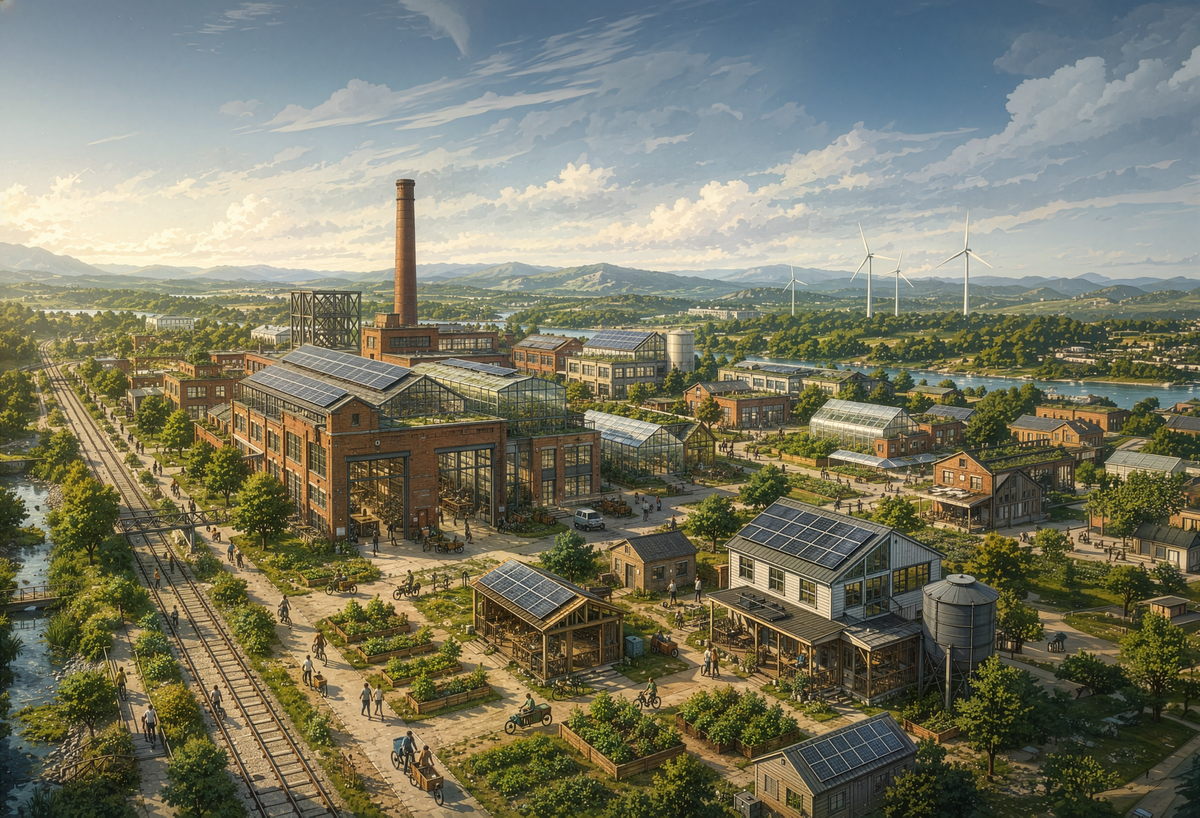
What Are Post-Industrial Villages? Local Production, Adaptive Reuse, and Community After Industrial Decline
The phrase post-industrial village describes more than a small town after the collapse of its factory, mine, mill, or rail depot. It points toward a deeper transformation in how human settlements organize work, production, infrastructure, and community after the dominance of centralized industrial capitalism. The industrial village was once built around a core productive engine: a coal mine, textile mill, steel plant, shipyard, quarry, chemical works, cannery, pottery complex, or railroad hub. Housing, shops, schools, churches, taverns, social clubs, and local identity formed around that engine. When the engine failed, the village was left with buildings, memory, unemployment, contamination, pride, resentment, and sometimes opportunity.
A post-industrial village is the settlement that emerges after that break. It may be a real place attempting to survive after industrial decline, or it may be a deliberate planning model for a new kind of productive community. In both cases, the central question is the same: what happens when a place can no longer depend on a single large employer, but still possesses land, buildings, skills, infrastructure, and social memory?
The answer does not have to be decline. The post-industrial village can become a model for distributed production, local resilience, small enterprise, ecological repair, and cultural renewal. It is not a return to pre-industrial peasant life, nor is it a nostalgic imitation of the 19th-century mill town. It is a settlement form suited to a world where mass industry has become automated, globalized, financialized, or relocated, but where people still need meaningful work, affordable housing, food, tools, energy, repair capacity, and social belonging.
At its core, the post-industrial village is an attempt to reunite things modern planning often separated: home, work, production, food, repair, culture, and infrastructure.
The conventional 20th-century landscape divided life into zones. Residential suburbs were for sleeping. Industrial parks were for production. Office parks were for administration. Shopping centers were for consumption. Farms were pushed outside the urban boundary. Waste facilities, logistics yards, and energy infrastructure were hidden in peripheral zones. This separation created convenience, but it also created dependence. A person might live in one municipality, work in another, buy food shipped from across the continent, rely on energy from distant power plants, and discard goods that no one nearby knows how to repair.
The post-industrial village challenges that separation. It asks whether a settlement can once again become a productive organism: not a giant factory town ruled by one employer, but a diversified local economy made up of workshops, gardens, studios, small manufacturers, digital workers, repair shops, food processors, energy systems, training spaces, and shared institutions.
This is what distinguishes a post-industrial village from a suburb, an eco-village, or a tourist village. A suburb is primarily residential. An eco-village is often primarily ecological or lifestyle-oriented. A tourist village may preserve old buildings as scenery while hollowing out the productive life that once sustained them. A post-industrial village, by contrast, must remain economically productive. Its purpose is not merely to look rustic, green, or authentic. Its purpose is to make life materially viable at a human scale.
That productive base can take many forms. A former mill building might become a fabrication space, housing cooperative, indoor farm, school, research studio, or small-business incubator. A disused rail corridor might become a logistics path, cycling route, fiber conduit, or linear park. Old industrial land might be remediated into greenhouses, solar arrays, public workshops, wetlands, or controlled manufacturing sites. A former company store might become a cooperative market. A warehouse might become a tool library, repair center, or micro-factory. The industrial past does not vanish; it is metabolized.
The most important principle is diversification. The old industrial village was often fragile because it depended on one employer or one commodity. If the mine closed, the town collapsed. If the mill moved overseas, the community lost its wage base. If the railroad bypassed the settlement, local commerce withered. A post-industrial village cannot repeat that mistake. It must be designed around multiple overlapping sources of livelihood: remote work, skilled trades, food production, small manufacturing, cultural production, education, tourism, research, digital services, repair, and local exchange.
This is why the post-industrial village is especially relevant in the age of automation and remote work. Industrial civilization no longer requires every productive worker to be physically concentrated in a city or factory. Designers, programmers, analysts, writers, engineers, marketers, traders, teachers, and administrators can often work through digital networks. At the same time, purely digital life is incomplete. People still need housing, energy, food, water, tools, maintenance, logistics, medicine, and physical community. The post-industrial village can function as a bridge between the digital economy and the material economy. It can house remote workers while also supporting workshops, greenhouses, trades, and small-scale production.
A mature post-industrial village would not be anti-technology. It would likely be filled with technology, but at a scale that people can understand, maintain, and govern. Solar panels, batteries, mesh networks, CNC machining, hydroponic racks, compost systems, water filtration, heat pumps, electric cargo vehicles, digital inventory systems, small laboratories, and shared fabrication tools all fit naturally into the model. The difference is that the technology is embedded in local use rather than imposed as an abstract corporate system. The village does not exist to serve technology; technology serves the village.
This matters because the industrial era produced extraordinary wealth, but it also produced forms of dependency that became invisible. People lost practical knowledge of repair, food production, tool use, building maintenance, and local governance. Communities became consumers of distant systems rather than stewards of nearby ones. When supply chains function perfectly, that dependency feels efficient. When shocks occur — war, inflation, energy instability, pandemics, shipping disruption, climate disasters, financial crises — the weakness becomes obvious.
The post-industrial village is not a fantasy of total self-sufficiency. Total self-sufficiency is usually unrealistic and often undesirable. Modern medicine, semiconductors, advanced materials, precision equipment, and many forms of heavy manufacturing require large-scale networks. But a village does not need to produce everything to become more capable. It only needs to produce, repair, store, and coordinate enough to reduce fragility. The goal is not isolation. The goal is local competence within a larger network.
The social structure of the post-industrial village is as important as the physical layout. A village of workshops and gardens can still fail if its governance is weak. Many intentional communities collapse not because they lack ideals, but because they lack clear rules about money, labor, ownership, conflict, decision-making, maintenance, and exit rights. A post-industrial village requires a constitution of sorts: who owns the land, who maintains shared assets, who pays for utilities, who has access to tools, how revenue is shared, how new members join, how bad actors are removed, how disputes are mediated, and how long-term capital improvements are funded.
Without this structure, the village can decay into interpersonal drama. With too much structure, it can become bureaucratic and lifeless. The balance is difficult. The village must be cooperative enough to share infrastructure, but individualistic enough to preserve initiative. It must allow private enterprise, but prevent the enclosure of common assets. It must welcome creativity, but demand maintenance discipline. It must be humane, but not naive.
This is one of the key lessons from failed communes, company towns, and utopian settlements. A company town had economic discipline, but often lacked freedom. A commune might have shared ideals, but often lacked operational rigor. A suburb offered privacy, but often lacked productive community. The post-industrial village must learn from all three. It needs the productive seriousness of the industrial town, the shared purpose of the commune, and the personal autonomy of the modern household.
Its architecture should reflect this hybrid character. The ideal form is neither dense city nor scattered rural sprawl. It is a clustered settlement with shared productive infrastructure. Housing should be close enough to workshops, gardens, offices, kitchens, and community spaces that daily life can happen without constant driving. At the same time, dirty, noisy, or hazardous functions should be sensibly separated. The design should allow for gradients: quiet residential space, mixed-use work areas, public commons, agricultural edges, storage zones, and heavier utility functions.
Adaptive reuse is especially powerful here. Old industrial buildings often have qualities that modern residential construction lacks: high ceilings, thick floors, large windows, freight access, durable materials, open spans, and proximity to rail, rivers, or older town centers. They were built for work. In a post-industrial village, those qualities can be repurposed for new forms of work. A former factory can become a vertical farm, tool library, maker hall, robotics lab, shared kitchen, indoor market, rehearsal space, or cooperative housing complex. The building’s history becomes an asset rather than a burden.
But romanticism must be avoided. Many old industrial sites are contaminated with industrial pollution or unstable, rotting structures, and obsolete or decaying utilities. Renovation can cost more than new construction. Zoning may prohibit mixed uses. Insurance may be difficult. Local politics may resist unconventional models. Banks may not understand the financing. A serious post-industrial village plan must confront these realities directly. The aesthetic of reuse is not enough. The numbers must work.
Economically, the village must avoid becoming a museum. Heritage can attract visitors, but tourism alone often creates low-wage service economies and seasonal instability. The stronger model combines heritage with production. Visitors might come for the restored mill district, but the village’s real life comes from workshops, training programs, digital businesses, farms, repair trades, and small manufacturers. The past draws attention; the present generates livelihood.
Education is another central pillar. A post-industrial village should be a place where people learn practical skills: carpentry, metalworking, electronics, coding, farming, food preservation, first aid, machine maintenance, accounting, media production, energy systems, and local governance. In the industrial village, knowledge was often inherited through family, apprenticeship, or shop-floor experience. In the post-industrial village, that knowledge must be deliberately rebuilt. A settlement that cannot train its own people becomes dependent on outside specialists for every repair and improvement.
This gives the post-industrial village a civic purpose. It can become a living school for the post-globalization age: not anti-global, but less helpless. It can teach people how infrastructure works, how food is grown, how buildings are maintained, how tools are repaired, how energy is stored, how water is managed, and how communities govern shared assets. In an era where many people feel alienated from both politics and production, this kind of practical citizenship matters.
The environmental dimension is equally important. Industrial villages were often extractive. They polluted rivers, scarred landscapes, burned coal, and treated waste as an externality. The post-industrial village must reverse that pattern. It should be designed around remediation, circular material flows, energy efficiency, repair culture, local food, water stewardship, and ecological restoration. But again, this should not become shallow green branding. The test is operational: does the village reduce waste, lower energy dependence, reuse materials, restore land, and make daily life less resource-intensive?
A real post-industrial village would likely include composting, rainwater capture where legal, greywater systems where permitted, shared cold storage, solar and battery systems, high-efficiency heating, tool-sharing, repair shops, salvage yards, greenhouses, tree planting, and local material reuse. None of these features alone is revolutionary. Together, they produce a different settlement logic: one based less on consumption and more on stewardship.
The political meaning of the post-industrial village is subtle but significant. It offers an alternative to two failed narratives. The first narrative says that rural and industrial communities must either accept decline or wait for a giant corporation to rescue them. The second says that the future belongs only to large cities, while small towns become retirement zones, tourist scenery, or sacrifice areas. The post-industrial village rejects both. It argues that smaller settlements can have a serious future if they become productive, networked, and institutionally competent.
This does not mean every town can or should become one. Some places lack water, access, population, capital, or environmental viability. Some old industrial sites are too damaged. Some communities may not want transformation. But as a model, the post-industrial village gives planners, entrepreneurs, homesteaders, artists, engineers, and local governments a way to think beyond decline.
The phrase also has value for speculative design and worldbuilding. In science fiction, post-industrial villages could emerge after automation hollows out megacities, after climate migration reshapes rural regions, after supply-chain shocks force local production, or after abandoned industrial corridors are reclaimed by new communities. They could be solar-powered maker hamlets, algae-farm settlements, old mining towns turned robotics foundries, rail villages turned logistics cooperatives, or cybernetic monasteries built inside dead factories. The concept carries both melancholy and hope: the ruins of the old machine become the foundation of a new village.
The greatest danger is aestheticizing poverty or decay. Rust, brick, weeds, and old machinery can look beautiful, but post-industrial life is not automatically noble. Deindustrialization destroyed livelihoods, families, tax bases, and identities. A serious treatment must respect that pain. The village should not be treated as a playground for outsiders who want cheap property and atmospheric ruins. Renewal must include the people and memory of the place, not merely its buildings.
A successful post-industrial village therefore requires moral seriousness. It must ask: who benefits from redevelopment? Are former workers and residents included? Does housing remain affordable? Are new businesses locally rooted or extractive? Are common spaces truly common? Is the industrial past honored honestly, including its injuries? Does the village create real livelihoods, or only scenery for wealthier newcomers?
In the end, the post-industrial village is not just a settlement type. It is a theory of recovery. It begins with the recognition that the industrial age left behind more than ruins. It left behind roads, rail spurs, warehouses, machine skills, working-class cultures, power lines, water systems, schools, main streets, and an ethic of making. The post-industrial task is to reorganize those inheritances for a different era.
The old industrial village asked: what can this place produce for the factory, the mine, the mill, or the empire?
The post-industrial village asks: what can this place produce for its own people, its surrounding region, and a more durable future?
That shift is profound. It changes the village from an appendage of industry into a self-conscious civic and productive organism. It does not reject modernity. It repairs it at a smaller scale. It does not flee from technology. It domesticates technology into human use. It does not worship the past. It salvages the past and puts it back to work.
A post-industrial village, at its best, is a place where the abandoned factory becomes a workshop, the polluted lot becomes a greenhouse, the rail line becomes a corridor, the warehouse becomes a school, the old skills become new trades, and the community stops waiting for rescue from outside capital.
It becomes, once again, a village that makes things.


This blog is not affiliated with Open Source Ecology