AST SpaceMobile Delay: What Blue Origin’s Launch Failure Reveals About Global Space Industry Bottlenecks
Blue Origin’s failure didn’t just delay ASTS, it exposed fragile launch capacity and a deeper bottleneck in orbital logistics.


A Launch Failure Didn’t Break AST SpaceMobile; It Exposed a Fragile Orbital Economy
A recent launch failure tied to Blue Origin, triggered a short-term market reaction in AST SpaceMobile. On the surface, this looks like a company-specific setback, or another delay in a capital-intensive rollout.

However, what the event actually reveals is something broader: the global commercial launch market, despite rapid progress, remains a constrained, failure-sensitive logistics layer that every satellite operator depends on. The satellites themselves are not the bottleneck. The bottleneck is access to orbit, on schedule, at scale. Orbital launch services are still fragile.
The Illusion of Reliability
Over the past few years, SpaceX has fundamentally reshaped expectations around launch cadence. Frequent, repeatable launches have created the impression that orbital access is now a solved problem or something closer to routine logistics than experimental engineering.
That perception is misleading.
Outside of SpaceX and Rocket Lab, most launch providers still operate under very different constraints:
- lower launch cadence
- higher schedule uncertainty
- less proven reliability at scale
Even within mature systems, failures still occur. Launch remains one of the most technically unforgiving processes in modern industry; there is no partial success state. Either the payload reaches orbit, or it doesn’t.
The result is a system where:
- delays propagate quickly
- backlogs compound
- and downstream operators absorb the impact
A single failure doesn’t break the system. It exposes that the system was never fully robust to begin with. For context, this was the first commercial launch provided by Blue Origin's New Glenn rocket.
AST SpaceMobile: Time-Sensitive Capital Deployment
For AST SpaceMobile, the consequences of delay are not abstract.
The company is building a direct-to-device satellite network using its BlueBird constellation, comprised of dozens of very large, complex satellites (693 sq ft phased array, the largest commercial array in low Earth orbit) designed to connect directly with standard mobile phones. This has surpassed its origins as a speculative R&D project. It is now a deployment-phase infrastructure build.
That distinction matters. Each satellite represents:
- significant upfront capital expenditure
- zero revenue contribution until operational
- dependency on constellation density for full functionality
Until enough satellites are deployed and operational in orbit, the system does not produce its intended revenue stream. Partial deployment is not equivalent to partial monetization; it is closer to idle capital.
Delays, therefore, have compounding effects:
- revenue is deferred
- burn continues
- capital efficiency declines
From a financial perspective, time is not neutral. It is a decay function on return.
The market reaction to the recent launch disruption reflects this sensitivity, but it often misattributes the cause.
Launch Diversification as Infrastructure Strategy
AST SpaceMobile’s use of multiple launch providers is a structural necessity.
By working with both SpaceX and Blue Origin, the company is attempting to mitigate a core risk: dependence on a single, failure-prone access point to orbit.
This is not unique to space.
In every critical infrastructure system:
- energy grids maintain redundancy across generation sources
- semiconductor supply chains diversify fabrication capacity
- global shipping networks route around congestion and disruption
 John D
Launch is no different. It is a transport layer.
Relying on a single provider introduces:
- scheduling bottlenecks
- systemic delay risk
- vulnerability to technical failure
Diversification does not eliminate these risks—but it reduces the probability that any single failure halts the entire deployment timeline.
The recent disruption demonstrates why this approach is necessary, not optional.
Why Rocket Lab Isn’t in the Rotation (Yet)

The absence of Rocket Lab from AST SpaceMobile’s current launch mix is often interpreted as a strategic omission.
In reality, it is a constraint mismatch.
Rocket Lab’s existing vehicle, Electron, is optimized for small payloads and high-frequency deployment. AST’s BlueBird satellites are large, heavy, and require significantly greater lift capacity.
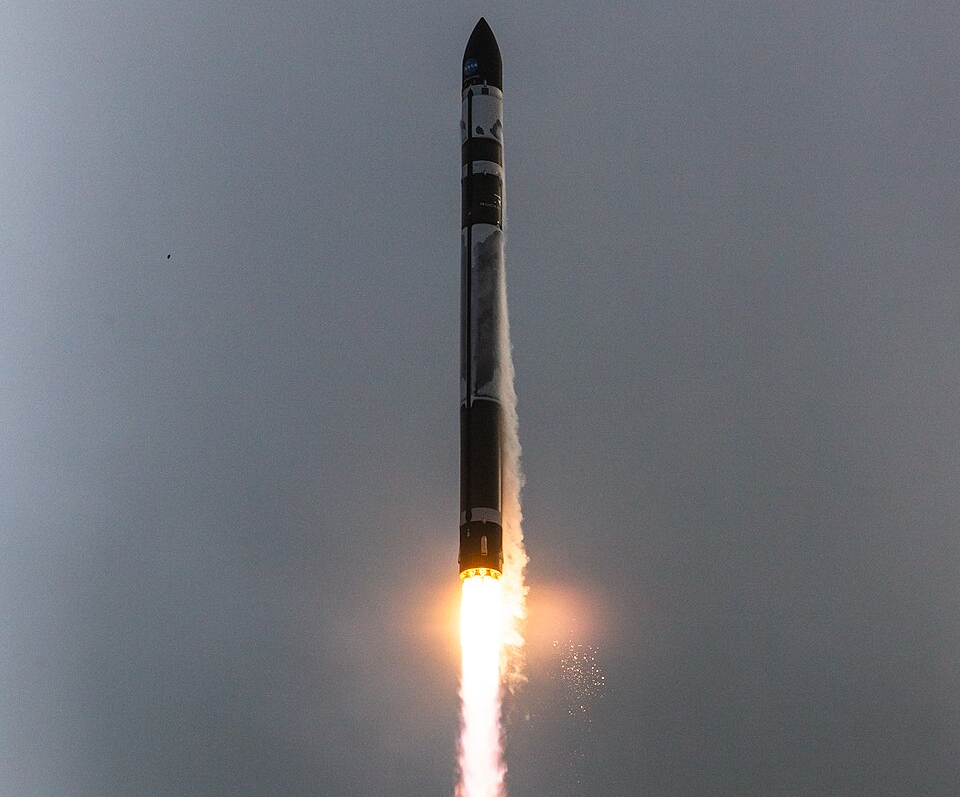
That leaves Neutron, Rocket Lab’s upcoming medium-lift vehicle, as the relevant comparison point.
But Neutron hasn't been built yet.
- not yet operational
- not yet proven at scale
- not yet demonstrated in high-cadence deployment scenarios
From AST’s perspective, this introduces multiple layers of uncertainty:
- vehicle readiness
- launch schedule reliability
- integration timelines
The decision is not a rejection of Rocket Lab’s capabilities. It is a timing issue.
AST needs:
- proven lift capacity
- predictable cadence
- immediate availability
Rocket Lab may become a viable partner in later phases, particularly for replenishment launches or incremental expansion; but it is not yet aligned with the current deployment requirements.
The Real Constraint: Global Launch Capacity
Zooming out, the deeper issue is total system capacity.
Global demand for launch services is increasing across multiple sectors:
- satellite broadband constellations
- defense and national security payloads
- Earth observation networks
- scientific and exploratory missions
At the same time, supply remains concentrated.
SpaceX dominates the market in both cadence and reliability. Other providers, including Blue Origin and Rocket Lab, are scaling, but have not yet reached comparable operational maturity.
This creates a structural imbalance:
- high demand for orbital deployment
- limited, unevenly distributed launch capacity
In this environment, access to launch is a technical requirement and a major competitive constraint.
Companies are not only competing on satellite design or network architecture. They are competing for:
- launch slots
- schedule priority
- integration windows
And those resources are very limited.
Market Mispricing: Event vs. System
The market response to launch failures tends to follow a predictable pattern:
- immediate negative reaction
- attribution to company-specific execution risk
- gradual normalization as timelines stabilize
What is often missed is that these events are not isolated. They are manifestations of a broader system constraint:
- launch remains failure-prone
- capacity remains limited
- timelines remain uncertain
Essentially, the risk is not unique to AST SpaceMobile. It is embedded in the infrastructure layer that all satellite operators rely on.
This creates a mispricing dynamic:
- short-term events are overemphasized
- long-term structural constraints are underweighted
From an analytical standpoint, the key question is
“How resilient is the system that depends on launches continuing to succeed?”
Conclusion: Orbital Logistics Is the Bottleneck
The commercial space industry is often framed around innovation:
- new satellite architectures
- new communication models
- new applications of orbital infrastructure
Logistics, above innovation, is the limiting factor.
The ability to reliably move payloads from Earth to orbit, on schedule, at scale, and without disruption, remains the foundational constraint on the entire sector.
The recent disruption involving Blue Origin and its downstream impact on AST SpaceMobile is a reminder:
- orbital access is still a bottleneck
- redundancy is still necessary
- time remains the most critical variable in capital-intensive deployment systems
Until launch capacity becomes truly abundant and failure-tolerant, every satellite network, from broadband to defense, will continue to operate within this constraint.
The satellites may define the future of connectivity, but the launch layer still determines how fast that future arrives.
John D