Comms Redundancy: A 6-Layer Survival Guide to Emergency Radio & Grid-Down Communication
Don't rely on one radio. Build a 6-layer comms system with cell, satellite, HAM, and mesh networks for true emergency preparedness.

The Layered Comms Doctrine: Why One Radio Is Never Enough
In any emergency, from a natural disaster to a personal crisis, information is life. The ability to call for help, coordinate with your team, or receive critical updates can be the single factor that turns a catastrophe into a manageable situation.
Relying on a single communications device is like building a house with only one door. If that door is blocked, you are trapped. True communications resilience is not about having the best single tool; it's about building a layered system where the failure of one component is a minor inconvenience, not a disaster. This is the Layered Comms Doctrine, and it’s the standard practiced by professionals from search and rescue teams to military units.
Let’s break down the idealized redundancy setup, examining the pros and cons of each layer and how they work together to create an unbreakable information chain.
Layer 1: The Common Cell Phone
Your smartphone is the first and most obvious layer. It’s always with you, and for day-to-day life, it’s all you need.

Pros:
• Ubiquity: Nearly everyone has one, and the network is vast.
• Ease of Use: Familiar and intuitive interface for calls, texts, and data.
• Information Access: Provides access to the internet, maps, weather, and emergency apps.
Cons:
• Grid Dependence: Cell networks are the first thing to fail in any disaster. They become overloaded, may be shut down, or are physically destroyed by infrastructure damage.
• Location Dependent: Useless in remote areas, deep valleys, or anywhere without a tower.
• Power Hungry: A dead battery turns it into a useless slab of reflective silicon.
Role in the Doctrine: Your primary tool for 99% of situations. It’s your first call for help, but you must have a plan for when it inevitably fails.
Layer 2: The Simple Walkie-Talkie (FRS/GMRS)
This is the 10-dollar simple consumer-grade radio. It’s the most underrated and cost-effective layer of redundancy you can add.

Pros:
- Extreme Low Cost: You can buy several for the price of a single meal.
- Simplicity: Push-to-talk (PTT) is fast and requires minimal fumbling, even under stress.
- No Infrastructure: Device-to-device communication works anywhere, anytime.
- Power Efficient: Lasts for days on a single charge.
Cons:
- Limited Range: Typically limited to a few miles, less in urban or forested terrain.
- No Privacy: Anyone with a similar radio can listen in.
- Low Power: Cannot penetrate dense obstacles or reach distant help.
Role in the Doctrine: The "Cheap Emergency" radio. This is your lifeline when you’re 200 yards from your friend and your cell phone has no signal. It’s the radio you hand to a civilian to give them comms capability.
Layer 3: The Advanced Handheld Radio (HAM/CB)
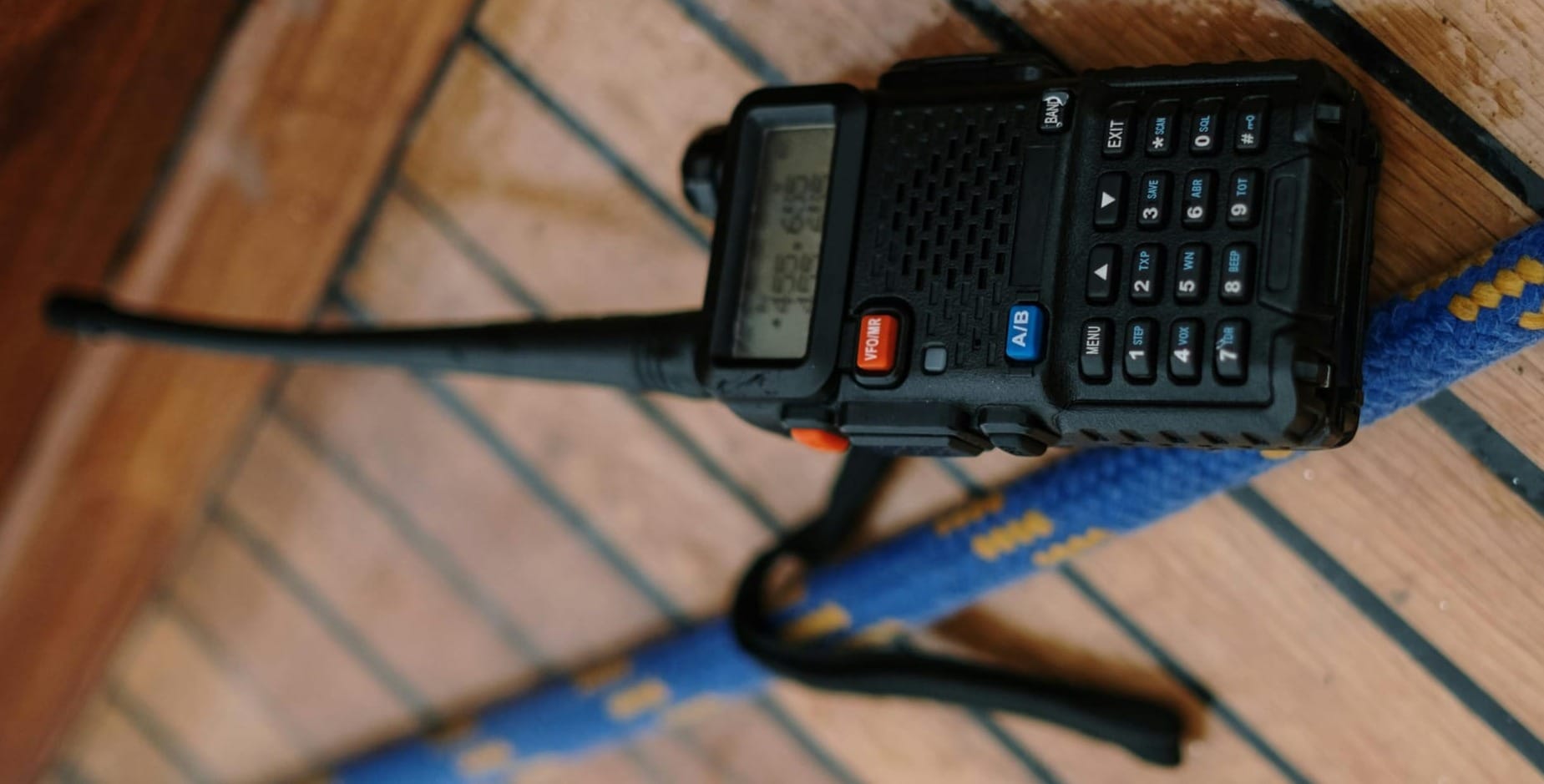
This is the next step up: a programmable VHF/UHF radio that requires a license (for HAM) to operate legally. This is the workhorse of serious preparedness.
Pros:
- Vastly Increased Range and Power: Can communicate over many miles, especially with a repeater network.
- Flexibility: Can access a huge number of frequencies, including local emergency services (with proper authorization).
- Durability: Often built to rugged specifications.
Cons:
- Knowledge Barrier: Requires study and a license (for HAM) to use legally and effectively.
- Dependent on Infrastructure: Long-range communication often relies on repeaters, which can fail in a grid-down scenario.
- Higher Cost: Quality units and accessories are significantly more expensive.
Role in the Doctrine: Your primary tactical and team-based radio. This is how you coordinate over a wide area, communicate with a home base, or interface with other knowledgeable groups. You should have two: one on your person and one in your pack as a redundant backup.
Layer 4: The Satellite Phone
When all terrestrial infrastructure is gone, the satellite phone is your link to the rest of the world.

Pros:
- Global Coverage: Works almost anywhere on the planet with a clear view of the sky.
- Ultimate Grid-Down Tool: Completely independent of any local infrastructure.
- Direct Connection: Allows for direct voice and data contact with emergency services or family far away.
Cons:
- Expensive: The device and the airtime are costly.
- Line-of-Sight Required: Won’t work indoors, in dense forest, or in deep canyons.
- Unwieldly: It's a fairly large electronic device that uses power, and is slower to establish a link, and generally requires more group funding and capabilities.
Role in the Doctrine: The emergency long-range lifeline. This is not for casual chat; this is for calling in a medevac, reporting a major disaster to a distant authority, or letting family know you’re alive when the region is dark.
Layer 5: Mesh Networks (Meshtastic/Meshcore)
This is the newest layer, leveraging off-the-shelf technology to create a resilient, decentralized communication network.
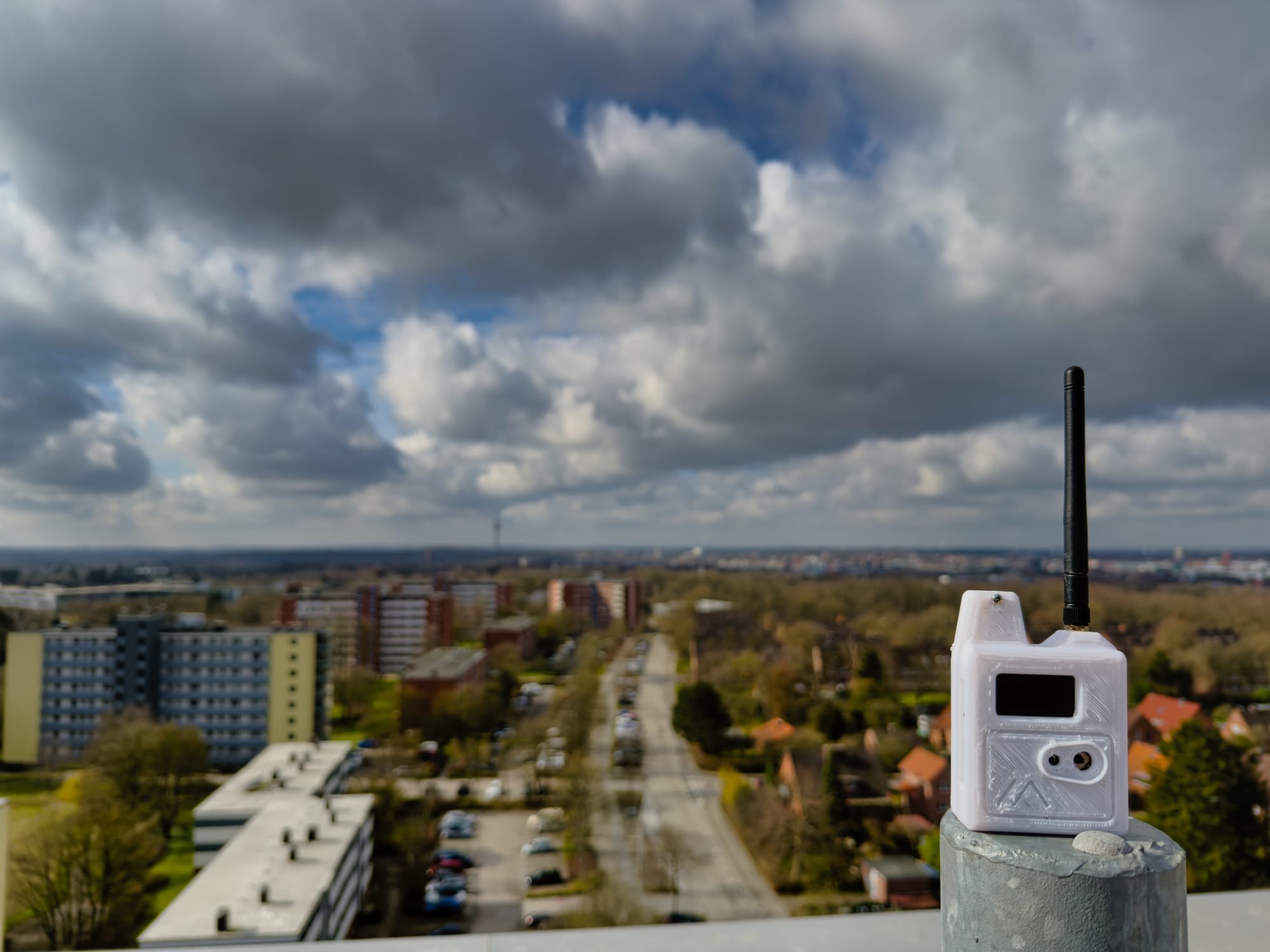
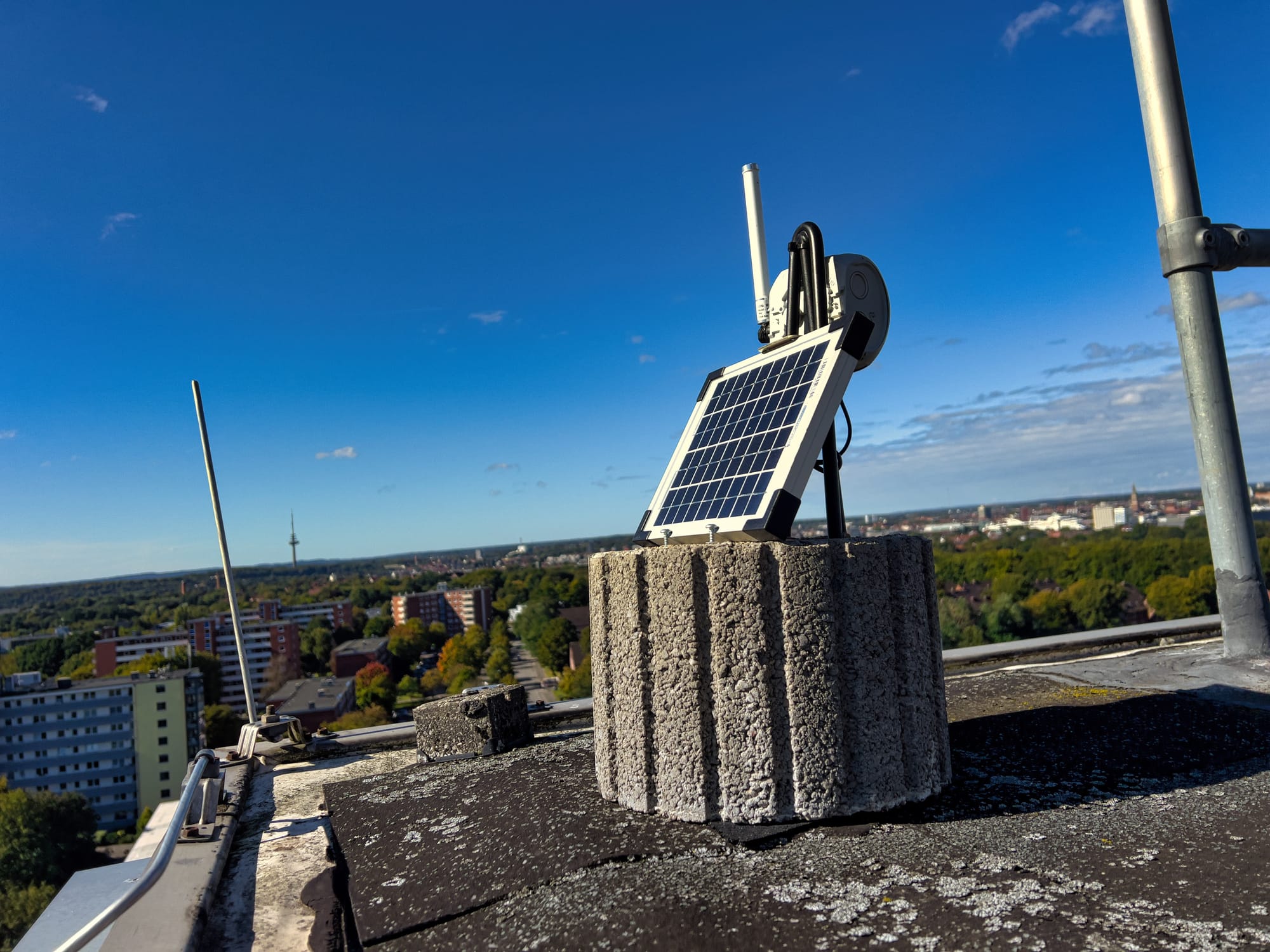
Meshtastic Node and Relay Photos by Fabian Horst
Pros:
- Infrastructure-Free: Creates its own network where every device acts as a relay, extending range automatically.
- Secure: Encrypted, low-power transmissions are energy efficient and secure.
- Low Cost: Can be built using inexpensive hardware and open-source software.
Cons:
- Closed System: Only communicates with other devices on the same mesh. You cannot use it to call for civil services or a hospital.
- Knowledge Intensive: Requires significant technical skill to set up, configure, and maintain.
- Node Density Dependent: The network’s effectiveness is entirely dependent on the number of active devices in an area.
- Tech Limitations: Lower range, low packet transfer, text-based data.
Role in the Doctrine: The local, resilient command-and-control net. It’s perfect for a neighborhood, a retreat community, or a small team that needs to communicate over a local distance reliably when all other systems are down.
Layer 6: The High-Power Base/Mobile Station
This is the final and most powerful layer: a high-power, grid-independent communications capability. Typically consisting of a desktop or vehicle-based High Frequency (HF) HAM radio, this is the backbone for long-range communication in a prolonged grid-down scenario. This is not a handheld; it is a fixed or semi-fixed asset that requires significant expertise in RF technology to operate effectively.
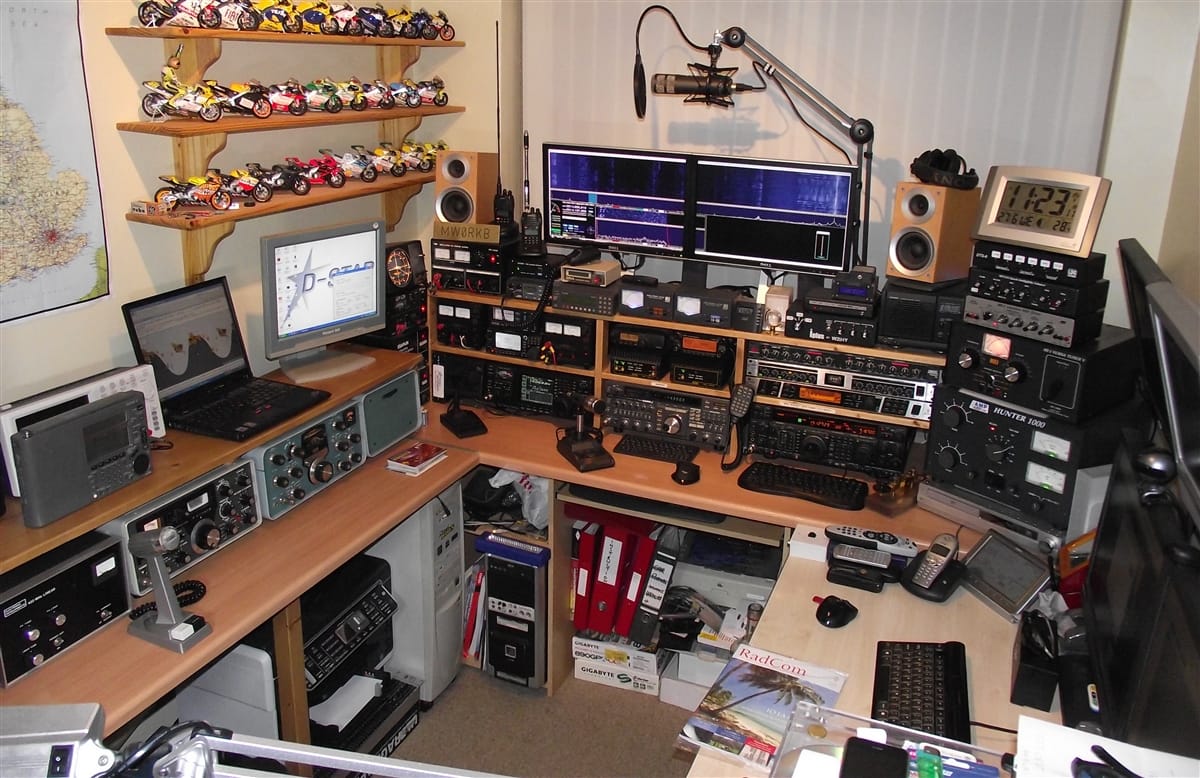
Pros:
- Extreme Range: This is the only method for true regional, continental, or even global communication without any infrastructure. By using the ionosphere to bounce signals—a technique known as skywave propagation—HF radio can reach halfway across the globe1•2.
- Grid Independence: These systems run on their own power (solar, generator, battery) and are completely independent of any terrestrial network, making them the most consistent, grid-down long-range communication method available2.
- Primary Settlement Comms: In a world where civil infrastructure has failed, these base stations would become the primary mechanism for communication between established settlements, cities, and regional hubs, forming the backbone of any new society.
Cons:
- High Energy Demand: Transmitting at high power requires a substantial amount of electricity, far more than a handheld. This necessitates a robust power solution, such as a solar array with battery storage or a generator.
- Not Man-Portable: A full base station with a power supply and antenna is not carried by an individual. It is set up in a secure, fixed location like a homestead or a base of operations. The closest mobile equivalent is a vehicle-mounted station or a dedicated "manpack" backpack radio for a specialized radio operator role, requiring heavy batteries.
- Expertise Required: Effective operation is not simple. It requires a deep understanding of radio propagation, antenna theory, and band conditions to reliably make contact.
- Antenna Dependent: Performance is entirely dependent on the quality and configuration of the antenna system. This often involves large, fixed antennas or deployable wire antennas that must be hoisted high into trees or on masts to work effectively.
Role in the Doctrine: The strategic communications hub. This is not for calling your friends across the valley; it's for calling another state, another country, or a ship at sea. It is the ultimate "reach-back" tool, providing a resilient link to the outside world when all other methods have failed3. It is the final, unbreakable layer that ensures you are never truly isolated.
The Unbreakable Chain
No single one of these devices does everything. A cell phone is useless without a tower. A satellite phone won’t work in a cave, or a paid subscription. A mesh network can’t call for an ambulance. The handheld HAM radio won’t reach your family across the country.
The Layered Comms Doctrine is about accepting these limitations and building a system where one layer’s weakness is another layer’s strength. The ideal prepared individual isn’t the one with the most expensive radio; it’s the one who has a cell phone in their pocket, a Baofeng in their pack, two advanced HAM radios for their team, a sat phone for true emergencies, and the knowledge to deploy a mesh network for their community. They understand that communication isn’t a piece of gear you buy; it’s a system you build. And in a crisis, that system is what separates the survivors from the statistics.
For further reading on establishing robust communication systems, visit OffGridWeb's guide to grid-down communications provide practical insights into planning for network outages. Additionally, Outdoor Happens offers a comprehensive overview of various off-grid communication options, detailing the strengths and applications of different technologies for emergency scenarios.
 Nicholas Italiano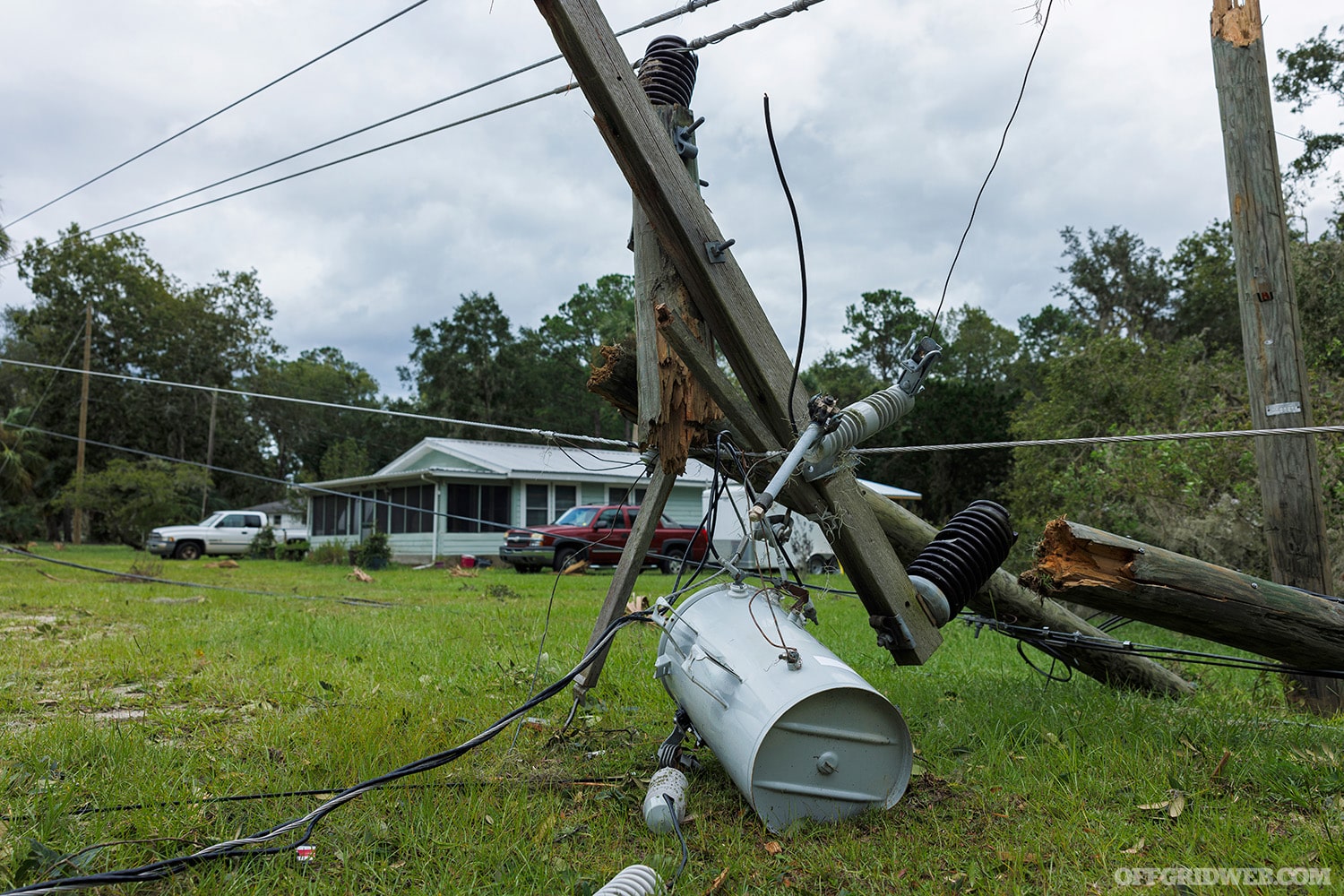
 Paul Collings
Disclaimer: No financial incentives, funding, or sponsorship were provided for the preparation of this content.
Useful Radio Links:
Learning Ham Radio Info: HamStudy.org
Study Guide: KB6NU.com/study-guides
National Association for Amateur Radio: ARRL.org
Seattle Emergency Communications: SeattleACS.org
Cascadia Radio (free PNW Ham Radio community): CascadiaRadio.org
Seattle ACS (Auxiliary Communications Service) is a collection of amateur radio (ham radio) operators supporting the City of Seattle in times of disaster and emergency.
Learn more here: https://www.seattleacs.org/about
(No Affiliation)