Perovskite-Silicon Tandem Cells and the Economic Viability of Building-Integrated Photovoltaics: A Strategic Technology Assessment
Perovskite-silicon tandem solar is entering BIPV markets, but cost, lifetime (T80), and policy will determine real adoption.

Introduction:
BIPV vs BAPV: what's the difference?
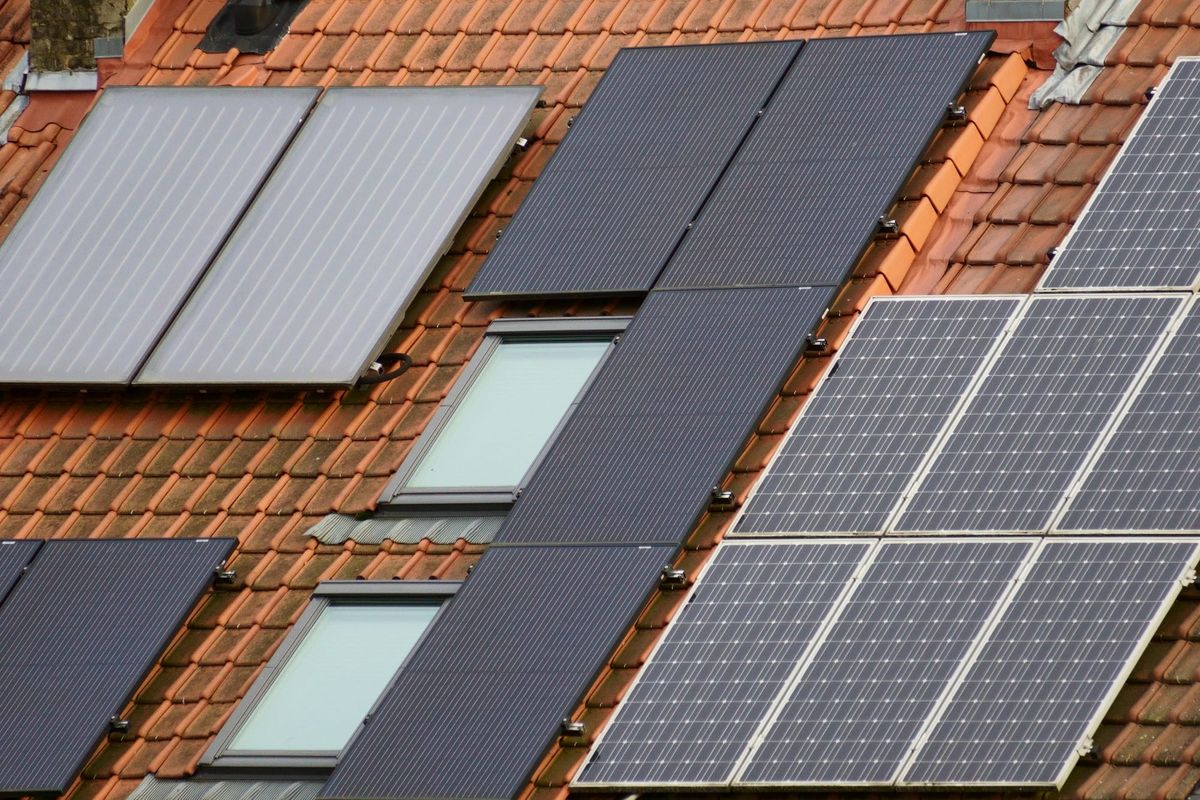
BAPV: Regular solar panels that are bolted on top of your roof or building is Building-Applied PV.
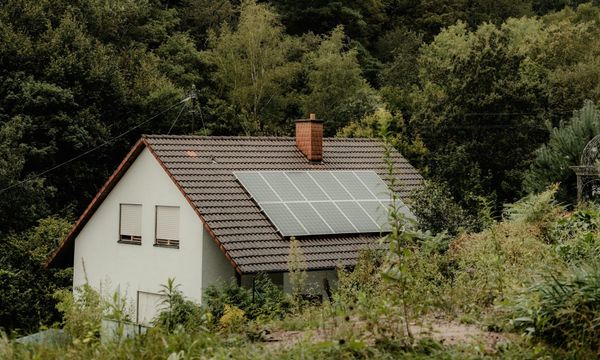
BIPV: Building-Integrated PV, meaning the solar material is the building. Instead of regular roofing tiles, glass, or wall cladding, you use photovoltaic materials that do both jobs at once: keeping the weather out and generating electricity. Think solar roof tiles or a glass facade that doubles as a solar panel. However, costs increase by 30%.
Summary
Perovskite-silicon tandem photovoltaics have, over the past thirty-six months, transitioned from a laboratory curiosity into the first articulated commercial architecture capable of surpassing the ~29.4% practical efficiency ceiling of crystalline silicon single-junction cells. Certified two terminal tandem efficiencies reached 34.85% at LONGi in April 2025 and 35.0% by late 2025, well in excess of the Shockley–Queisser limit of 33.7% for single-junction devices and approaching the ~43% theoretical cap of a perovskite-silicon dual junction. Oxford PV shipped the world’s first commercial perovskite silicon tandem modules in September 2024 (24.5% module efficiency; 26.9% module record) and, in 2025, entered patent licensing agreements with Trinasolar and First Solar that concentrate a substantial share of commercially viable core perovskite IP under its control.
 Kelly Pickerel
Parallel advances in scalable deposition, encapsulation compliant with IEC 61215, and large-area format engineering have narrowed, though not closed, the gap between laboratory champions and commercially warrantable modules. Operational lifetimes remain the binding technical constraint: industry targets for T80 warranties approaching 20–25 years are still forward looking, with Oxford PV publicly guiding to a 20-year lifetime only by 2027–2028
For the building-integrated photovoltaics (BIPV) market, this technological trajectory is strategically material but not yet economically decisive. BIPV continues to command a 25–40% premium over conventional rooftop PV. A National Renewable Energy Laboratory (NREL) benchmark recorded residential BIPV at $5.02/W versus $3.92/W for racked systems in 2021 and façade-integrated products remain in the €200–€1,000/m² range in Europe. The fragmentation of published market sizing (ranging from roughly $21 billion to $35 billion in 2024–2025 across reputable commercial sources, with 2035 projections spanning $90 billion to over $250 billion) underscores definitional ambiguity and should be treated as indicative rather than definitive.
Policy is now the most consequential near-term lever. The European Union’s 2024 recast of the Energy Performance of Buildings Directive (Directive (EU) 2024/1275), which mandates zero emission new construction and phased solar-readiness requirements, is expected to materially accelerate BIPV deployment. The U.S. Inflation Reduction Act Sections 45X and 48C provide domestic manufacturing subsidies whose future has been partially curtailed by Section 70514 of the One Big Beautiful Bill Act of 2025. his report finds that perovskite-silicon tandem BIPV is unlikely to reach broad $/Wp parity with utility silicon before 2028–2030 under a base case, but is a strategically credible candidate for the premium, efficiency-constrained BIPV segment, such as facades, urban infill, and high-value rooftops, where area-normalized energy yield, not raw $/Wp, governs economics.

2. Technology Primer: Perovskite-Silicon Tandem Architecture
2.1 Physics of Tandem Stacking
A perovskite-silicon tandem cell layers a wide-bandgap perovskite top absorber (typically ~1.68 eV) over a narrow-bandgap crystalline silicon bottom cell (~1.12 eV), enabling each sub-cell to harvest a different portion of the AM1.5G solar spectrum and thereby exceed the Shockley Queisser limit of 33.7% that constrains any single-junction device with a 1.34 eV bandgap. The detailed-balance limit for a two layer cell is approximately 42%; for a perovskite-silicon pair, LONGi and other researchers cite a practical theoretical ceiling of ~43%
There are two primary terminal architectures:
Two-terminal (2T) monolithic stacks share a single external circuit, requiring current matching between sub-cells via precise bandgap and thickness control. This architecture minimizes bill-of-materials complexity and is the preferred commercial path at Oxford PV, LONGi, Qcells, and JinkoSolar
• Two-terminal (2T) monolithic stacks share a single external circuit, requiring current matching between sub-cells via precise bandgap and thickness control. This architecture minimizes bill-of-materials complexity and is the preferred commercial path at Oxford PV, LONGi, Qcells, and JinkoSolar
• Four-terminal (4T) and emerging three-terminal (3T) designs allow independent operation of sub-cells, eliminating current-matching constraints and, according to Aiko’s research unit Solarlab Aiko Europe, offering superior performance under spectrally variable conditions and better suitability for bifacial applications
2.2 Certified Efficiency Records vs. Theoretical Limits
Table 2.1 summarizes certified efficiency milestones as documented in the Progress in Photovoltaics “Solar Cell Efficiency Tables” series (Green et al., Versions 66 and 67) and corroborated by company and institutional disclosures
Table 2.1 — Certified Perovskite-Silicon Tandem Efficiency Milestones (Cell and Module Level)
| Entity Format / Area | Architecture | Certified Efficiency | Date | Certifying Lab |
|---|---|---|---|---|
| LONGi small-area cell | 2T monolithic | 33.9% | Nov 2023 | NREL |
| LONGi small-area cell | 2T monolithic | 34.6% | Jun 2024 | NREL |
| LONGi small-area cell | 2T monolithic | 34.85% | Apr 2025 | NREL |
| LONGi large-area (260.9 cm²) | 2T monolithic | 33.0% | Jun 2025 | NREL |
| JinkoSolar cell on TOPCon | 2T monolithic | 34.76% | Nov 2025 | NPVM (China) |
| Aiko / Solarlab lab cell (HJT) | 2T monolithic | 34.76% | Dec 2025 | — |
| Trina Solar 210 mm half-cut (industrial) | 2T monolithic | 32.6% | Dec 2025 | Fraunhofer ISE |
| Qcells full-area M10 (330.56 cm²) | 2T monolithic (Q.ANTUM) | 28.6% | Dec 2024 | Fraunhofer ISE |
| Oxford PV 60-cell module (1.6 m²) | 2T monolithic | 26.9% | Jun 2024 | Fraunhofer CalLab |
| Oxford PV 72-cell commercial module | 2T monolithic | 24.5% | Sep 2024 (shipped) | — |
| EPFL/CSEM textured Si HJT | 2T monolithic | 30.22% | 2023–2024 | — |
| Flexible PSC/c-Si (Nature) | 2T monolithic | 33.6% | 2025 | — |
| Shockley–Queisser (single junction) | — | 33.7% (theoretical) | — | Theoretical |
| Theoretical 2T tandem ceiling (perovskite–silicon) | 2T tandem | ~43% (detailed balance) | — | Theoretical |
Sources: LONGi 2025; JinkoSolar 2025; Aiko 2025; Nature 2025 flexible tandem, Trina 2025; Qcells 2024; Oxford PV 2024.
The LONGi SNEC 2025 result of 33% efficiency on a 260.9 cm² large-area device Longi is particularly consequential because it demonstrates that champion-cell performance is beginning to migrate to industrial wafer formats, which is historically the most reliable leading indicator of imminent mass-production capability.
2.3 Monolithic vs. Mechanically Stacked Designs
Monolithic 2T designs involve sequential deposition of the perovskite stack directly onto the silicon sub-cell, typically with a transparent conductive oxide (TCO) recombination layer — most often indium tin oxide (ITO) or indium-zinc oxide (IZO) Wiley Online Library — mediating interconnection. Mechanically stacked 4T designs use two optically coupled but electrically independent cells; they allow reuse of optimized single-junction silicon modules but incur higher bill-of-materials and module-area costs. The industrial consensus, as reflected in the 2024 International Technology Roadmap for Photovoltaics (ITRPV), favors 2T monolithic designs for mass production, with the ITRPV forecasting tandem mass production to begin in 2027.
2.4 Key Absorber Chemistries
Current state-of-the-art tandem top cells overwhelmingly use mixed-cation, mixed-halide hybrid perovskites of the general form A(Pb)(I,Br)₃, where A is a combination of formamidinium (FA⁺), cesium (Cs⁺), and less commonly in tandem-grade devices, methylammonium (MA⁺). Methylammonium has been progressively displaced from tandem compositions because of its thermal instability: compositions containing only FA⁺/Cs⁺ cations are increasingly favored for their superior thermal robustness and reduced phase segregation. A 1.68 eV bandgap, suitable for current-matching with silicon, is typically obtained with approximately 22–25% Br⁻ substitution; triple-halide formulations incorporating Cl⁻ and rubidium alloying (e.g., the melamine-modulated Rb-alloyed 1.68 eV compositions reaching 25.0% single-junction and 33.5% tandem efficiency reported in Nature Communications in 2025) are emerging as dominant.
3. Key Technical Challenges
3.1 Lead Toxicity and Encapsulation
All high-efficiency perovskite tandems incorporate lead halide absorbers (typically 300–600 mg Pb/m²). Lead leakage into soil and groundwater in the event of module breakage is a well documented regulatory and reputational risk. Published encapsulation strategies now demonstrate compliance with International Electrotechnical Commission (IEC) Standard 61215, the benchmark design-qualification and type-approval standard originally developed for crystalline silicon modules. A 2021 Nature Communications study reported an ionogel encapsulant that reduced post-impact lead leakage to near-undetectable levels while passing IEC 61215 damp-heat and thermal-cycling tests. Subsequent work reported by Mariani et al. in Nature Communications (2024) demonstrated polyisobutylene/hexagonal boron nitride composite encapsulation with lead leakage below 100 ppb while passing 85 °C / 85% RH damp-heat and –40 °C to 85 °C thermal-cycling protocols. IEC 61215 and IEC 61730 (safety qualification) remain the baseline regulatory standards; ISO/TS 18178 and IEC 63092 add building-integration requirements.
3.2 Thermal, UV, and Operational Degradation
The dominant tandem-specific degradation mechanisms are (a) halide segregation under illumination in wide-bandgap mixed-halide perovskites, (b) ion migration at perovskite/charge transport-layer interfaces, (c) thermally induced strain and phase transitions in the wide bandgap top cell, and (d) metal-induced degradation from back-contact migration. Triple-halide formulations with passivating additives (piperazinium iodide, sulfonium based molecules such as DMPESI) have produced lab devices with theoretical T80 lifetimes of 9+ years under continuous 1-sun illumination. A 2024 LONGi collaboration published in Nature Energy reported T80 = 1,200 h under ISOS-L protocols for tandem cells with LiF/EDAI bilayer passivation, which is a useful but still insufficient benchmark relative to the ≈35,000 h typically required for 25-year field warranties.
3.3 Scalable Deposition Methods
Spin-coating, the workhorse of laboratory perovskite research, is fundamentally incompatible with gigawatt-scale manufacturing. Three scalable alternatives dominate current industrial development:
• Blade coating and slot-die coating — solution-based, roll-to-roll-compatible, with demonstrated uniformity over >100 cm² areas using engineered precursor inks and nitrogen knife drying. A Science 2024 publication reported a certified 24.5% all-perovskite tandem module (20.25 cm² aperture) using blade-coated lead-tin films with aminoacetamide hydrochloride additive.
• Vapor deposition (thermal evaporation / co-sublimation) - used by Oxford PV (sputtering-based approach reported to) and Swift Solar, whose continuous vapor process deposits absorbing perovskite in under five minutes and is a cornerstone of its U.S. factory strategy
• Hybrid vapor-solution two-step deposition; favored for textured silicon substrates in monolithic tandems, where conformal coverage of micropyramid surfaces is required.
3.4 Lifetime Benchmarks vs. Silicon
Commercial crystalline silicon modules carry 25- to 30-year linear performance warranties with typical annual degradation of 0.4–0.8% (T80 at ~25+ years). The best perovskite-silicon tandem laboratory cells have demonstrated T80 > 2,000 h under continuous illumination (flexible tandem, Nature 2025) and T90 > 1,400 h for wide-bandgap compositions. Oxford PV’s current commercial modules carry a 15-year lifetime target, with public guidance targeting 20 years by 2027–2028 and 30 years by 2030. This gap between lab accelerated-aging projections and field-validated warranty terms remains the single most material barrier to broad commercial deployment.
3.5 Lattice Mismatch and Interface Recombination
Unlike III-V multi-junctions, perovskite-silicon tandems do not suffer from epitaxial lattice mismatch (the perovskite is polycrystalline and deposited onto textured silicon). The dominant electronic losses arise from interface recombination at (a) the perovskite/electron-transport layer (ETL) boundary and (b) the TCO recombination layer between sub-cells. Bilayer passivation strategies, such as AlOₓ/PDAI2 treatment combined with LiF/EDAI layers, have driven TOPCon-based industrial tandem efficiencies to 31.6–32.76% in 2025 publications.
4. Commercialization Landscape
4.1 Company Profiles Table
4.1 Leading Commercializers of Perovskite-Silicon Tandem Technology
| Company | HQ | Architecture | Best Certified Efficiency | Estimated TRL | Key Funding / Partnerships |
|---|---|---|---|---|---|
| Oxford PV | UK / DE | 2T monolithic on HJT | 26.9% (module); 24.5% (shipped) | 8–9 | ~$239M raised; partnerships with Trinasolar (Apr 2025), First Solar (Feb 2026); first shipment Sep 2024 |
| LONGi | China | 2T monolithic | 34.85% (cell); 33% (260.9 cm²) | 6–7 | Public company; R&D-led internal funding |
| Qcells (Hanwha) | Korea / DE | 2T monolithic on Q.ANTUM (PERC) | 28.6% (full-area M10) | 6–7 | Government funding (PEPPERONI); North America expansion |
| JinkoSolar | China | 2T monolithic on TOPCon | 34.76% (cell) | 5–6 | Public company; internally funded |
| Trinasolar | China | 2T monolithic | 32.6% (210 mm industrial); 865 W module | 6–7 | Exclusive license from Oxford PV (China) |
| Saule Technologies | Poland | Inkjet-printed perovskite (BIPV/BAPV) | — (module-scale demo) | 5–6 | Columbus Energy €10M lead; Skanska partnership |
| Heliatek | Germany | OPV thin film (adjacent to perovskite) | 9% (HeliaSol) | 9 | $80M factory; BIPV partnerships (AGC, Reckli, innogy) |
| Swift Solar | USA | 2T monolithic (vapor deposited) | — (pilot-line cells) | 4–5 | $27M Series A (2024); ~$44M total; acquired Meyer Burger assets |
| Caelux | USA | “Active Glass” perovskite coating | — (first shipment Jul 2025) | 5–6 | ~$24M Series A (Temasek, Khosla, Reliance) |
| CubicPV | USA | Perovskite mini-modules; Si wafer integration | 24% (mini module with NREL) | 4–5 | >$100M (Breakthrough Energy Ventures) |
| Tandem PV | USA | 2T monolithic (internal) | 29.7% | 5 | 40 MW demo factory; ~$50M raised |
| GCL Optoelectronics | China | Single-junction perovskite (large-area) | 29.51% (2.76 m²) | 7–8 | Large-scale industrial development |
| UtmoLight | China | Single-junction perovskite | 18.1% (0.72 m² module) | 7–8 | ~$700M gigawatt-scale factory (2025); 1 GW production line; 25-year warranty claims |
Sources: Oxford PV funding (Crunchbase/Tracxn); Oxford PV commercial shipment; Swift Solar Series A; Caelux shipment; Heliatek commercialization; UtmoLight; LONGi 2025; JinkoSolar 2025, Saule-Skanska; Tandem PV.
4.2 Technology Readiness Levels
Using the European Space Agency TRL scale adapted for PV manufacturing: Oxford PV is the sole firm at TRL 8–9 (system qualified through operation; first commercial deliveries completed). LONGi, Qcells, Trinasolar, and JinkoSolar sit at TRL 6–7 (pilot-line demonstration in industrial formats); most U.S. startups (Swift, Caelux, Tandem PV, CubicPV) are at TRL 4–5 (demonstrator / early pilot). Saule Technologies’ work in BIPV-specific formats sits at TRL 5–6 but has been validated through live deployments including the Skanska office building in Warsaw, ascribed as the first BIPV perovskite demonstration worldwide.


4.3 Recent Funding, Partnerships, and Pilot Deployments
• Oxford PV, a 2010 spin-out of the University of Oxford, has raised a cumulative ~$239 million, with its Series D closing in July 2019 at £65 million led by Meyer Burger and Goldwind. The company holds the most extensive perovskite IP portfolio globally and shipped the first ~100 kW of tandem modules to an undisclosed U.S. utility-scale developer in September 2024.
• Swift Solar closed a $27 million Series A in June 2024 (Eni Next / Fontinalis co-led) and subsequently acquired Meyer Burger’s insolvent German manufacturing assets and IP portfolio, onboarding former CEO Gunter Erfurt. In August 2025 Swift demonstrated perovskite tandem modules within a U.S. Department of Defense Rapid Deployment Hybrid MicroGrid at Virginia Beach.
• First Solar acquired the Swedish perovskite company Evolar AB in 2023 and in February 2026 signed a non-exclusive U.S. patent licensing agreement with Oxford PV.
• Saule Technologies signed an agreement with Skanska in 2018 for semi-transparent BIPV façades; Columbus Energy invested €10 million in 2021
4.4 IP Landscape and Patent Concentration Risks
Perovskite-photovoltaic patent activity has grown rapidly; Cintelliq reported that roughly 75% of all perovskite PV patents published since 2008 were filed in 2016–2017 alone. PatSnap analytics identify approximately 101 directly relevant perovskite-silicon tandem patents with an estimated 300–500 active families across core architectures. Oxford PV self-describes its portfolio as the “strongest in perovskite PV,” covering materials, processes, device architectures, and products, with core patents fundamental to commercially viable monolithic two-terminal tandems.
The strategic consequence is concentration risk: with Oxford PV’s foundational IP now licensed to Trinasolar (China-exclusive) and First Solar (U.S., non-exclusive), most major non-incumbents may need to negotiate access terms. European process patents are distributed across Helmholtz-Zentrum Berlin, CSEM/EPFL, and Oxford PV, while U.S. innovation is more fragmented, with Swift Solar holding exclusive licenses from MIT, Stanford, and NREL.
5. Building-Integrated Photovoltaics (BIPV): Market & Economic Analysis
5.1 BIPV vs. BAPV: Regulatory and Financial Distinctions
BIPV products replace conventional building envelope components, such as roofing, façade cladding, skylight glazing, curtain walls, with photovoltaic materials that simultaneously provide structural, weatherproofing, aesthetic, and generation functions. BAPV (building-applied PV) is mounted on top of an existing envelope without replacing it. The legal distinction matters: BIPV modules must comply with both PV (IEC 61215/61730) and building-product standards (IEC 63092, ISO/TS 18178, plus national building-code fire, wind, and structural requirements), resulting in double certification burdens not applicable to BAPV. Financially, BIPV systems can offset conventional envelope material costs but typically carry a 10–30% system premium relative to racked BAPV.
5.2 Global Market Size and Projections
Published BIPV market estimates vary substantially due to inconsistent scope definitions (inclusion/exclusion of BIPV glass only, roof-integrated PV, or all solar-shingle products). Table 5.1 consolidates publicly available estimates; the wide range underscores the need for cautious interpretation.
Table 5.1 – Published Global BIPV Market Size Estimates
| Source | 2023–2025 Baseline | Projected 2030–2035 | CAGR | Notes |
|---|---|---|---|---|
| Grand View Research | $23.67B (2023) | $89.8B (2030) | 21.2% | Broad BIPV definition |
| Transparency Market Research | $21.4B (2024) | $204.6B (2035) | 22.8% | Includes all envelope integration |
| Research Nester | $27.74B (2025) | $164.73B (2035) | 19.5% | — |
| Precedence Research | $34.78B (2025) | $250.91B (2035) | 21.85% | Most optimistic |
| Expert Market Research | $28.85B (2025) | $167.07B (2035) | 19.20% | — |
| Market Research Future (BIPV glass segment only) | $7.21B (2024) | $63.54B (2035) | 21.88% | Glass subsegment only |
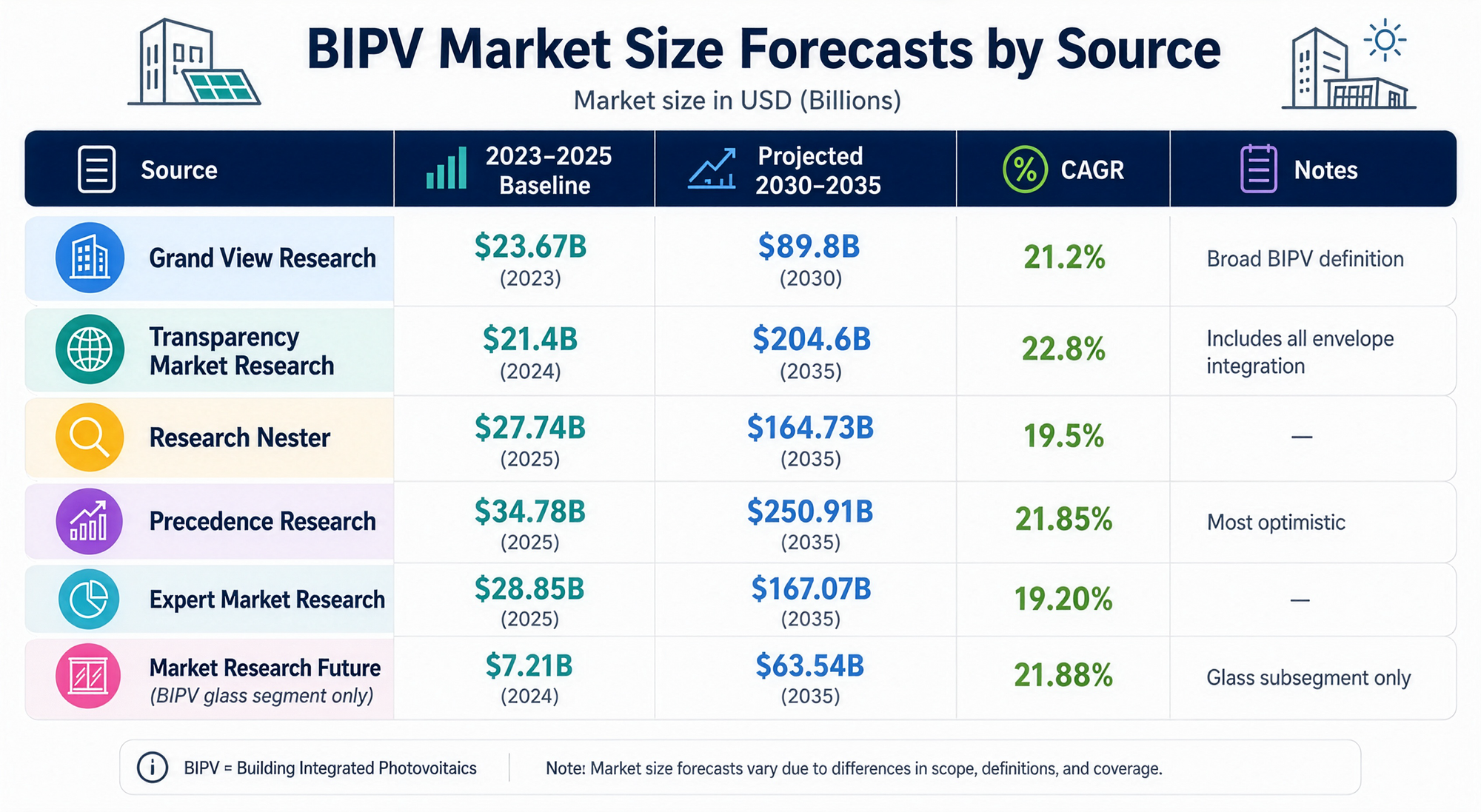
These estimates derive from commercial market-research providers whose methodologies are typically proprietary. For public-interest research, IEA PVPS Task 15 (now in its 2024–2027 Phase III) is developing more standardized market-sizing methodologies. The IEA PVPS 2024 Snapshot Report (primary data) documents that cumulative global PV capacity reached over 2.2 TW by end-2024, of which BIPV remains a small niche. Germany, the largest single country market, holds approximately 2.4 GW of BIPV capacity.
5.3 Cost Structure: $/Wp and €/m²
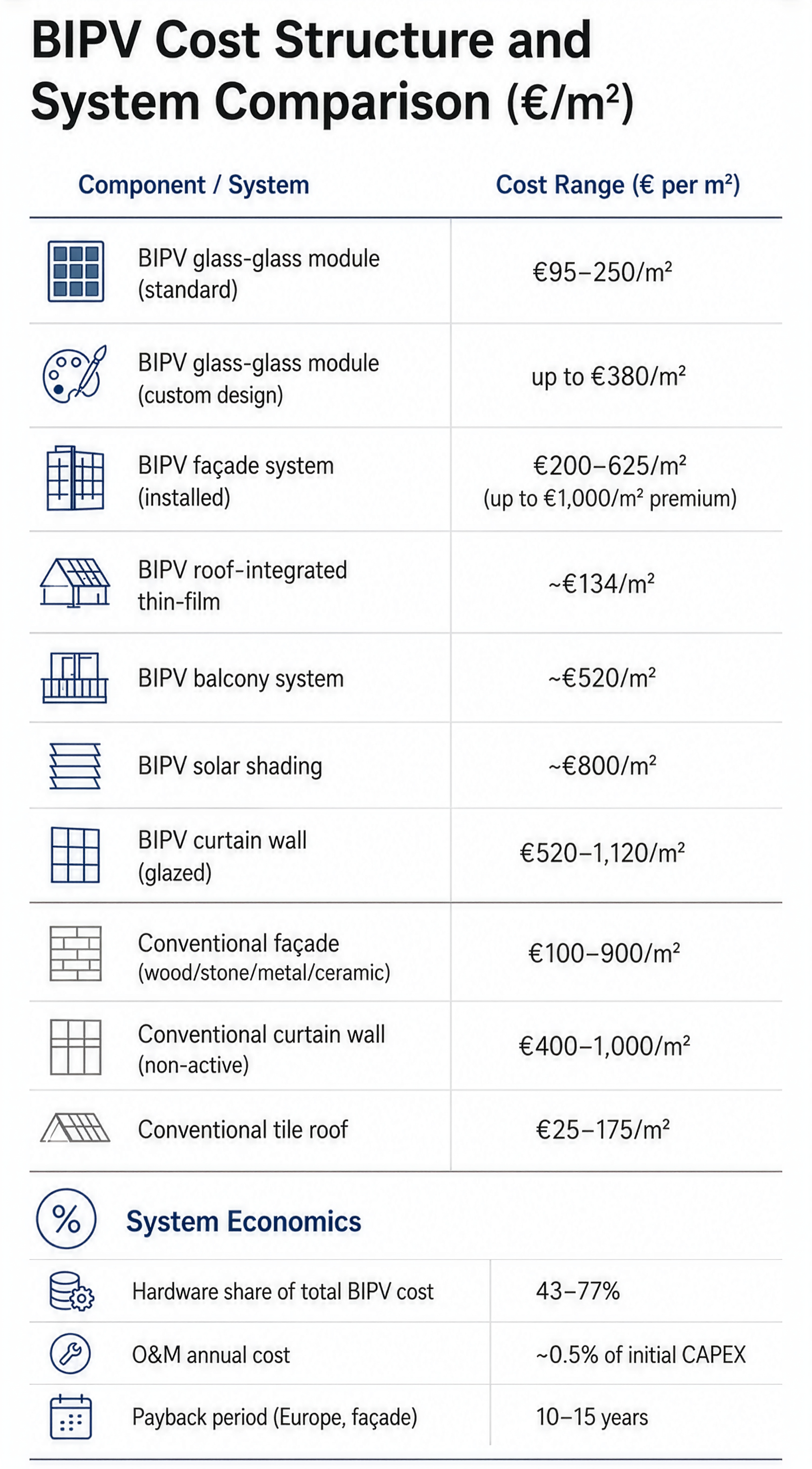
NREL’s 2023 analysis of residential roof-integrated PV found the average installed price of residential BIPV at $5.02/W in 2021, versus $3.92/W for conventional rooftop PV; a premium of roughly 28%. NREL’s 2024 ATB and Q1-2024 system cost benchmarks place 2024 residential PV at approximately $2.80–3.30/W (Minimum Sustainable Price basis) and utility-scale PV at approximately $1.15–1.35/W on an AC basis. BIPV prices per unit area in Europe (Table 5.2) are documented in the Royal Institution of Chartered Surveyors (RICS) prefabricated BIPV cost study and commercial analyses.
Table 5.2 — BIPV Cost Structure Benchmarks (Europe, 2023–2024 range)
| Component / System | Cost Range |
|---|---|
| BIPV glass-glass module (standard) | €95–250 per m² |
| BIPV glass-glass module (customized colour/design) | up to €380 per m² |
| BIPV façade system (installed, all-in) | €200–625 per m² (up to €1,000 premium) |
| BIPV roof-integrated thin-film system | ~€134 per m² |
| BIPV balcony system | ~€520 per m² |
| BIPV solar shading | ~€800 per m² |
| BIPV curtain wall (glazed) | €520–1,120 per m² |
| Conventional façade (wood, stone, metal, ceramic) | €100–900 per m² |
| Conventional curtain wall (glazed, non-active) | €400–1,000 per m² |
| Conventional tile roof | €25–175 per m² |
| Hardware share of total BIPV cost | 43–77% |
| O&M annual cost | ~0.5% of initial CAPEX |
| Payback period (Europe, façade) | 10–15 years |
5.4 LCOE Modeling Considerations
Standard utility-scale PV LCOE calculations are inadequate for BIPV because they omit (a) avoided envelope material costs, (b) reduced insolation on non-optimal orientations (vertical façades typically receive 40–70% of the irradiance of optimally tilted arrays), (c) suboptimal tilts and partial shading, (d) aesthetic premium capture in rental/sale value, and (e) longer capital recovery horizons consistent with building life (30–50 years rather than 25-year PV). A 2020 Energy study modelling European capitals found that combining all orientations (south, east, west, north, roof) yields nearly full lifetime payback at system prices below roughly €200/m² even excluding societal and environmental externalities; at €800/m², the net-present value is near-zero for single-orientation façades in most climates. NREL’s comparative BIPV shingle modelling suggests that residential BIPV can reach LCOE parity with conventional rooftop PV if BIPV system prices are at least 5% below rack-mounted systems, a threshold not yet met in market prices.
5.5 Value Stack: Dual Function as Building Envelope
BIPV’s fundamental economic case rests on “value stacking”, avoiding the purchase of otherwise-required materials. In premium commercial construction, a BIPV façade at €600 1,000/m² competitively displaces curtain wall glazing at €520–1,120/m², such that incremental cost is modest. Perovskite-silicon tandem technology is particularly suited to this segment because area-normalized energy yield, not $/Wp, is the governing economic variable. A perovskite-silicon tandem module delivering ~20% more Wh/m² than a conventional silicon module is more valuable in an area-constrained envelope context than in unconstrained utility-scale deployment.
6. Regulatory and Policy Environment
6.1 EU Taxonomy and the EPBD Recast (Directive 2024/1275)
The European Union’s recast Energy Performance of Buildings Directive (EU/2024/1275), adopted 24 April 2024 and in force 28 May 2024, is the most significant BIPV demand-side policy instrument in force globally. Key provisions with direct BIPV implications:
• Article 7: All new buildings must be designed to optimize solar energy generation potential based on solar irradiance, enabling subsequent cost-effective installation of solar technologies.
• Solar readiness requirements: All new public and non-residential buildings with useful floor area above 250 m² must be solar-ready by 31 December 2026; existing non-residential buildings phase in from 31 December 2027; new residential buildings by 31 December 2029
• Zero-emission building (ZEB) baseline: All new buildings must meet ZEB criteria (zero operational emissions from fossil fuels on-site); public-sector new buildings from 2028, all new buildings from 2030
• Whole-life carbon (WLC) reporting: Required for all new buildings by 2030, based on EN 15978 and Level(s) Indicator 1.2 frameworks.
Member States must transpose the Directive into national law by 29 May 2026. Taken together with the EU Taxonomy’s definition of sustainable investments and the Corporate Sustainability Reporting Directive’s embodied-carbon disclosure mandates, the EPBD creates a structural demand floor for renewable on-site generation in the European building stock, of which BIPV is a principal beneficiary
6.2 U.S. IRA Section 45X and 48C, and Partial Rollback
Section 45X (Advanced Manufacturing Production Credit) created by Section 13502 of the Inflation Reduction Act of 2022 provides tiered tax credits for U.S.-manufactured solar components, including thin-film and crystalline photovoltaic cells at $0.04/W of DC capacity, solar modules at $0.07/W, wafers at $12/m², and polysilicon at $3/kg. Perovskite silicon tandem cells and modules qualify as “photovoltaic cells” under Treasury’s final October 2024 regulations. Credits phase down 25% annually starting 2030, eliminated by 2034 for non-critical-mineral components.
Section 48C (Qualifying Advanced Energy Project Credit) offers a 30% investment tax credit (subject to prevailing wage/apprenticeship compliance) for qualifying investments in advanced energy manufacturing facilities, with a $10 billion allocation under the Inflation Reduction Act. Section 48C and 45X are mutually exclusive for the same facility.
Policy reversal — Section 70514, One Big Beautiful Bill Act of 2025: Enacted under the new administration, this provision restricts the availability of Section 45X by increasing domestic content requirements, imposing “prohibited foreign entity” restrictions, accelerating wind energy credit phase-out to 2027, and setting phase-out percentages for all non-metallurgical coal critical minerals. As of this report, the net effect on perovskite-silicon tandem eligibility appears to remain favorable for domestically manufactured cells and modules, but prohibited-foreign-entity rules could disqualify licensing arrangements involving Chinese partners; a direct threat to, for example, Trinasolar-Oxford PV U.S. deployments.
6.3 Building Codes, Fire Ratings, and Permitting
For U.S. BIPV, the 2021 International Building Code and International Residential Code require BIPV products to be listed either to UL 7103 (Outline of Investigation for Building-Integrated Photovoltaic Roof Coverings) or to the combination of UL 61730-1/-2 (PV module safety qualification) plus UL 790 (Fire Tests of Roof Coverings) plus ASTM D3161 or UL 1897 (wind resistance). Class A fire rating under UL 790/ASTM E108 is the standard specification for most commercial and residential roof-integrated deployments. IEC 63092 is the equivalent international BIPV standard, though Europe has waived its formal adoption, instead harmonizing IEC 61730 as an EN standard and relying on national building codes. Double certification (electrical plus building) substantially increases time-to-market; IEA PVPS Task 15’s 2024 report (T15-24:2024) identifies harmonization of these regimes as the single most consequential policy lever for BIPV cost reduction.
6.4 Net Metering and Grid Interconnection
Table 7.1 — Perovskite-Silicon Tandem BIPV Strategic Risk Matrix
| Risk Category | Specific Risk | Likelihood | Impact | Mitigants / Observations |
|---|---|---|---|---|
| Technology risk | T80 lifetime below 20 years in commercial deployment | Medium | High | Oxford PV targeting ~20-year lifetime by 2027–2028; accelerated ageing data promising but not yet field-validated; silicon baseline is 25–30 years |
| Technology risk | Halide segregation and phase separation in wide-bandgap top cells | Medium | Medium | Mitigation via Rb/Cs alloying and triple-halide additives; still an active research area |
| Supply chain risk | Indium (ITO/IZO recombination layers) | Medium | High | No primary indium mines; 55–60% refined output from China; demand may exceed supply by 2030; substitution via AZO/IMO possible but reduces efficiency |
| Supply chain risk | Tin (lead-tin perovskites; mainly all-perovskite tandems) | Low | Low | Relevant primarily to all-perovskite tandems; not a major constraint for PSC/Si 2T systems |
| Supply chain risk | Lead (toxicity and regulatory exposure) | Low (abundance) | High (regulatory) | Encapsulation strategies demonstrated to limit leakage; typical loading ~300–600 mg per m² |
| Regulatory risk | EU RoHS / REACH extension to lead in PV | Medium | High | PV currently exempt; future inclusion plausible as deployment scales |
| Regulatory risk | U.S. IRA rollback (Section 70514 OBBB 2025) | Already materialized (partial) | Medium | Impacts China-linked manufacturing; retains credit for domestic supply |
| Regulatory risk | Double certification burden (IEC/UL plus building codes) | High (current) | Medium | IEA PVPS Task 15 harmonization underway; resolution expected 2026–2028 |
| Market adoption risk | BIPV cost premium persists | High | Medium | Historically ~28% premium vs BAPV; narrowing with scale but not yet at parity |
| Market adoption risk | Construction industry inertia and unfamiliar specifications | Medium | High | Requires early engagement with architects and authorities; partnerships help adoption |
| Competitive displacement | Low-cost mono-PERC and TOPCon competition | High (near term) | High | TOPCon pricing remains low; tandems must justify premium via higher output per area |
| Competitive displacement | All-back-contact silicon approaching 26–27% efficiency | Medium | Medium | Reduces tandem’s incremental efficiency advantage |
| IP / litigation risk | Core patent concentration (Oxford PV) | Already materialized | Medium | Licensing model mitigates risk but reinforces incumbent structure |
| Capital risk | Gigawatt-scale factory CAPEX unproven | Medium | High | Few firms have committed to >1 GW scale; large capital uncertainty remains |

8. Investment and Deployment Outlook
8.1 Scenario Analysis
Given the speculative character of long-range technology forecasting, the following scenarios are presented as structured analytical framework, not point forecasts. All cumulative capacity figures are author estimates synthesizing published company guidance, IEA PVPS snapshots, and peer commercial forecasts
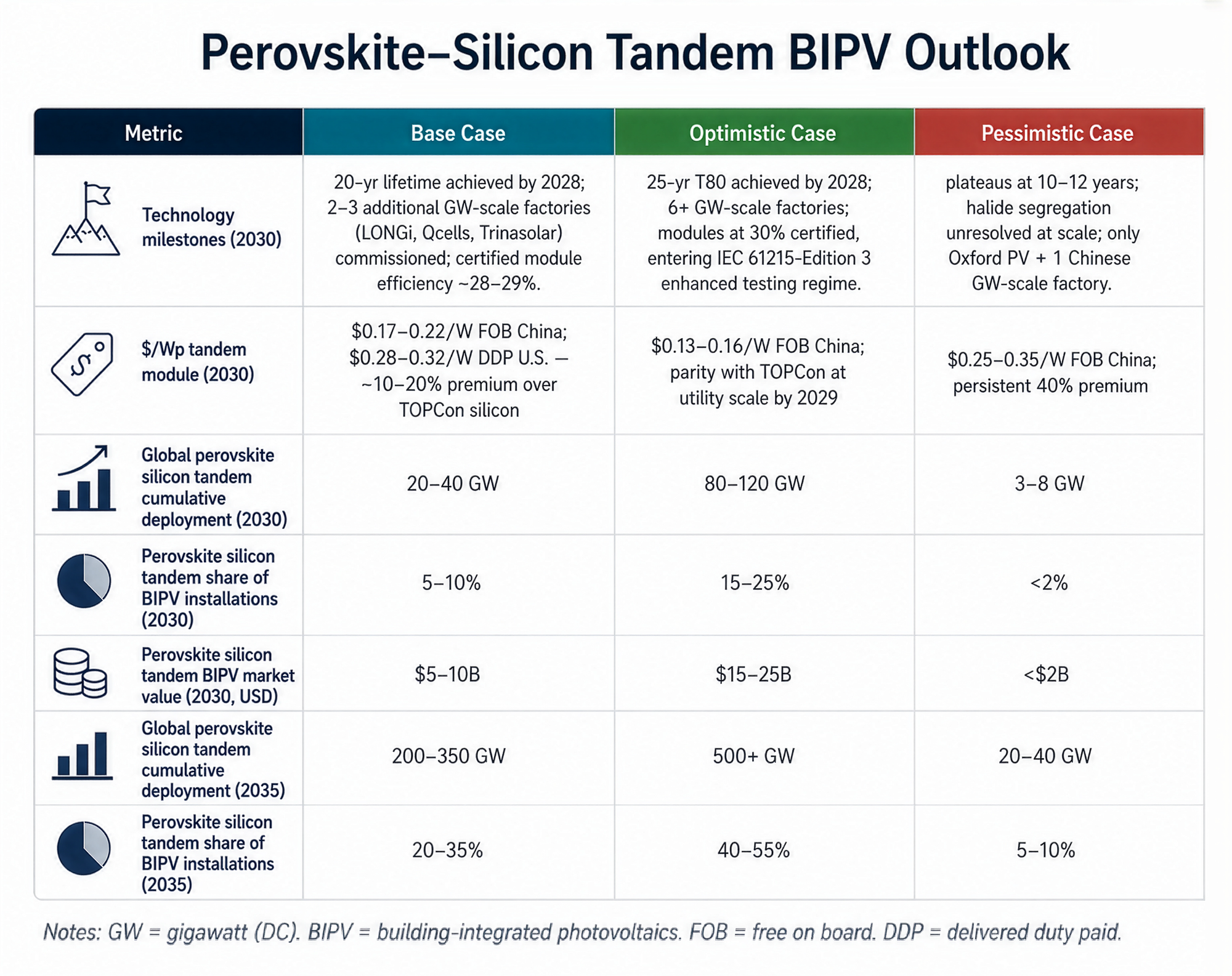
Table 8.1 — Perovskite-Silicon Tandem BIPV Market Penetration Scenarios, 2030 and 2035
| Metric | Base Case | Optimistic Case | Pessimistic Case |
|---|---|---|---|
| Commercial T80 technology milestones (2030) | Oxford PV ~20-year lifetime by 2028; 2–3 additional GW-scale factories (LONGi, Qcells, Trinasolar); module efficiency ~28–29% | 25-year T80 by 2028; 6+ GW-scale factories; modules at ~30% efficiency; entering enhanced IEC testing | T80 plateaus at 10–12 years; halide segregation unresolved; only Oxford PV plus one Chinese GW-scale factory |
| $/Wp tandem module (2030) | $0.17–0.22/W FOB China; $0.28–0.32/W U.S. (10–20% premium over TOPCon) | $0.13–0.16/W FOB China; parity with TOPCon by ~2029 | $0.25–0.35/W FOB China; ~40% premium persists |
| Global tandem cumulative deployment (2030) | 20–40 GW | 80–120 GW | 3–8 GW |
| Tandem share of BIPV installations (2030) | 5–10% | 15–25% | <2% |
| Tandem BIPV market value (2030, USD) | $5–10B | $15–25B | <$2B |
| Global tandem cumulative deployment (2035) | 200–350 GW | 500+ GW | 20–40 GW |
| Tandem share of BIPV installations (2035) | 20–35% | 40–55% | 5–10% |
Base-case assumptions: EPBD 2024/1275 implementation on schedule; U.S. IRA 45X/48C credits remain partially available for domestic production; continued laboratory-to-industrial efficiency conversion at observed 2022–2025 rate; no material regulatory action on lead content in PV beyond encapsulation mandates.
8.2 Cost-Parity Inflection Points
Chinese TOPCon modules were priced at $0.082–0.087/W FOB China in 2025, with U.S. delivered pricing between $0.26–0.28/W driven by tariffs and domestic-content policies. For perovskite-silicon tandems to reach $/Wp parity at utility scale with TOPCon, module-level cost must fall within 10–15% of TOPCon silicon, at which point the ~20% higher energy yield per unit area delivers superior LCOE. Under the base case, this parity is unlikely before 2028–2030. For Wh/m²-normalized parity, which is more relevant to BIPV, tandems may already be competitive in premium façade and area-constrained rooftop applications, given the displaced-material cost offset documented in Section 5.5.
8.3 Strategic Recommendations
(a) Technology developers. Prioritize operational lifetime validation under IEC 61215 enhanced protocols over further incremental efficiency gains. A 20-year field-validated warranty is a higher-leverage commercialization milestone than a 36% certified cell record. Invest in scalable vapor-phase or slot-die deposition with demonstrable yields above 90% on ≥M10 wafer formats. For BIPV-targeted products, develop semi-transparent and colored tandem variants, a segment currently dominated by legacy organic PV (Heliatek) and single-junction perovskite pilot products (Saule); where tandem efficiency premium is most defensible
(b) Real estate and construction firms. Integrate BIPV into early-stage architectural and structural design rather than retrofit; doing so captures envelope material-cost offsets that otherwise vanish. In the EU, EPBD 2024/1275 solar-readiness compliance makes this integration prudent regardless. Favour partnerships with TRL 7+ suppliers (Oxford PV tandem modules, Heliatek OPV, Onyx Solar BIPV glass) over TRL 4–5 developers until commercial T80 warranties extend beyond 20 years.
(c) Energy policymakers. Harmonize BIPV standards between electrical (IEC 61215/61730) and building-product (IEC 63092, UL 7103) regimes; the IEA PVPS Task 15 2024 report identifies this as the single most impactful non-subsidy lever. Institute mandatory lead-encapsulation performance standards for commercial perovskite PV aligned with IEC 61215 damp-heat and impact test limits. Calibrate BIPV-specific incentives against the Wh/m² metric rather than $/W, which systematically penalizes area-efficient tandem architectures.
(d) Institutional investors. Perovskite-silicon tandem is a “picks-and-shovels” opportunity more than a pure-play technology bet: the most likely near-term winners are integrated silicon incumbents (LONGi, JinkoSolar, Trinasolar, Qcells/Hanwha) who can convert existing cell production to tandem incrementally. Oxford PV’s licensing model creates an ARM Holdings analogue IP franchise worth monitoring for any IPO. Avoid concentrated exposure to single junction perovskite BIPV plays until T80 lifetimes exceed 15 years in independent field data. Sovereign and energy-community capital is likely to remain an important subsidy bridge; track IRA 48C Round 2 allocation outcomes closely.
9. Conclusion
Perovskite-silicon tandem photovoltaics have definitively crossed the laboratory/commercial threshold during 2024–2025, marked by Oxford PV’s first commercial shipment, LONGi’s certified 34.85% cell efficiency, and Qcells’ and Trina’s demonstration of mass-producible industrial formats. However, the technology’s translation into the building-integrated photovoltaics market will be shaped less by continued efficiency-record milestones than by three more prosaic factors: (1) the achievement of field-validated T80 lifetimes of 20 years or more, (2) the harmonization of electrical and building-product certification regimes, and (3) the regulatory demand pull created by the EU’s EPBD recast and, with greater uncertainty, by the post-2025 trajectory of U.S. IRA manufacturing credits.
The BIPV market itself remains economically bifurcated: the roof-integrated segment competes directly with conventional residential rooftop PV on $/W and is unlikely to achieve parity before the late 2020s, while the façade and premium envelope segment competes with conventional building materials at €200–1,000/m² and already offers positive lifetime NPV in favorable European climates. Perovskite-silicon tandem technology’s principal BIPV value is in the latter segment, where its ~20% higher area-normalized energy yield substantively improves the investment case without requiring $/W parity with utility-scale silicon.
Stakeholders should plan for a base-case scenario of 5–10% perovskite-silicon tandem penetration of the BIPV installed base by 2030 and 20–35% by 2035, conditional on continued incremental improvement in lifetime, stable or favourable policy, and progressive cost convergence with dominant TOPCon silicon. The optimistic and pessimistic tails, 40%+ and <5% respectively by 2035, are plausible and warrant scenario-planning rather than point forecast reliance. The strategic thesis is not that perovskite-silicon tandem will displace silicon wholesale, but that it will anchor the highest-value tier of the PV stack, and that BIPV is the single application segment where that tier’s economic case is most defensible today.
10. References
1. Green, M. A., Dunlop, E. D., Yoshita, M., Kopidakis, N., Bothe, K., Siefer, G., Hao, X., & Jiang, J. Y. (2025). Solar Cell Efficiency Tables (Version 66). Progress in Photovoltaics: Research and Applications, 33(7), 795–810. https://onlinelibrary.wiley.com/doi/10.1002/pip.3919
2. Green, M. A., et al. (2026). Solar Cell Efficiency Tables (Version 67). Progress in Photovoltaics: Research and Applications, 34(4), 482–496. https://onlinelibrary.wiley.com/doi/abs/10.1002/pip.70068
3. LONGi Green Energy Technology Co. (2025). 34.85%! LONGi Breaks World Record for Crystalline Silicon-Perovskite Tandem Solar Cell Efficiency Again. https://www.longi.com/en/news/silicon-perovskite-tandem-solar-cells-new-world-efficiency/
4. LONGi Green Energy Technology Co. (2025). LONGi Announces Two New Global Solar Cell Efficiency Records (SNEC 2025). https://www.longi.com/en/news/new-world-record-in-snec 2025/
5. JinkoSolar. (2025). JinkoSolar achieves 34.76% efficiency for perovskite-silicon tandem solar cell. pv magazine International, 1 December 2025. https://www.pv magazine.com/2025/12/01/jinkosolar-achieves-34-76-efficiency-for-perovskite-silicon tandem-solar-cells/
6. Trina Solar. (2025). Trina Solar posts new milestones for tandem efficiency, module power. pv magazine International, 24 December 2025. https://www.pv-magazine.com/2025/12/24/trina solar-posts-milestones-for-tandem-efficiency-module-power/
7. Aiko/Solarlab. (2025). Aiko achieves 34.76% efficiency for 2-terminal perovskite-silicon tandem solar cell. pv magazine International, 23 December 2025. https://www.pv magazine.com/2025/12/23/aiko-achieves-34-76-efficiency-for-2-terminal-perovskite silicon-tandem-solar-cell/
8. Qcells. (2024). Qcells Achieves World Record Efficiency for Commercially Scalable Perovskite-Silicon Tandem Solar Cell (28.6%). https://us.qcells.com/blog/qcells-tandem-cell world-record-efficiency/
9. Oxford PV. (2024). Oxford PV debuts residential solar module with record-setting 26.9% efficiency. https://www.oxfordpv.com/press-releases/oxford-pv-solar-sustainability-initiative
10. Oxford PV. (2024). 20% more powerful tandem solar panels enter commercial use (First Commercial Shipment). https://www.oxfordpv.com/
11. Oxford PV & Trinasolar. (2025). Oxford PV and Trinasolar announce a landmark Perovskite PV Patent Licensing Agreement. https://www.oxfordpv.com/
12. Flexible perovskite/silicon tandem solar cells with 33.6% efficiency. (2025). Nature. https://www.nature.com/articles/s41586-025-09849-4
13. Mariotti, S., et al. (2022). Stability challenges for the commercialization of perovskite–silicon tandem solar cells. Nature Reviews Materials. https://www.nature.com/articles/s41578-022 00521-1
14. Suo, J., et al. (2023). Multifunctional sulfonium-based treatment for perovskite solar cells with less than 1% efficiency loss over 4,500-h operational stability tests. Nature Energy, 8, 1319–1328. https://www.nature.com/articles/s41560-023-01421-6
15. Towards efficient, scalable and stable perovskite/silicon tandem solar cells. (2025). Nature Photonics. https://www.nature.com/articles/s41566-025-01732-y
16. Mariani, P., et al. (2024). Low-temperature strain-free encapsulation for perovskite solar cells and modules passing multifaceted accelerated ageing tests. Nature Communications, 15, 4552. https://www.mdpi.com/2304-6740/13/4/123
17. Dipta, S. S., Rahim, A., & Uddin, A. (2024). Encapsulating perovskite solar cells for long-term stability and prevention of lead toxicity. Applied Physics Reviews, 11(2), 021301. https://pubs.aip.org/aip/apr/article/11/2/021301/3280360/Encapsulating-perovskite-solar cells-for-long-term
18. European Parliament and Council. (2024). Directive (EU) 2024/1275 of 24 April 2024 on the energy performance of buildings (recast). Official Journal of the European Union L-series, 8 May 2024. https://eur-lex.europa.eu/eli/dir/2024/1275/oj/eng
19. European Commission. Energy Performance of Buildings Directive - official summary. https://energy.ec.europa.eu/topics/energy-efficiency/energy-performance-buildings/energy performance-buildings-directive_en
20. U.S. Internal Revenue Service. (2024). Advanced Manufacturing Production Credit (Section 45X). https://www.irs.gov/credits-deductions/advanced-manufacturing-production-credit
21. U.S. Department of Energy. Qualifying Advanced Energy Project Credit (48C) Program. https://www.energy.gov/infrastructure/qualifying-advanced-energy-project-credit-48c program
22. Inflation Reduction Act Tracker. IRA Section 13502 — Advanced Manufacturing Production Credit (with 2025 Section 70514 amendment coverage). https://iratracker.org/programs/ira section-13502-advanced-manufacturing-production-credit-for-solar-and-wind manufacturers/
23. Congressional Research Service. The Section 45X Advanced Manufacturing Production Credit (IF12809). https://www.congress.gov/crs-product/IF12809
24. IEA PVPS Task 15. (2024). Advancing BIPV Standardization: Addressing Regulatory Gaps and Performance Challenges (Report T15-24:2024). https://iea-pvps.org/wp content/uploads/2024/12/IEA-PVPS-T15-24-2024-REPORT-BIPV-Standardization.pdf
25. IEA PVPS Task 15. (2023). Fire Safety of BIPV: International Mapping of Accredited and R&D Facilities (Report T15-15:2023). https://iea-pvps.org/wp content/uploads/2023/07/Report_IEA-PVPS_T15-15-2023_Mapping-of-Fire-Safety Laboratories.pdf
26. IEA PVPS. (2025). Snapshot of Global PV Markets 2025. https://iea-pvps.org/snapshot reports/snapshot-2025/
27. National Renewable Energy Laboratory (NREL). (2023). Building-Integrated Photovoltaics (BIPV) in the Residential Sector: Cost Analysis (NREL/TP-85230). https://docs.nrel.gov/docs/fy23osti/85230.pdf
28. National Renewable Energy Laboratory (NREL). (2012). Building Integrated Photovoltaics (BIPV) in the Residential Sector: An Analysis of Installed Rooftop System Prices (NREL/TP 53103). https://docs.nrel.gov/docs/fy12osti/53103.pdf
29. NREL Annual Technology Baseline. (2024). Residential PV. https://atb.nrel.gov/electricity/2024/residential_pv
30. U.S. Department of Energy & NREL. (2024). Solar Photovoltaic System Cost Benchmarks (Q1-2024). https://data.nrel.gov/submissions/307
31. UL Solutions. Building Integrated Photovoltaic (BIPV) System Testing and Certification (UL 7103, UL 61730, UL 790). https://www.ul.com/services/building-integrated-photovoltaic bipv-system-testing-and-certification
32. OPIS (a Dow Jones company). Global module prices stable-to-soft amid mixed sentiments (February 2025). pv magazine International. https://www.pv magazine.com/2025/02/14/global-module-prices-stable-to-soft-amid-mixed-sentiments/
33. Swift Solar. (2024). Swift Solar Announces $27 Million Series A Funding Round. PR Newswire, 12 June 2024. https://www.prnewswire.com/news-releases/swift-solar announces-27-million-series-a-funding-round-302170435.html
34. Caelux. (2025). Caelux Completes First Commercial Shipment of its Proprietary Active Glass Technology. https://caelux.com/caelux-completes-first-commercial-shipment-of-its proprietary-active-glass-technology-marking-major-company-milestone/
35. Saule Technologies. Company site, Products and BIPV applications. https://sauletech.com/
36. Heliatek GmbH. Corporate site — HeliaSol commercialization, IEC certification. https://www.heliatek.com/en/
37. Critical mineral bottlenecks constrain sub-technology choices in low-carbon energy deployment. (2025). PMC, Joule-linked analysis. https://pmc.ncbi.nlm.nih.gov/articles/PMC12419118/
38. Economic analysis of BIPV systems as a building envelope material for building skins in Europe. (2020). Energy (Elsevier). https://www.sciencedirect.com/science/article/pii/S0360544220310380
39. RICS. Cost of Prefabricated Building-Integrated Photovoltaics. https://www.rics.org/content/dam/ricsglobal/documents/to-be-sorted/cost-of-prefabricated building-integrated-photovoltaics-rics.pdf
40. PatSnap. (2026). Perovskite-Silicon Tandem Solar Cell Technology Landscape 2026 (patent analytics). https://www.patsnap.com/resources/blog/articles/perovskite-silicon-tandem solar-cells-hit-34-in-2026/
Note on market-size sources. Commercial BIPV market sizing (Grand View Research, Transparency Market Research, Research Nester, Precedence Research, Expert Market Research, Market Research Future) has been cited in Table 5.1 with explicit notation of methodological variance. These are commercial syndicated-research products rather than peer reviewed or government publications, and specific dollar forecasts should be treated as indicative.
Recency caveat. All pre-2022 figures (notably the NREL 2012 BIPV cost analysis and 2021 BIPV price data) are explicitly labelled within the text. The solar technology and policy environment evolved rapidly between 2022 and 2026, and certain certified-efficiency figures, policy thresholds, and module pricing should be checked against current Solar Cell Efficiency Tables and OPIS weekly assessments for operational decisions.