
How to Make a Bowstring (Field-Ready Guide for Survival and Traditional Archery)
Learn how to make a durable bowstring using simple materials, an essential survival skill for traditional archery and field repairs.

Why Bowstrings Matter More Than the Bow
In a survival scenario, your bow is only as useful as your string.
Wood lasts. Arrows can be repaired.
But the string is the single most failure-prone component.
If your string fails, your bow is useless.
This makes bowstring construction one of the most valuable overlooked skills in traditional archery.
Core Principles of a Good Bowstring
From The Essentials of Archery (1942)
A proper bowstring must be:
- Strong
- Low stretch
- Consistent in length
- Protected at wear points
Critical insight:
Stretch is a problem. A bowstring must maintain its length under load.
Best Materials (Ranked for Survival Use)
1. Linen / Flax (Best Overall)
- High strength
- Minimal stretch
- Historically proven
2. Natural Fibers (Emergency Use)
- Plant fibers (twisted)
- Bark fibers
- Sinew (advanced)
Learn how to utilize natural fibers into cordage here:
 John D
3. Modern Substitutes
- Paracord (only in emergency)
- Nylon (stretches too much)
Basic Bowstring Design
A proper string has:
- Two loops (“eyes”)
- Bottom loop → tight fit
- Top loop → adjustable
- Reinforced center
- Where fingers and arrow contact
- Wax coating
- Reduces wear
- Adds durability
DIY Bowstring Guide: Build, Repair, and Maintain Strings in the Field
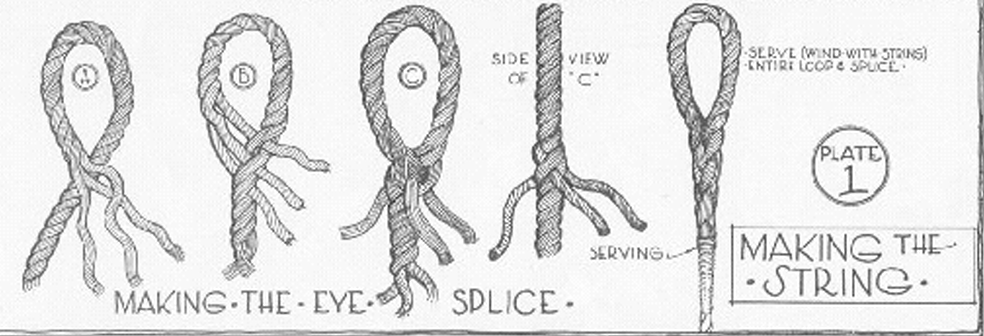
Method 1: Simple Flax Twine Bowstring (Fastest Field Method)
Step-by-step
- Cut twine:
- Length = bow length + ~18 inches
- Separate strands:
- Open the twine about 6 inches at one end
- Form the loop (“eye”):
- Split strands into two groups
- Fold and weave them back into each other
- Splice:
- Continue crossing strands down the string
- Taper the splice gradually
- Reinforce:
- Wrap (whip) the loop with thread
- Wax thoroughly
Result:
- Fast, functional string
- Ideal for field replacement
Method 2: Three-Ply Twisted Bowstring (Stronger, More Reliable)
This is the real standard.
Concept:
You are making a mini rope.
Setup:
- 18 strands total (for ~45 lb bow)
- Divide into 3 bundles of 6
Process:
- Stretch strands between two anchor points
- Twist each bundle clockwise
- Combine bundles:
- Twist them together counterclockwise
- Let tension naturally form a rope
Important:
- Opposing twists = strength + stability
Finish:
- Splice loop
- Wax entire string
Method 3: Reinforced (Tapered) Bowstring
This is the best long-term design.
What’s different:
- Ends are thickened
- Center remains flexible
Why it matters:
- Loops take the most stress
- Reinforcement prevents failure
How it works:
- Add extra strands near both ends
- Stagger them for smooth taper
- Twist as normal
Waxing (Critical Step Most People Skip)
“Wax is to a string maker what tar is to a sailor.”
-The Essentials of Archery (1942) by L.E. Stemmler
Why wax matters:
- Prevents fraying
- Adds water resistance
- Increases lifespan
Best option:
- Beeswax + resin
Field alternative:
- Candle wax
- Tree resin
Sizing the String Correctly
A bowstring must be shorter than the bow.
Rule of thumb:
- ~6–7 inch brace height (“fist-mele”)
This is:
Distance from string to handle when strung
Strength Guidelines (Important)
From the book:
- 15 strands → up to ~35 lbs
- 18 strands → up to ~45 lbs
- 21 strands → up to ~60 lbs
- 24 strands → heavy bows
Field Repairs & Adjustments
If string stretches:
- Twist it tighter
If slightly too long:
- Add twists or adjust loop
If fraying:
- Re-wax immediately
- Reinforce with wrapping
Survival-Level Insight
If you remember nothing else:
- The string fails before the bow
- You should always carry:
- spare cordage
- wax (or substitute)
- You should know at least:
- one fast method
- one durable method
Practical Strategy (Realistic)
Minimum viable skill:
- Make a basic spliced string
Intermediate:
- Make a 3-ply string
Advanced:
- Reinforced tapered string with proper waxing
Final Takeaway
Bowstring construction is not optional knowledge—it’s core infrastructure.
A bow without a string is a stick.
A string without knowledge is a liability.
If you're serious about survival, bushcraft, and self-reliance, this is one of the highest ROI skills you can learn.
Other posts you may enjoy
 John D
 John D
 John D
 John D