
Decentralized Autonomous Technologist Commune (DATC): A Scalable Framework for Autonomous, Networked Communities
A new model for autonomous communes: DATC blends tech, governance, and networked economies into a scalable, real-world system.

Technical Framework for a Decentralized Autonomous Technologist Commune
TL:DR:
DATC is a modular, tech-enabled commune model combining autonomy, shared contribution, and scalable governance across networked communities.
Disclaimer:
This is a theoretical framework for an intentional community / experimental city.
Important Preliminary Clarifications
Before diving into the framework, please keep these two points in mind to avoid common misconceptions:
- Technology is a Tool, Not a Requirement: The core of this model is decentralized, voluntary cooperation. While it could incorporate blockchain, DAOs, or smart contracts, it absolutely does not have to. The framework is designed to work perfectly well with traditional legal and financial systems like cooperatives, LLCs, and standard banking. The technology serves the model, not the other way around.
- Legal Structure is a Variable, Not a Constant: This document outlines a conceptual model, not a legal prescription. The specific legal entity used (LLC, Cooperative, etc.) will depend on the jurisdiction and the goals of the group. This framework focuses on the principles of good governance and structure, not the one-size-fits-all legal mechanics. For a pilot program, the goal is functionality, not legal perfection.
Definition:
A Decentralized Autonomous Technologist Commune (DATC) is a distributed network of self-governing, technology-enabled cooperative communities that operate with functional independence, shared contribution systems, and selective engagement with external economies.
Glossary of Terms
Decentralized
Merriam-Webster (adapted):
Decentralize (v.): to disperse or distribute functions and powers away from a central authority.
DATC Context:
Decentralized refers to the intentional distribution of decision-making, production, and resource control across multiple nodes (individuals, teams, or communes) rather than concentrating authority in a single governing body. Within a DATC network, decentralization is not the absence of coordination, but the removal of single points of failure. Governance, production, and economic activity are structured so that no single entity can bottleneck or collapse the system.
In practice, this means:
- Local decision authority for operational matters
- Distributed production across specialized communes
- Network-level coordination without centralized dependency
Autonomous
Merriam-Webster (adapted):
Autonomous (adj.): existing or capable of existing independently; self-governing.
DATC Context:
Each DATC operates as an autonomous entity with the capacity to sustain its core functions, such as food, shelter, governance, and internal economy, without requiring continuous external control. Autonomy is not absolute isolation; it is functional independence combined with selective, strategic engagement.
This creates a spectrum of autonomy:
- High autonomy domains: food production, internal governance, housing, basic services
- Selective engagement domains: finance, external trade, logistics, compliance
The goal is resilience: each commune can operate independently if required, while still benefiting from networked cooperation and external systems when advantageous.
Technologist
Merriam-Webster (adapted):
Technologist (n.): a person who specializes in the practical application of technology.
DATC Context:
A technologist within a DATC is not defined by credentials alone, but by their ability to apply tools, systems, and knowledge to increase efficiency, autonomy, and output. This includes software, AI systems, fabrication tools, agricultural technology, and infrastructure optimization.
Technologists serve as force multipliers:
- Automating administrative and production processes
- Designing and maintaining infrastructure systems
- Reducing labor requirements through applied efficiency
- Enabling smaller groups to achieve large-scale output
In the DATC model, technological capability is a core driver of time abundance and economic viability.
Commune
Merriam-Webster (adapted):
Commune (n.): a group of people living together and sharing possessions and responsibilities.
DATC Context:
A commune is a structured, cooperative living and production unit where members contribute labor, skills, or capital in exchange for shared access to resources and community benefits. Unlike informal or purely ideological communes, a DATC commune is explicitly results-oriented, economically integrated, and operationally defined.
Key characteristics:
- Work-equity or contribution-based participation
- Shared infrastructure (housing, food systems, tools)
- Defined governance and accountability systems
- Integration with external markets or networked communes
The commune is the primary operational unit of the DATC framework; small enough to remain adaptive but structured enough to sustain long-term viability.




Photos by Marianne Rixhon, Andy Lee, Zlfdmr23, Kindel Media, Solarimo GmbH, Robertkso on Pexels
Decentralized Autonomous Organization (DAO)
Merriam-Webster (adapted-style):
DAO (n.): an organization governed by rules encoded as computer programs, typically using distributed ledger technology to enable transparent, automated decision-making without centralized control.
DATC Context:
A DAO within the DATC framework is an optional digital governance and coordination layer used to formalize decision-making, resource allocation, and record-keeping across members or between communes.
It is not required for a DATC to function, but can be deployed where it provides clear advantages in:
- Transparency: Immutable records of decisions, contributions, and treasury flows
- Coordination at scale: Voting, proposals, and multi-party agreements across distributed communes
- Automation: Smart contracts executing predefined rules (e.g., payouts, access, permissions)
- Inter-commune trust: Reducing reliance on personal trust when coordinating across distance
A DAO may be incorporated into a DATC as a programmable governance layer to enhance transparency, automate coordination, and support inter-commune operations at scale.
Summary
This framework attempts to propose the DATC as a voluntary, contribution-based, technology-enabled communal model built around modular specialization, AI-assisted administration, networked exchange among peer communities, and a pragmatic interface with existing markets and institutions rather than total withdrawal from them. The strongest reading of the DATC is not “a commune with gadgets,” and not “a DAO with houses,” but a hybrid institutional design: a member-governed residential commons, one or more legally legible operating entities, and a narrowly scoped programmable coordination layer for treasury, records, and high-trust workflows. [1]
Taken together, the evidence suggests three first-order design conclusions. First, the DATC should use explicit boundaries, local-fit rules, internal monitoring, and graduated sanctions rather than rely on pure goodwill; this is consistent both with the DATC Framework and with the commons-governance literature associated with Elinor Ostrom [2]. Second, purely consensual governance should not be the default for all decisions, because intentional-community experience shows that unstructured consensus often becomes slow, conflict-prone, and hard to scale, while sociocratic structures can improve inclusion and reduce domination when implemented carefully. Third, tradable governance or revenue tokens are the wrong default for a pilot, because current tax, securities, and crypto-asset rules create avoidable exposure before the core social and economic model has been validated. [3]
The largest constraint on DATC success is not software; it is institutional legitimacy. Country, budget, site size, founding membership, and productive vertical are unspecified, so the framework below is modular and jurisdiction-agnostic. Where law materially matters, it uses current U.S. and European examples for illustration only. The practical implication is that the first pilot should be designed as a legally compliant, low-complexity node with one or two revenue engines, a conservative work-equity system, strong dispute procedures, and a resilience stack that favors redundancy and privacy over novelty. [4]
A pilot DATC is therefore best framed as a managed experiment with clear gates: validate the contribution model, validate enterprise profitability, validate member retention and conflict-handling, and only then add heavier layers such as on-chain voting, community microgrids, internal scrip, or multi-site federation. That sequencing is consistent with both the DATC text and staged infrastructure practice in other complex systems. [5]
Operating Definition and Design Logic
A DATC can be defined as a federation-ready residential-production commons in which members voluntarily exchange labor, skill, and governance participation for access to shared needs infrastructure, while community enterprises generate external revenue and decentralized technologies reduce coordination costs, surveillance exposure, and single-point dependency. The DAT Framework is especially clear on five ideas: members should be differentiated by role and commitment level; contribution should structure access and upside; specialized nodes should trade with one another; technology should reduce overhead and increase autonomy; and external-state interaction should be handled strategically, not denied.
For technical design purposes, the DATC should rest on eight core principles. Boundaries must be explicit: who is a member, what assets are common, and what rights attach to contribution. Rules must fit local conditions rather than be ideologically uniform. Members affected by operational rules must be able to revise them. Monitoring must be accountable to the membership. Sanctions should be graduated and appealable. Intercommunal scaling should be federated rather than centralized. External compliance should be channeled through a dedicated interface function. Technical systems should be privacy-preserving and reversible. Those principles align the DATC Framework with the long-enduring commons literature and with cooperative policy guidance that emphasizes autonomy, member participation, human development, technology support, and inter-cooperative linkages. [6]
Three existing cases are especially useful as design analogues. Twin Oaks Community and Acorn Community [7] demonstrates that pooled provision, labor accounting, and member ownership can persist when work rules are concrete and social obligations are legible. Auroville [8] shows how a resident-wide deliberative body can coexist with a smaller committee that handles external interfacing and administrative continuity. Arcosanti [9] shows that physical form, craft production, and ecological settlement can be tightly integrated when the site itself is treated as an ongoing experiment in architecture, work, and community life. None of these models is a DATC, but each illuminates a subsystem the DATC needs. [10]
The ethical baseline is equally important. A DATC is not defensible if basic needs are conditioned on opaque algorithmic scoring, if members are subject to pervasive behavioral surveillance, or if exit becomes practically impossible because housing, labor, identity, and treasury records are all fused together. Responsible use of AI and data systems requires explicit purpose limitation, data minimization, and human override. In practice, that means using AI for narrow administrative support, forecasting, documentation, and safety workflows, but not as the final authority on discipline, expulsion, or intimate social ranking. [11]
Governance and Social Operating Model
The most robust DATC governance model is a four-layer hybrid. A constitutional layer sets mission, rights, duties, asset rules, amendment thresholds, and exit mechanics. An operational layer runs day-to-day domains such as housing, food, site operations, member welfare, production, and education through circles or councils with clearly delegated authority. An interface layer handles licensing, taxes, regulated commerce, and legal correspondence through an elected board or officer set. A programmable layer records selected votes, budget controls, and treasury permissions where automation adds trust or auditability. This architecture fits the DATC draft, avoids governance-by-vibe, and reflects what both real communities and DAO law suggest: human institutions still need explicit default rules, update procedures, and dispute pathways. [12]
| Governance Model | Strengths | Likely Failure Mode | Best DATC Use |
|---|---|---|---|
| Consensus-first assembly | Strong legitimacy for high-trust, small groups | Slow decisions, burnout, unresolved interpersonal vetoes | Founding values, constitutional changes, admissions appeals |
| Sociocratic circle system | Structured participation, clearer delegation, double-linking, better operational tempo | Requires training; inequalities can still surface in practice | Day-to-day domain governance |
| Member-owned cooperative board model | External legibility, fiduciary clarity, contractability | Elite capture if the board becomes the real sovereign | Legal shell, regulated commerce, landholding, compliance |
| DAO-assisted governance | Auditability, programmable treasury controls, transparent rule execution | Token concentration, unclear accountability, smart-contract and upgrade risks | Treasury approvals, versioned bylaws, quorum-gated policy ratification |
| Polycentric hybrid | Reduces single-point failure by splitting powers by function | Complexity if roles and escalation paths are vague | Recommended end-state for a scaling DATC |
This comparison synthesizes the DATC draft, commons design principles, official community governance materials, sociocracy research, consensus case evidence, DAO governance reviews, and current DAO law. [13]
Social structure should be formal, not assumed. The DATC text already provides a workable starting taxonomy including provisional members, core members, associate members, and specialist contractors. Admission should combine skills screening, values alignment, and a probation period with explicit review criteria. Core roles should include operations steward, membership steward, finance steward, site/infrastructure steward, education/training steward, mediation or ombuds function, and regulated-interface officer. Training should be mandatory, not optional, in safety, privacy, conflict de-escalation, accounting hygiene, and whatever productive vertical the pilot actually chooses. Cooperative guidance also points toward human resource development, legal/tax support, technology support, and education as core institutional functions rather than nice-to-haves [14]
The DATC draft’s work-equity logic is strong, but it needs refinement. A labor-credit or work-equity system can align contribution and benefit, yet it must count invisible but mission-critical work; care work, governance work, cleaning, training, maintenance, emotional labor, safety duty, and conflict resolution, or it will quietly privilege only revenue-proximate work. That is a known tension in worker-controlled organizations: democratic governance and surplus production can pull against each other if invisible labor is systematically under-counted. The DATC Framework’s 20-hour baseline should therefore be treated as a design hypothesis, not as a guaranteed entitlement, until a pilot produces measured evidence on labor inputs, enterprise margins, and member-support costs. [15]
Dispute resolution should be narrower and safer than the DATC draft’s “public trial” framing. A rigorous DATC process should move from informal mediation to formal mediation, then to restorative conference if appropriate, then to a rights-based review panel, and only then to suspension or termination. Privacy should be preserved wherever possible; public exposure should be limited to what is necessary for legitimacy and due process. This is more consistent with commons practice, modern privacy guidance, and scalable community operations than a theatrical or punitive model of public accusation. [16]
Economic Architecture
The recommended DATC economy has three layers. The first is a needs floor: housing, food access, utilities, and shared services supported through work-equity or labor-credit commitments. The second is an internal settlement layer: a ledger for contributions, room allocations, shared resources, and non-cash exchanges. The third is an external revenue layer: cooperative or member-owned enterprises that sell lawful goods and services into outside markets and replenish the communal treasury. This structure preserves the primary text’s core intuition; contribution buys security and upside, while reducing the temptation to make every internal exchange look like a speculative financial instrument. [17]
A necessary clarification is what “autonomous” should mean in an operational framework. For a DATC, the useful interpretation is functional independence: direct exchange, cooperative procurement, peer production, open-source tooling, local fabrication, and reduced reliance on centralized intermediaries or gatekeeping institutions. The objective is not isolation, but the capacity to operate effectively without single points of external dependency.
The failure mode of this concept is unstructured autonomy; where the pursuit of independence leads to fragmentation, informality, or lack of institutional safeguards. Established labor and development frameworks consistently identify informal or weakly structured systems as high-risk environments due to gaps in legal protection, social safeguards, and predictable dispute resolution.
A serious DATC should therefore treat autonomy as a designed capability, not an absence of structure. Informal or internal coordination mechanisms may be useful in early-stage or intra-community contexts, but repeated external interactions, especially those involving trade, labor, or compliance exposure, should be progressively formalized. This ensures durability, legal resilience, and scalability while preserving the system’s core objective of operational independence. [18]
| Economic Model | Main Use | Advantages | Main Risks | Recommended DATC Posture |
|---|---|---|---|---|
| Work-equity or labor-credit system | Needs floor and internal fairness | Clear reciprocity; familiar intentional-community logic | Under-counting care and governance labor; gaming metrics | Core pilot mechanism |
| Income-sharing cooperative pool | High-solidarity membership tier | Strong mutuality; simple welfare floor | Free-rider anxiety; lower individual differentiation | Use for core members only |
| Internal mutual-credit or local scrip | Shared services and low-friction internal trade | Preserves liquidity without external cash | Accounting opacity; tax confusion if treated as currency | Use as internal ledger, not public money |
| Barter and direct exchange | Inter-member or inter-node reciprocity | Flexible, low-cash coordination | Tax/reporting obligations; valuation disputes | Use sparingly and document fair value |
| Transferable token system | On-chain treasury, incentive, or access layer | Auditability and interoperability | Securities, commodity, or crypto exposure; concentration risk | Avoid in pilot; introduce later only with legal memo |
| Specialized enterprise portfolio | External revenue engine | Resilience through diversification | Mission drift, overwork, governance-production tension | Essential for scale |
This comparison draws on the DATC draft, intentional-community practice, official tax treatment of barter and digital assets, current crypto interpretations, local-currency evidence, and informal-economy guidance. [19]
Tokenomics deserves special caution. Current guidance from the U.S. Securities and Exchange Commission [20] and the Commodity Futures Trading Commission [21], updated in March 2026, creates a more coherent token taxonomy than before, but it does not eliminate risk. Some non-security crypto assets may not themselves be securities, yet offerings, sales, wrapping, staking-related arrangements, or profit-linked structures can still trigger legal analysis; some non-security crypto assets can also fall within commodities concepts. Meanwhile, current tax guidance states that digital assets are treated as property, and digital assets paid as compensation can constitute wages subject to ordinary employment tax treatment. That combination strongly favors a pilot design based on non-transferable internal accounting points or off-chain labor ledgers, not tradable governance or revenue tokens. [22]
Local currencies and barter are useful if their scope is disciplined. The best use case is narrow internal settlement, reciprocity with trusted neighboring nodes, or short-chain community exchange. They should not be expected to solve macro-localization by themselves; evidence from the Bristol Pound case suggests that convertible local currencies often run into political and institutional barriers they cannot overcome on their own. In addition, barter income remains taxable at fair market value in at least some major jurisdictions, and formal barter exchanges create reporting obligations. DATC founders should therefore think of local scrip as a coordination tool, not as a substitute sovereign economy. [23]
Technology and Physical Infrastructure
The right DATC technology principle is selective decentralization: decentralize where trust minimization, censorship resistance, auditability, or resilience materially matter; centralize where safety, cost, usability, or legal clarity matter more. A good DATC does not put every social process on-chain. It uses open, inspectable, interoperable systems for records, communications, and infrastructure where lock-in or single-point failure would be strategically harmful. IPFS provides content-addressed, peer-to-peer storage primitives; smart contracts provide programmable execution on a blockchain; and federal standards guidance emphasizes AI risk management, privacy engineering, and zero-trust assumptions rather than blind trust in any device, network location, or automation layer. [24]
| Tech Stack | Typical Components | Benefits | Hidden Costs | Best Stage |
|---|---|---|---|---|
| Minimum viable resilience stack | Local-first docs, encrypted backups, Matrix/Briar communications, standard accounting software, Wi-Fi plus local NAS, solar plus battery for critical loads | Fast to deploy, legally legible, low cognitive load | Less censorship resistance; weaker inter-node portability | Pilot |
| Federated commons stack | Self-hosted services, federated communications, versioned governance docs, selective IPFS publication, multisig treasury, mesh backup links, building sensors with privacy controls | Better redundancy, better inter-node coordination, less vendor lock-in | Requires admin skill, documentation discipline, identity and access management | Scale |
| High-decentralization stack | On-chain treasury logic, IPFS-backed records, community mesh, node-based identity, microgrid controls integration, automated procurement or inventory logic | Maximum transparency and resilience for core workflows | High legal and compliance complexity, higher training burden, smart-contract and operational security risk | Replication only after validation |
This comparison is grounded in official protocol documentation, community-network practice, federal cyber/privacy guidance, and current secure-by-design practice. [25]
For communications, the practical combination is a federated day-to-day channel plus an off-grid fallback. Matrix is useful for open, decentralized community messaging, while Briar is especially valuable for crisis or low-connectivity conditions because it can sync over Bluetooth, Wi-Fi, or Tor without relying on central servers. For site networking, the Spanish community-network tradition shows that open, neutral telecommunications infrastructure can be governed as a commons rather than bought entirely as a closed commercial service. These tools fit a DATC’s resilience logic, but they require member training, key management, and clear admin separation. [26]
Physical design should follow a “service-core-first” logic. Before optimizing for aesthetic completeness, a pilot site should secure: clustered housing with good thermal performance; a shared kitchen and dining area; a workshop or production space; secure storage; a quiet clinic or recovery room; a training/classroom room; a communications/admin room; water and sanitation redundancy; and an energy room sized to critical loads. Cohousing research suggests that communal design and formal social structures reinforce social interaction when layout, visibility, clustering, and shared spaces are intentionally planned. High-performance building standards further reduce energy costs, overheating, condensation, and comfort problems. [27]
Food production and resilience should be treated as modular capabilities rather than ideological absolutes. The DATC text’s closed-loop agricultural vision is plausible as a specialization, but it should not become a universal design requirement for every node. Official food-systems guidance supports integrating urban and peri-urban agriculture into planning because it can improve resilience, fresh-food access, employment, and urban-rural linkages, but long-term sustainability depends on planning integration and local conditions. In other words: food systems matter, but the right productive vertical may be agriculture, fabrication, software, logistics, care, or education depending on the founding team and site. [28]
For power, the preferred end-state is a community microgrid or staged energy-resilience plan with critical-load islanding, storage, and clearly scoped operating modes. Official U.S. guidance defines community microgrids as systems serving two or more properties that can operate independently from the grid while remaining connected through a point of common coupling, and it treats microgrid development as a staged design process rather than a one-shot purchase. DATC founders should borrow that sequencing logic even if the actual energy architecture stays modest in the pilot phase. [29]
Legal, Regulatory, and Risk Posture
A DATC should assume from day one that it needs legal separation between land, operations, and governance. A common pattern is one entity to hold real property, one entity to conduct taxable or regulated operations, and one constitutional association or governance layer to represent the membership. In some jurisdictions a cooperative shell may best express member governance; in others an LLC, association, nonprofit, or hybrid is more workable. An illustrative state-level DAO wrapper is the statute in Wyoming [30], which explicitly allows a DAO form to be managed partly through smart contracts, requires public identifiers for governing smart contracts, and warns that member rights and duties may differ materially from ordinary LLCs. That is useful as a legal pattern, but not a default answer for an unspecified country. [31]
The next legal reality is that land-use and building approvals are highly local. Official public guidance in both France and England/Wales makes the same broad point: if you build something new, materially change a building, change use, or intensify occupancy, local permits and building controls are likely to apply. For a DATC, that means the earliest legal workstream is not token design; it is zoning, use classification, density, sanitation, fire safety, wastewater, and whether the chosen property can lawfully function as a multi-household communal residential enterprise. [32]
| Risk Domain | Likelihood | Impact | Why It Matters | Baseline Mitigation |
|---|---|---|---|---|
| Land use, zoning, and occupancy | High | High | Wrong site classification can halt the project before launch | Legal site screen before lease or purchase; phased occupancy plan; written use opinion |
| Worker classification | Medium to High | High | Member labor can be recharacterized as employment if control is strong | Separate member duties from contractor work; document control tests; payroll readiness |
| Tax and bookkeeping | High | High | Barter, digital assets, shared expenses, and pooled revenue create reporting complexity | Double-entry books; fair-value policy; reserve for taxes; external accountant |
| Token, securities, and commodity exposure | Medium | High | Transferable or profit-linked tokens can trigger securities or commodities analysis | No tradable token in pilot; written legal memo before issuance; keep governance points non-transferable |
| Money transmission and AML exposure | Low to Medium | High | Redeemable internal currencies or exchange services may trigger financial regulation | Keep internal credits closed-loop and non-custodial; avoid public exchange features |
| Food, health, and safety | Medium | High | Home production, communal kitchens, water systems, and workshops can be regulated | Hazard analysis; licensed kitchens where needed; SOPs; inspections; insurance |
| Data privacy and cyber risk | High | High | Member records, contribution logs, and surveillance tools can create legal and ethical harm | Data minimization, encryption, role-based access, human review, incident response |
| Governance capture and abuse | Medium | High | Founder dominance, token whales, or hidden elites can delegitimize the community | Term limits, rotation, transparency, anti-concentration rules, appeals |
| Infrastructure failure and disaster | Medium | High | Power, water, network, or climate failure can quickly become a social crisis | Critical-load planning, backups, drills, food and water buffers, hazard-specific sheltering |
| Reputational and community-relations risk | Medium | Medium to High | Local opposition or bad publicity can jeopardize permits and markets | External-relations office, community-benefit plan, honest communications, documented safety |
The matrix above consolidates current public guidance on planning, labor status, taxation, crypto regulation, food production, microgrid regulation, privacy, and commons governance. [33]
Several legal specifics are worth making explicit. Tax guidance states that barter income is includable at fair market value, and digital assets are treated as property. Compensation paid in digital assets can still be wages. Current U.S. crypto guidance is materially clearer than it was before March 2026, but not permissive enough to justify casual token issuance; MiCA likewise imposes transparency, authorization, disclosure, and supervision obligations across covered crypto-asset activities in Europe. Food law is similarly practical rather than ideological: at least some jurisdictions allow low-risk “cottage food” production in primary residential kitchens, but that does not automatically extend to higher-risk processing. For energy infrastructure, community microgrids sit inside a regulatory environment involving local utilities, state energy offices, and utility commissions. A DATC that wants durability should internalize those realities instead of designing around them. [34]
Transition, Scale, and Measurement
The right rollout logic is staged complexity. A good DATC should not build its most legally and socially complex version first. It should start with a small, measurable pilot; add stable productive depth; then replicate only after the first node can demonstrate viable governance, books, resilience, and member retention. That is consistent with the DATC draft’s own phased language and with mature infrastructure practice, where scoping, data collection, conceptual design, project development, and implementation are distinct stages rather than one blended leap. [35]
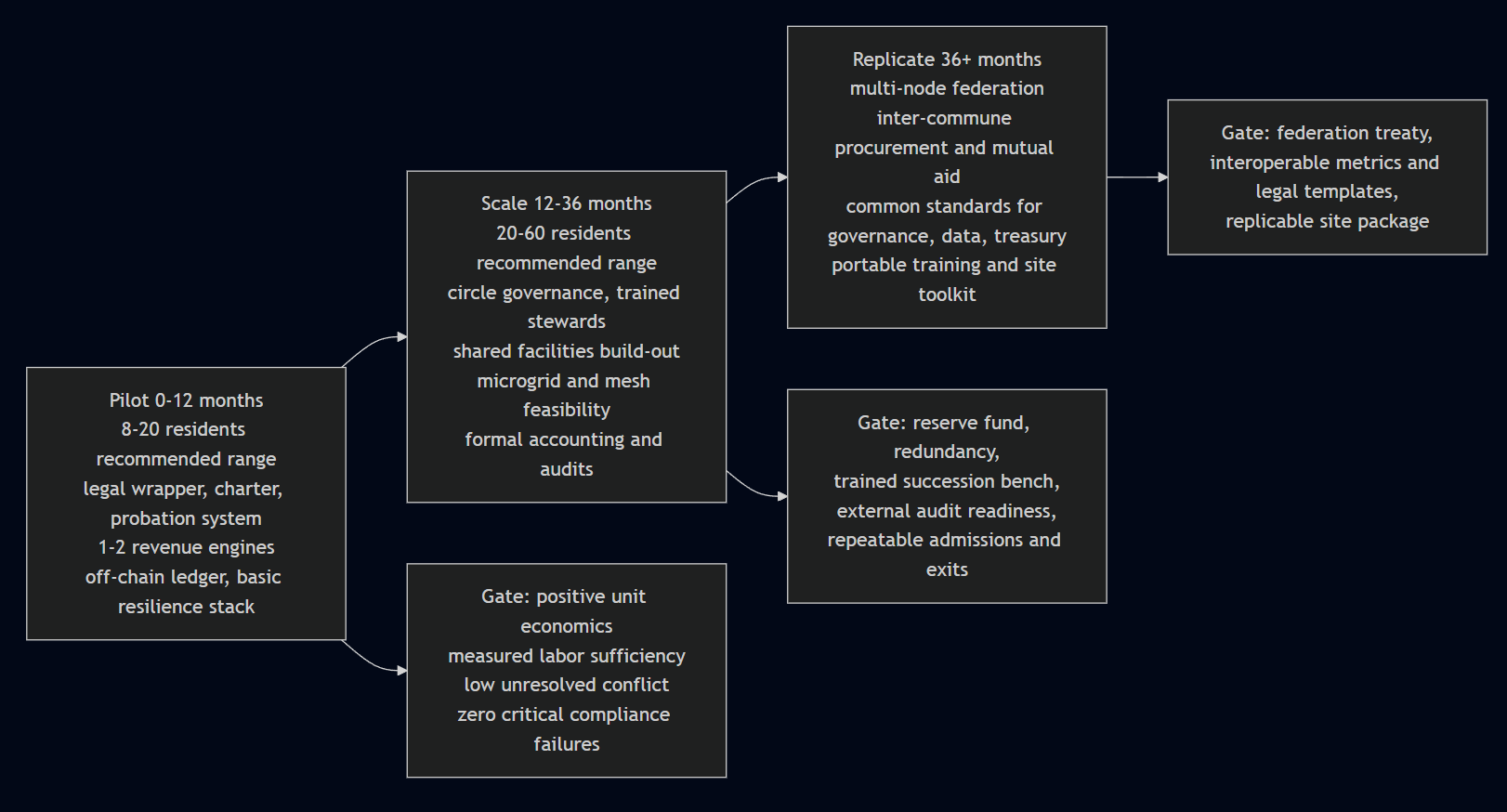
The flow above converts the DATC development pathway into a gated deployment sequence and borrows the general staged-design discipline used in other resilience-intensive systems. [5]
| KPI Family | Suggested Metric | Pilot Gate | Scale Gate | Why It Matters |
|---|---|---|---|---|
| Governance health | Participation in major decisions | at least 70% of eligible members | at least 75% with delegated circles functioning | Tests legitimacy and engagement |
| Dispute handling | Median days to resolve formal grievances | under 30 days | under 21 days | Measures whether conflict is governable |
| Economic viability | External revenue / operating expense | above 1.0 for 2 consecutive quarters | above 1.15 for 4 consecutive quarters | Prevents mission from being funded by optimism |
| Reserves | Treasury runway | at least 4 months | at least 6 months | Buffers shocks and seasonality |
| Labor sufficiency | Essential functions covered without chronic overload | 90% coverage with backups for critical roles | 100% coverage plus trained succession bench | Tests the “time abundance” promise |
| Social durability | Retention of members past probation | at least 70% | at least 80% | Screens for culture fit and operational realism |
| Infrastructure resilience | Critical-load support duration | documented backup plan | at least 72 hours islandable or equivalent contingency | Makes resilience measurable |
| Compliance posture | Critical unresolved legal or safety findings | zero | zero | Prevents scaling on hidden liabilities |
| Ethics and privacy | High-risk data processes with formal review | all identified | all reviewed annually | Forces AI and data restraint |
These KPIs operationalize the DATC text’s own success metrics, self-sufficiency, member satisfaction, economic viability, and autonomy. while adding governance, compliance, and resilience measures needed for real-world scaling. [36]
The recommended next steps are straightforward. First, choose the legal geography and intended productive vertical; without those two decisions, design work remains abstract. Second, draft a constitutional charter before drafting software. Third, build a pilot economics model that tests three labor assumptions, not one, including a stressed version that exceeds the optimistic estimate in the DATC Framework. Fourth, run a site-screen matrix on zoning, water, sanitation, fire, insurance, and utility interconnection before negotiating land. Fifth, define the minimum viable transparency package: bookkeeping, contribution logging, decision logs, and grievance logs. Sixth, treat tokenization as a phase-three option that requires a written legal memo, not as part of the founding identity. [37]
Three templates should be developed immediately. A charter template should contain mission, scope, asset model, member rights, due-process guarantees, decision-rights matrix, transparency rules, sanctions ladder, treasury rules, amendment procedures, and dissolution or federation clauses. A membership agreement template should define status category, probation length, contribution floor, benefits, housing license terms, conduct standards, privacy notices, conflict procedures, exit mechanics, and treatment of tools or capital contributed by the member. A DAO smart-contract checklist should cover legal wrapper reference, human-readable constitutional mirror, multisig design, quorum and threshold logic, anti-concentration rules, emergency pause authority, upgradeability, audit status, off-chain dispute fallback, accounting export, key recovery, and incident response. Taken together, those templates translate the DATC idea from philosophy into an implementable operating system. [38]
The overall judgment is favorable but conditional. A DATC is technically and institutionally plausible if it is designed as a hybrid common with firm boundaries, disciplined legal interfaces, measured economic experimentation, and selective use of decentralized technology. It becomes much less plausible when framed as a fully informal, fully consensual, or fully tokenized alternative society from day one. In short: start lawful, start legible, start modular, measure everything, and only then federate. [39]
Content Provided as a Thought Experiment by Equitas Collective and The Means Initiative
Disclaimer:
This is a theoretical framework for an intentional community / experimental city.
You Might Like These Too
 John D
 John D
 John D
 John D