
The Boys’ Book of Hunting and Fishing (1916): Survival Lessons That Still Matter Today
A 1916 survival guide reveals timeless lessons on hunting, camping, and self-reliance that still apply today.

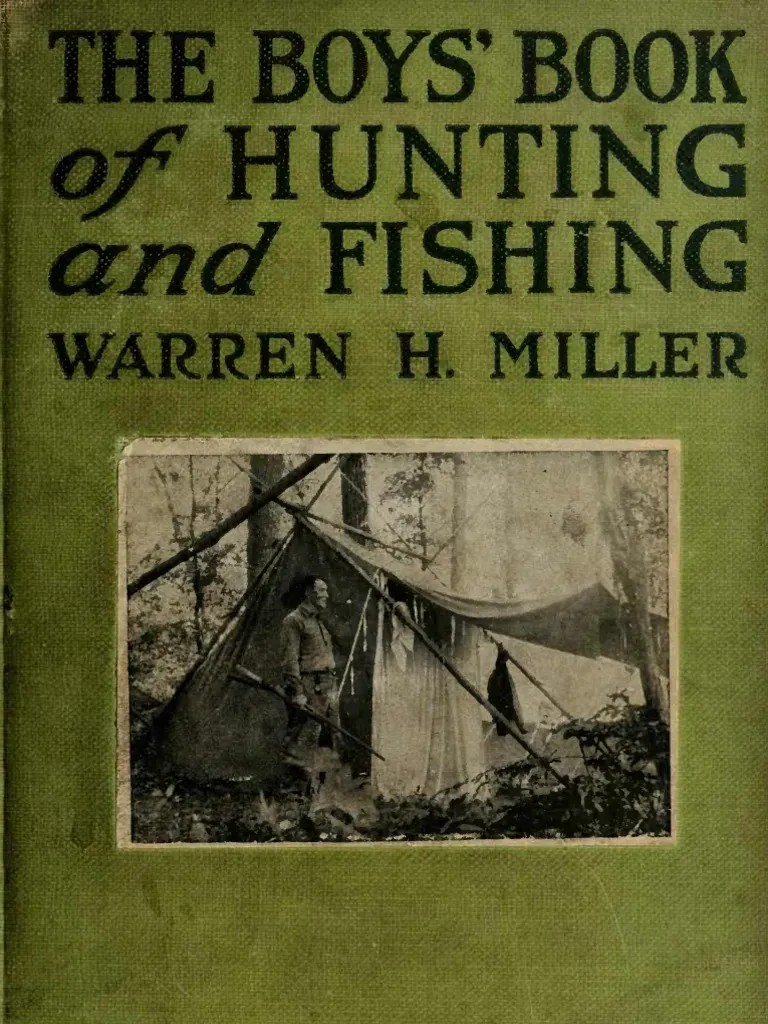
More than a century ago, long before modern survival gear, YouTube tutorials, or lightweight synthetic equipment, a practical guide was written to teach young people how to live and operate outdoors. The book was designed to help beginners learn hunting, fishing, and camping from the ground up. While its intended audience was young, its underlying principles are anything but simplistic. In fact, many of its ideas remain more grounded and practical than much of today’s survival advice.
Public Domain, Free Book Download Courtesy of WebArchive
 Miller, Warren H. (Warren Hastings), b. 1876
Despite being published in 1916, the book presents a clear and enduring philosophy: self-reliance is built through skill, not equipment.
One of the most striking aspects of the book is its tone. It does not romanticize the outdoors or frame it as an escape. Instead, it treats outdoor living as something to be learned methodically, like a craft. From the beginning, the author makes it clear that the goal is not just to inspire interest, but to provide usable instruction especially for those with limited means. This practical orientation carries through every section, from selecting equipment to developing technique and avoiding common mistakes. It is not a collection of stories or vague advice; it is a working manual.
A recurring theme throughout the book is the importance of skill over gear. The author repeatedly warns about poorly made or overpriced equipment and emphasizes that beginners do not need expensive tools to get started. In fact, relying too heavily on gear without understanding its use is seen as a liability. Instead, the book promotes simple, reliable equipment and a strong understanding of how to use it effectively. Whether discussing fishing tackle or firearms, the focus remains on technique, familiarity, and control rather than ownership of high-end tools. The implication is straightforward:
Capability comes from practice, not purchases.
That idea connects directly to another core principle: learning by doing. The book stresses that outdoor competence cannot be developed passively. Reading about techniques is only the starting point. Real understanding comes from repeated attempts, direct experience, and learning through mistakes. This applies across all domains covered in the book, whether casting a line, handling a firearm, setting up camp, or preparing food in the field. Practice is described as the only form of learning that continues to reward effort over time, reinforcing the idea that skill is built gradually through consistent use.
Efficiency is another key focus, particularly in the sections on camping. Rather than encouraging large or complex setups, the book emphasizes lightweight, practical systems that allow for extended time outdoors without unnecessary burden. This includes guidance on selecting tents, organizing gear, and maintaining comfort with minimal resources. The goal is not luxury, but functionality. Creating setups that are easy to carry, quick to deploy, and reliable in varying conditions. The underlying principle is simple but powerful: the more efficient your system, the more capable you become in the field.
Although the book never explicitly uses the term, it presents a clear systems-based approach to survival. Its structure is divided into major functional areas: fishing, shooting, and camping. Each is treated as a complete system with its own tools, techniques, and methods of application. Within these sections, the author covers everything from equipment selection to environmental awareness and practical execution. Later chapters expand into broader topics such as camp cooking, fire building, woodsmanship, and living off natural resources. Together, these form a comprehensive framework for operating independently outdoors.
Safety is treated as a foundational requirement rather than an afterthought, particularly when it comes to firearms. The book makes it clear that most accidents are the result of improper training rather than the tools themselves. This leads to a consistent emphasis on learning correct handling techniques, building familiarity gradually, and avoiding overconfidence. In this context, safety is not just a rule, it is a critical component of the entire system. Without it, everything else becomes unstable.
The author also promotes a progressive approach to skill development. Beginners are encouraged to start with simpler, more manageable tools and gradually work their way up. For example, the use of smaller-caliber rifles is recommended as a way to build accuracy and familiarity before moving on to more demanding applications. This step-by-step progression allows individuals to develop competence without taking on unnecessary risk, reinforcing the idea that mastery is built incrementally.
Resourcefulness is another major theme, particularly in the later sections of the book. Topics such as camp cooking, fire building, and living off the land highlight the importance of working with available materials rather than relying on external systems. There is also an emphasis on making one’s own gear whenever possible, both as a cost-saving measure and as a way to better understand how tools function. This reinforces a broader idea: self-reliance is not just about having resources, but about knowing how to use and adapt them effectively.
While some aspects of the book are clearly dated, particularly specific equipment recommendations, the underlying principles remain highly relevant. The emphasis on skill development, efficiency, safety, and adaptability reflects fundamental realities of operating in outdoor environments. These are not ideas tied to a specific era, but to the nature of the work itself.
Modern survival content often focuses heavily on gear, optimization, and convenience. In contrast, this early 20th-century manual takes a more grounded approach. It assumes limited resources, prioritizes practical skill, and focuses on what actually works in the field. More than anything, it presents self-reliance as something that must be built deliberately over time, not through theory alone, and not through equipment alone, but through consistent, hands-on effort.
And in that sense, its lessons remain just as relevant today as they were over a hundred years ago.
More Books Like This Available Here:
 John D